
*This post may contain affiliate links. As an Amazon Associate we earn from qualifying purchases.
Have you ever played Nintendo games and wondered if you could get them cheaper somewhere else? Maybe you are like me and you love to find good deals, so you are always looking to get a better deal. If you are, then you have probably asked the question:
Are Nintendo Games cheaper in Japan?
Although you would assume that Nintendo games would be cheaper in Japan as that is where they are made, that is not true at all. Although some games may be a couple dollars cheaper in Japan, by the time you pay for shipping and importing of the game, it actually turns out to be more expensive than if you just purchased the game here in the United States.
If you want to know more about the Nintendo games and how to get them cheaper, you will want to keep reading this article. You can also watch this short video about why Nintendo games practically never go on sale like other gaming console games.
Are you a huge Nintendo fan? Then you have to check out the Mario and Nintendo gear that you can get. Whether you want a Mario wallet, a Nintendo sweatshirt, or a classic NES hat there are plenty of choices to choose from. You can find them all by clicking here.
If you are looking for the cheapest Nintendo games though, this is the best place to find them on sale and cheaper than anywhere else.
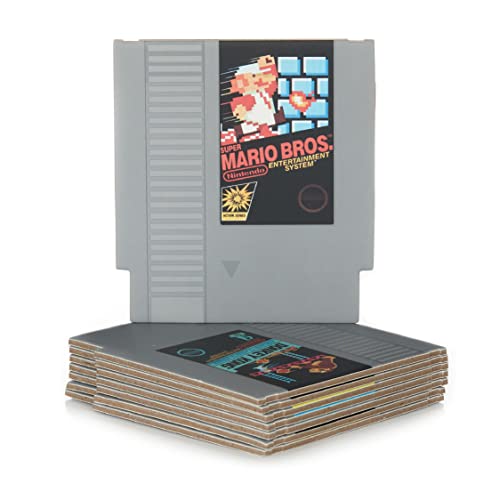
Do you love Nintendo? Then you have to check out this amazon NES cartridge drink coaster set!
This set includes 8 double sides drink coasters that look just like the classic NES cartridges.
This set is a perfect gift for the gamer in your life!
Games with English options in Japan
Probably the best thing about the Nintendo Switch is that it’s totally region-free. This also applies to the Nintendo eShop, but it is obvious that you need a Nintendo Account that needs to be set to Japan. This is entirely incredible news for players who are familiar with the Japanese language and need to import Nintendo Switch games by getting them legitimately from the Nintendo eShop. Although if you download a game from the Japanese eShop to play here in the United States there is a chance you will save a few dollars.
Finding the best deals on Nintendo Switch games in Nintendo’s eShop
The costs of games in the Nintendo eShop can differ enormously from nation to nation. For instance, when the Hollow Knight was first released, it was $15 in the US, and when compared to $7.66 in Mexico’s eShop; it was almost half the price! If you learn how to balance buying games from different countries, this is a good way to save some money.
Multiple Nintendo accounts are beneficial
To benefit from the less expensive eShop costs in different countries, you will need a Nintendo account for every area. Creating a new account only takes a few moments. Normally, the most significant field on the webform is the location where you are living. This directs the area of the eShop you’ll visit when you, in the long run, add the new account to your Switch.
To create multiple accounts, you will need a separate email address for everyone. This simply isn’t an issue today with Gmail addresses as well as with email generators.
Without going into further detail, the manner in which Google deals with its email spaces implies one location can be many. Google overlooks any periods and suffixes before the @, and Gmail tails are compatible. Suppose your email address is [email protected]. Here are a couple of instances of modifiers you can use to enlist new Nintendo accounts without shuffling separate inboxes:
You can riff on these guidelines. To do so, you will simply make sure to make a note of what email address is connected to what country. Another genius tip is to make a couple of Nintendo accounts at a time. Regardless of whether you are enrolling one in Canada to purchase a particular game, or Japan since the eShop costs in that country are normally cheaper, you will need to keep track of them.
There is an approach to avoid this progression altogether, and that is done by changing the district on your primary account. In the beginning, you should have a vacant wallet to change locations. So when you have another Nintendo account enrolled and checked, you have to hop on to your Switch, go to the system settings menu and include another user. Call this user as “Germany” or “Japan”. The next step is to link a nation specified Nintendo account to that recently made profile. So whenever you head to the Nintendo eShop, the profile you pick will direct which specified retail store you will go to.
Paying can be difficult
The following obstacle is figuring out how to pay. As Nintendo clarifies, credit cards from your country won’t work in an alternate district’s eShop. While some people are able to use Paypal and have it work, others are not. The best way to pay for games from different countries is to purchase gift cards for the eshop. Doing this will allow you to purchase the gift cards in the different forms of currency.
Enjoy it until you can’t
Some years ago, changing your country in Steam to purchase games at lower costs was straightforward. Presently, it’s inconceivable without utilizing a VPN to imitate your area. Game gifting was another well-known method for moving buys among accounts and across computerized borders, but Valve also shut down that in 2014 by presenting location locking.
Although technically it is still possible to purchase a Nintendo game through the eShop in a different country, no one knows how long this will last. Every year companies like Nintendo crackdown on ways that people cheat the system to buy cheaper games and in app purchases. If you are caught doing any of these “illegal” things, Nintendo may decide to ban your device.
Cheapest place to buy Nintendo games.
Although some people prefer to buy games online through the eShop, others have different places they go to buy games. Quite a few people have found that the cheapest place to buy a game is from your friends.
Oftentimes one of your friends will purchase the game, and be playing it, and then pass the entire game. Once they have done that and they no longer want to play it anymore, they will be looking for a way to make some of their original money back. This is a great way to get games at half price or sometimes even more.
Other people like to look for specific games stored around the holiday seasons to try and score cheaper games, and games that are on sale.
Some people prefer to buy from places like GameStop that sell used games. These people prefer to buy from here as they have some sort of a warranty online buying from someone on Facebook Marketplace.
Which leads us to the last place people shop for games. That place is Facebook Marketplace. This place is full of friendly people who normally are just like your friends who are just simply looking to get back a little bit of the money they used when they bought the game in the first place.
Conclusion
Now that you know that it is not really worth buying Nintendo games directly from Japan, you can go ahead and keep buying them from wherever you have been getting them. While some people are ok paying full price, we understand the majority of people prefer to simply get a good deal and find a cheap Nintendo game.