
*This post may contain affiliate links. As an Amazon Associate we earn from qualifying purchases.
Have you ever been playing pool and someone wanted to play Snooker? Maybe they said they were basically the same thing but something doesn’t sound right about that? Well, in this article we will go over everything you need to know about Pool and Snooker and if they are the same thing or not.
So are Pool and Snooker the same thing?
Although some people believe Pool and Snooker are the same thing, that is not true. They are actually two very different games and have entirely different rules as well as different table sizes, ball sizes, and many other differences.
In this article we will cover every difference between pool and Snooker so you can know exactly what the difference is the next time someone says that it is the same thing. So if you want to know more about the differences, you will want to keep reading. You can also watch this short video to learn the difference between Pool and Snooker.
If you are looking to get better at playing pool one of the best ways to do that is by upgrading your pool cue. One of my favorite cues is the Viking Valhalla. It is available in a variety of colors and won’t break the bank. You can find it by clicking here.
Both Pool and Snooker are part of the cue sports family. The cue sports family consists of games of skill that are played on a table with pockets. The sports generally involve hitting balls using a stick known as cue stick to send the shots into the table pouches. There are three member sports in this category, including billiard, pool, and snooker. Frequently, the names are used interchangeably because of their similarities, but each game is unique.
Both Snooker and Pool are modifications of the mother billiards that were first played in the nineteenth century. Snooker was the first version of billiards to be developed, and the play was based entirely on strategy. In a bid to make the sport simpler, snooker was modified further giving rise to Pool. Though the original billiards was a familiar sport among gamblers, it had too many rules which necessitated the changes. Outside of these two reasons, there are no other similarities between Pool and Snooker.
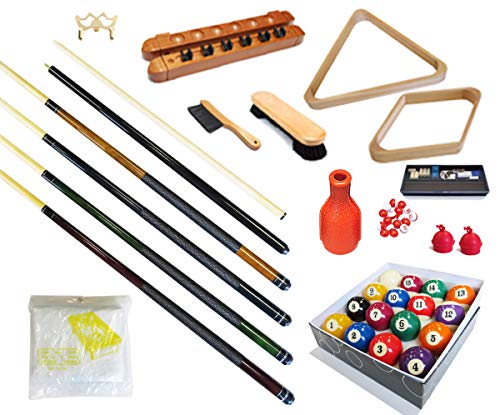
If you have a pool table then you need to get this accessory kit. It includes pool cues, extra pool balls, and all the gear you need to keep your pool table in tip-top shape.
If you are tired of your kids (or friends) ruining your good pool cue when they play then having these extra ones will keep that from happening (just be sure to hide your good one!).
How are Pool and Snooker different?
- Games played.
Both pool and snooker have their different versions. Pool has six subtypes that include straight pool, 8-ball, 9-ball, 7-ball, One pocket, and rotation pool. Among them, 8-ball and 9-ball are currently the most known and played, having succeeded 7-ball and straight pool.
The main disadvantage of 7-ball was its short duration of play. For one pocket, the rule requires that cue balls are hit into specific pockets. Rotation pool, otherwise referred to as 61, is the most intricate pool version given that only shots hit with another ball into the pockets are counted.
On the other hand, Snooker has numerous variants that are less frequently played compared to the original version. The game has two types of balls. They are the object balls and the red balls, which are potted or pocketed strategically. Snooker versions include life pool, 6-red Snooker, Russian Pyramid, and the Brazilian Sinuca Brasileira.
The name of Pool originated from the pooling of gamblers’ money. This is said to be exactly how snooker became known as pool, and pool gots its name. The 6-red Snooker is played with only six red balls instead of the usual fifteen. The Brazilian type involves only one red ball and has additional rules. Some of these snooker subtypes have further variations; for example, the Russian pyramid has other subdivisions like Moscow and Petersburg pyramids.
- Balls Used
From a distance, the balls appear similar in size. However, they have a noticeable difference. Pool’s standard cue shot has a size of 2¼” while snooker’s ball size varies between regions. In America, the standard size is 2 1/8 while in Europe, the smaller 2 1/16″ ball is preferred. For coin operated pool tables, a larger ball is used.
- Cues
Given the two sports have the same origin, most people think that pool and snooker use the same cues. If you have ever played the two games though, you know that is not true at all. Pool uses sticks that are either one or two-piece(s) with a length of between 57″ and 58″. The tip diameter of the pool stick ranges from 11-14 mm and is covered by linen on the holding end. In contrast, the length of the snooker cue can be anything between 57″ and 63″ with a tip diameter of 10mm. The cue sticks are usually made of ash and thus lack a covering on the holding end.
How do the tables of the two games vary?
- Size
The difference between pool tables and snooker tables is quite large. Pool tables are generally smaller with regulation tables measuring 3.5’ by 7’ and tournament tables measuring 4.5’ by 9’. For snooker tables, the standard measurement for those used in tournaments is 6’ x 12’ while common tables vary in size and can be customized to fit in the available space. Generally, pool tables have height the same as American tables while snooker tables are 2 feet taller.
- Surface
Initially, both tables had green surfaces, but currently, they come in different colors that are more appealing. The surface of a pool table is small, with a cloth covering to provide the necessary friction. On the other hand, snooker tables are much larger with smoother surfaces that allow for precise control of the balls. Mostly, nylon or wool is used as the cloth covering on these tables. The type of material used for making the cloth covering of either table surfaces is the primary determinant of the wear and tear rate.
- Pockets
The pocket designs of the pool and snooker tables differ significantly as well. The Pool table has cushion lining that enters the pocket at almost 90 degrees while the cushion lining of the Snooker table flows into the pockets in a slanted manner. The pockets’ openings are also smaller in pool tables requiring more force for the ball to pass into them. On the other hand, Snooker tables have larger pockets. As a result, the angle needed to pocket a shot in the two games also vary.
- Other accessories
The accuracy and precision required for the two games vary, necessitating the use of different extra equipment. For snooker, extension arms are used on the table due to the shot difficulties and large table size. Spider and ball markers are also used commonly. Pool, however, requires mainly chalk for the tip of the cue.
Are the rules of Pool and Snooker the same?
The rules governing pool and snooker are actually very different. This not only makes you know two sets of rules, but it also makes the way they are played different. As a result, Snooker is regarded as a game of strategies that should be played slowly while pool is a fast-paced game lasting only a few minutes. This could have resulted from pool traditionally being played between the horse races, but it is unknown at this time where it started being a fast paced game from.
Conclusion
Both pool and snooker evolved from billiards, but the games are not similar. Each has its rules, uses a unique table, and requires different additional accessories. Pool is simpler and more comfortable to play compared to Snooker; therefore, it would be a good starting point for anyone who wants to play cue sports.