
*This post may contain affiliate links. As an Amazon Associate we earn from qualifying purchases.
Have you ever been playing pool and thought the balls you were using were a different size from what you were used to playing with? Maybe you thought you were crazy so you jsut had to look it up. Well, in this article we will answer all your questions about pool balls and if they are different sizes.
So are pool balls different sizes?
Pool balls do come in different sizes depending upon the size of the table and the brand of the pool balls. Although you may have thought you were crazy to say the pool balls were different sizes, you actually are not.
If you want to know more about the pool ball sizes and about pool in general, you will want to keep reading. You can also watch this video to learn everything there is to know about pool balls.
If you are looking to get better at playing pool one of the best ways to do that is by upgrading your pool cue. One of my favorite cues is the Viking Valhalla. It is available in a variety of colors and won’t break the bank. You can find it by clicking here.
What determines the size of a pool ball?
The size of the pool balls depends upon many factors. The brand is also considered. There are tons of categories of the pool ball brands in the market. Each develops balls according to their method. Although a regular standard is available, different types of balls are used for practice and leisure gameplay than for tournaments.
Billiards is categorized into multiple games such as carom billiard, snooker, English billiard, pool, etc. All of them differ in terms of rules and regulations. They also have different sizes of balls as well as different sizes of tables.
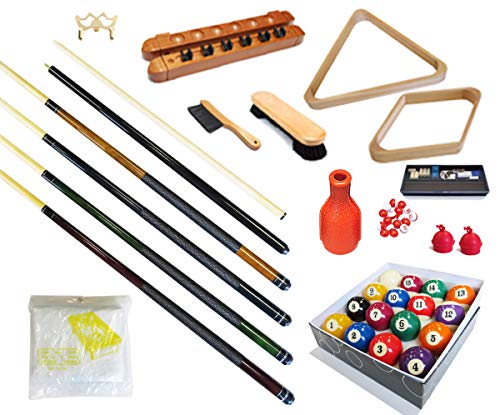
If you have a pool table then you need to get this accessory kit. It includes pool cues, extra pool balls, and all the gear you need to keep your pool table in tip-top shape.
If you are tired of your kids (or friends) ruining your good pool cue when they play then having these extra ones will keep that from happening (just be sure to hide your good one!).
What are the different types of pool games?
The pool is divided into games like 8-ball, 9-ball, 1-ball, Straight Pool, Bank Pool. Since all of them can be played on the same table, typically called the pool table, they follow the same ball size.
There are a few cases that differ in this manner. There is a possibility that you have been playing with a cue ball to hit other balls having a size smaller than the cue ball. Although it may seem reasonable to you, it is not the real ball set you are provided to play with.
The original and new pool ball set has the same size. Although these balls are more significant than other billiard games, the cue ball is precise of the same size as that of the other balls.
What pool balls are right for me?
There will be different kinds of choices you need to make before selecting the right balls for you. As compared to the original and historical aspects, today, cue balls and other ball sets are comparatively smaller. The dimensions also differentiate from geographical variation.
The largest pool ball is Russian Kaisa, which is 2 11/16 inches in size. The other types of the ball, such as Carom, American, English, and snooker, are smaller in size.
- English Pool Balls
British Pool balls are 6 inches in size. Because of their large size, they can only be played on the classic English tables, having a length of 8 feet on the longer side.
They are further categorized as
- English classic balls
- Aramith English balls
Contrary to its name, the classic English balls are Chinese made. They are the cheaper set of balls having the size a little smaller than Aramith English Pool balls. They are inexpensive, and most of the time they are never used in local pool halls because they are not going to hold up to the constant use.
The Aramith balls on the other hand are high-quality balls. That is why you can see them in expensive formal pool tables. Because of their excellent finish and standard size, they are used in major tournaments.
Both of these balls are available on pool tables; however, the game level and excellence of game changes with the change in the ball. Professional players like to play with Aramith balls because they are of the standard size. Whereas local halls, pubs, and entertainment places have just average quality English classic balls.
You can instantly recognize American pool balls as these are classic solids and stripes on its design. Different traditional spots make these balls look way more diverse than any other ball.
American pool balls typically come with these standard sizes mentioned below. As expected, standard and Aramith balls are only available for America balls.
- Numbered 1-8, 7x 2 1/4 inch ‘solid’ balls
- Numbered 9-15, 7x 2 1/4 inch ‘stripe’ balls
- White cue ball size 1x 2 1/4 inch
Rather than English pool balls or snooker balls, American balls have many other options that you usually expect. There are some other sets of balls available as well rather than Aramith sets if you want to buy them. If you are looking for the best Aramith pool ball set, you can find them here for a good price.
Mixed pool ball sets
When there are many tables in the pool hall and every pool table is booked, the sets being used at each may be of different brands or different models. It won’t be hard to recognize and search for the recommended one though.
It cannot be very easy to ensure that each table has got the same balls or the same set of balls. In some cases, it might be possible that the pool tables are stocked with mixed sets of balls.
Sizes and Weights of Pool Balls:
Although the pool balls are of different sizes, there’s a standard size and weight that have a diameter of 2 ¼” and a weight of approximately 6 ounces per ball.
Likewise, to state this wouldn’t be wrong that the cue ball might be a bit bigger in size on a coin-operated pool table. If this is the case, it usually has a diameter of 2 3/8″ to make things smoother for you with the size margin. On the off chance, you might find that all the balls in the rack are 2 3/8″. You might also notice that they are slightly more substantial as well.
Usually, you will encounter pool balls in two sizes:
- 2 ¼” 6 ounces is the standard size.
- 2 3/8″ little larger than 6 ounces.
This is why if you have your own table or plan to play in a tournament, we recommend purchasing an authentic Aramith set, and use that to play no matter where you go to make sure you are always able to play with accuracy.
Conclusion
No matter if the pool balls are two separate sizes or not, most people never notice the difference when they play. The most important thing while playing is simply to have fun and always enjoy playing the game and abiding by the rules.
If you do want to play professionally, it is recommended that you have your own pool balls, as well as pool cue, and pool table to practice on. You may also want to only play with your personal pool balls and pool cue to make sure that your practice does not go to waste.
There is nothing more frustrating than going to a pool hall and the balls are a mixed set, and they don’t have one single pool cue in the entire place.
Now that you know there are actually different sizes of pool balls, you can be sure to tell your friends that you are right and that you are not crazy for thinking that the balls were different sizes.