
*This post may contain affiliate links. As an Amazon Associate we earn from qualifying purchases.
Have you ever wondered when you were playing pool what a pool ball was made out of? Maybe someone said that they are hollow, and you want to find out. Well, in this article we will go over everything you need to know about pool balls.
So are pool balls hollow?
Although pool balls seem to be made out of plastic or some sort of stone, they are not hollow. Instead they are filled with different materials that make up the core of the pool balls.
If you want to know why pool balls are not hollow and all about pool balls, you will want to keep reading. You can also watch this short video to see exactly what a pool ball is made out of when it is cut open.
If you are looking to get better at playing pool one of the best ways to do that is by upgrading your pool cue. One of my favorite cues is the Viking Valhalla. It is available in a variety of colors and won’t break the bank. You can find it by clicking here.
Things to know about pool
Pool is one of the most popular cue sports. We play it on a table with 6 pockets into which we hit the balls. It has many famous variants like eight-ball, nine-ball, ten-ball, blackball, seven ball, one pocket, bank pool, and straight pool.
To play pool, you will use a cue stick to hit the ball and put it into the pocket. We commonly know these balls as billiard balls. These are small, and hard balls used to play the sport.
If the manufacturer makes hollow balls, then it will affect its weight and strength to withstand any hitting force. They can make it with wood, clay, ivory, or polymers. Usually, pool balls are made up of polyester or phenolic resin. Phenolic resin is a thermosetting plastic resistant to heat. They shape this plastic with the help of heat and get permanent after cooling. Once shaped, it cannot be changed or altered.
Similarly, if we cut pool balls into two halves, we will find it filled from inside. There will be no hollow space inside. It will take the shape of a semi hemisphere with a filler the same at every point with color variation only.
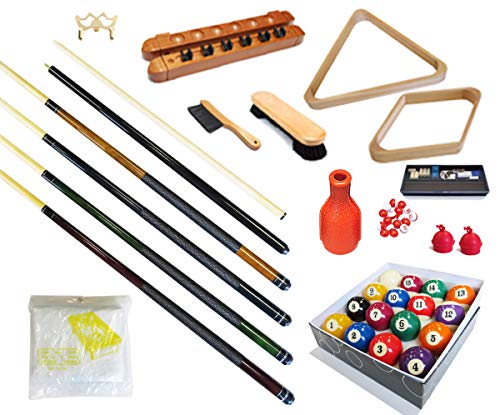
If you have a pool table then you need to get this accessory kit. It includes pool cues, extra pool balls, and all the gear you need to keep your pool table in tip-top shape.
If you are tired of your kids (or friends) ruining your good pool cue when they play then having these extra ones will keep that from happening (just be sure to hide your good one!).
Why are pool balls not hollow?
Most people think that pool balls like the balls used in most of the sports are hollow, like in cricket, football, basketball, tennis, etc. all of these sports use hollow balls. So why are pool balls different?
This is because in other sports mentioned above the main purpose is to bounce and travel more distance as compared to the pool table. Making the balls hollow will save money and make them economical, but the main reason for making pool balls solid is because of the way we use them.
They do not make pool balls to cover large distances as cricket balls do. In the pool, we hit balls with cue sticks to disperse them in the pockets. This needs a proper combination of weight, balance, and a smooth surface. With a hollow ball, the pool balls will bounce and can go off the table. So it becomes essential to rethink the structure of pool balls.
Features of a good pool ball
- Solid
Billiard balls need to be solid. It is necessary to maintain its shape. While hitting any ball, a player applies a certain force on it. Force is not the only determinant though. To maintain its direction, they make it solid so that a player can use corners of the ball to rotate or spin the ball in a desirable direction.
- Smooth
We know billiard balls for their extreme smoothness. Manufacturers make them scratch resistance to maintain a smooth and plain surface throughout the game. Their polished surface excites the players and gives a feeling of luxury. This makes pool balls look new and last long.
- Homogenous
The material used to make pool balls is homogenous throughout the ball. Its density and type remain the same. This gives a uniform structure to the ball. Also, the center of gravity for the balls remains in the center and doesn’t change with movements.
- Heavy
We can link heaviness with the high quality of pool balls. They make pool balls heavy to make them remain connected with the table, as it is important to maintain contact between the table and the ball. Their weight varies from 160g-170g (5.5-6.0 oz). That’s why pool balls are made heavy. This also gives a feeling of luxury to the players.
- Dimension
Billiard balls come in various dimensions depending upon the game they are being used for. For a pool, dimension is 2.25 inches or 57.2 mm, plus or minus 0.0005(0.127mm).
It is interesting to know that they made earlier pool balls with ivory. Ivory is a white, hard material from the tusk (mostly elephants) of animals. Today it is illegal because this caused the killing of elephants and other species just to make billiard balls.
Being solid gives various advantages to pool balls, but being hollow gives some big disadvantages as well.
Below are the issues of a hollow pool ball.
- Bounce
With a hollow structure, it leads to air inside the ball. This provides extra bounce to the ball when hit anywhere. When any ball strikes on a hard surface, it bends inside (if hollow) and then releases itself to regain its original shape and results in a bounce. Being solid eliminates these bounces for pool balls.
- Lightweight
Players’ stroke pool balls with an extreme force which can make them leave the table. To avoid this, they are made heavy, but if we make them hollow, their weight will decrease and this will lead to more chances of the ball getting off the table
- Breakable
Hollowness creates a major problem and increases the chances of breakdown for the pool ball. We hit them hard with a small area cue stick. This combination of extreme force and less area is deadly and can break any hollow pool ball. That’s why being solid is important.
- Difficult to master
While playing, players use the solid nature of the ball to make it bounce from different corners and sides. They assume a predetermined track that the ball will follow. The problem with hollow balls is that this becomes difficult. When they are hit hard, they will bend inside irregularly and follow an undetermined path. This disturbs the game play and makes it difficult to make a shot.
Conclusion
Pool balls are an essential part of the game. We also know these as billiard balls. They are solid and not hollow.. Being solid provides various advantages to pool balls like toughness, durability, balance, predetermined shots and many more. These games all need the solid pool balls to work. Pool requires heavy and durable balls, which are the present billiard balls.
Pool balls are made out of many different materials today. Although they were originally made out of ivory, today the pool balls are made out of resin and other materials.
Pool balls are essential to playing pool, and with them being solid instead of hollow, it completes the game and makes it fun to play. The creators of pool were very smart and knew exactly what hollow balls would do, and knew that the balls needed to be solid.
No matter how long you have played pool, you know it is a fun game, and without solid balls the game would not be what we know it today.