
*This post may contain affiliate links. As an Amazon Associate we earn from qualifying purchases.
Have you ever wanted to take a pool cue on vacation but wasn”t sure if you could? Maybe you are planning on visiting your friends in a different state, and want to bring your pool cue.
Well, in this article we will go over everything you need to know about pool cues and if they are allowed on a plane.
So are pool cues allowed on airplanes?
Although many people don’t think that they are allowed to take a pool cue on an airplane, they actually are allowed on airplanes. You will need to contact the airline you are flying with to find out how to transport it, but you can take it on a plane with you.
If you want to know more about pool cues being able to go on an airplane, you will want to keep reading. You can also watch this short video to learn everything there is to know about pool cues.
If you are looking to get better at playing pool one of the best ways to do that is by upgrading your pool cue. One of my favorite cues is the Viking Valhalla. It is available in a variety of colors and won’t break the bank. You can find it by clicking here.
How to Carry Pool Cues On Airplanes
Like others passionate about the game they love, pool players also cherish the timeless game of pool. This is why it is not impossible to see a pool player about to embark on a flight with pool cues.
For obvious reasons, air travel is one of the most regulated and controlled forms of transport. This is why, out of safety concerns, many items fall under restriction about what you can take on flights.
Many items are allowed on trains and ships that are banned from airplanes. For pool players, they do not forbid pool cues from being taken on a flight.
However, certain conditions and requirements are in place before they can take pool cues on flights.
The information about taking your pool cue on a plane often comes from the airlines themselves or the relevant air travel regulatory agencies like the Transportation Security Administration. It is from this information released that details are often provided on items that are allowed on airplanes.
Although you can take a pool cue onto an airplane, you cannot take it as your carry on item or personal item on an airplane.
You can still carry your pool cues and cases on airplanes as long as you check them in as luggage before you board your flight. As long as you follow the guidelines and rules put in place by the TSA and airlines.
For those who may wonder how they will go about checking the pool cues and cases in as luggage, we will provide more information in the rest of this article.
Below are some steps that can be taken when traveling.
- Most people when they travel will get a carrying case or box to the airport that will keep their pool cue safe. If you need to purchase a case that will work for traveling, you can get one here. Boxes that are sealed at the point of checking them in are not to be opened. They do the screening of all the packages before the loading of items onto the airplane.
- It is important to stress that while getting set to do the checking in of the items, we should keep apart the pool cues in their own case.
- If you are lost and you are not sure of how to go about packing upon reaching the airport, do not worry as there is still something that you can do. All you need to do is approach either the Transport Security Administration (TSA) officer or airline customer help desk for more instructions.
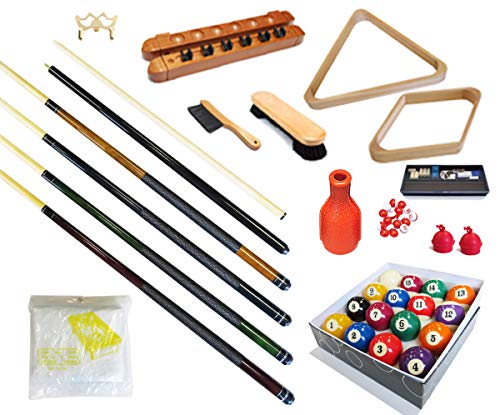
If you have a pool table then you need to get this accessory kit. It includes pool cues, extra pool balls, and all the gear you need to keep your pool table in tip-top shape.
If you are tired of your kids (or friends) ruining your good pool cue when they play then having these extra ones will keep that from happening (just be sure to hide your good one!).
Why Carry Your Pool Cues On Airplanes?
Some people may be interested in knowing why anyone would even take a pool cue on an airplane. It turns out that there are many reasons for traveling with pool cues. Like other people who play a gaming console, it is also common with pool players to get attached to items used in playing the game.
For this reason, it is understandable that they take their pool cues with them. As world-class tennis players become used to their favorite racquets and carry it everywhere they have a game, we can say the same thing for pool players.
It is also not very economical to buy new sets of pool cues every time there is a game. This is a very important point because a high-quality pool cue does not come cheap. Some excellent pool cues can cost as much as hundreds of dollars for just one unit.
When you realize that a typical pool player can have several pool cues in his or her collection, the price tag will be far from cheap. Therefore, it makes a lot more sense for the pool player to move around with the pool cues rather than buying new ones.
Since the airport authorities have opened up the space to allow pool lovers to carry their cues with them while flying, there is no reason they should not be allowed to explore that option. The option itself is in place to make life easier for pool players.
Information you need to know while carrying your pool cues on Airplanes
As long as a passenger knows of all the rules and regulations, traveling by air can be endless fun with no stress at all. The recent carry-on directives put in place by the federal authorities give room for one standard-sized carry-on bag and one personal item.
The personal item can be a briefcase, average-sized backpack, laptop computers or purses.
That said, the passenger must also know that some particular airlines or even airports can have their own extra rules regarding restrictions. For this reason, you will want to reach out to your local airport and airline before your departure to find out if your airline has any further restrictions.
This will allow you to get updates on the latest changes, so the surprise will not overwhelm you when it is time to enjoy your flight. Rules are changed or updated by airlines and airports, so it is always a wise decision to double-check and confirm before departure.
After everything is said and done, we should understand that the final decision regarding carrying pool cues or any other item lies with the Transportation Security Administration (TSA) officer on duty at the checkpoint.
However, the thing is, that as long as you adhere to the prevailing guidelines, you will be fine and encounter no issues. Air travel is under a lot of regulation and scrutiny. This is because of security threats from different angles. The TSA has placed many items under restriction, but these do not include pool cues at all.
Conclusion
Now that you know that you can carry a pool cue on the airplane with you when you travel around the globe, you can enjoy taking your specific pool cue with you. This is great news for those that are going to be gone for a while, or are simply going to a place to play pool.
Your specific pool cue can be extremely important to you, and the TSA knows that. This is why even though they have placed restrictions on many items, they have not placed any restrictions as of yet on traveling with a pool cue.