
*This post may contain affiliate links. As an Amazon Associate we earn from qualifying purchases.
Do you like playing pool, but not sure if you can play in all the pool halls? Are you under 21 but still want to play in a pool hall? Well, in this article we will go over exactly how old you need to be to play in a pool hall as well as the pool hall rules.
So are pool halls 21 and up?
Although most pool halls you can enter when you are 18 or older there are some places in the United States that do not allow you to come in unless you are 21 or older. This is because every different state has different rules and regulations for establishments that sell alcohol such as pool halls and bars with pool tables.
So to answer the question, some pool halls are 21 and up for the simple fact that they sell alcohol, but the majority of pool halls you can enter even with selling alcohol at 18.
If you want to know more about pool halls, you will want to keep reading. You can also watch this short video to learn all about pool halls in america in 1964!
If you are looking to get better at playing pool one of the best ways to do that is by upgrading your pool cue. One of my favorite cues is the Viking Valhalla. It is available in a variety of colors and won’t break the bank. You can find it by clicking here.
Places for minors to play pool
If you are a minor (or know one) that loves playing pool you will have quit a bit of difficulty finding somewhere nearby where a minor can play pool. But just because it is difficult doesn’t mean that it’s impossible.
The best place to reliably find a pool table that minors can play on without any age restrictions will be at your local bowling alley. Most bowling alleys have arcade rooms and pool tables in them and there won’t be an age restriction on playing pool at a bowling alley in most cases.
Now this isn’t always the case as some bowling alleys will only have pool tables inside of their bar areas and they won’t allow any minors inside of that. However, most bowling alleys have the pool tables behind the lanes or in the arcade area so minors can play on them without any issues.
If you don’t have a bowling alley near you then you can also look for local arcades. Unless it is a barcade then it won’t have an age limit so minors can go and enjoy all of the games including pool.
A pool table won’t be found as reliably in arcades as they will be in bowling alleys but they are the two most likely locations where minors will be able to play as much pool as they like.
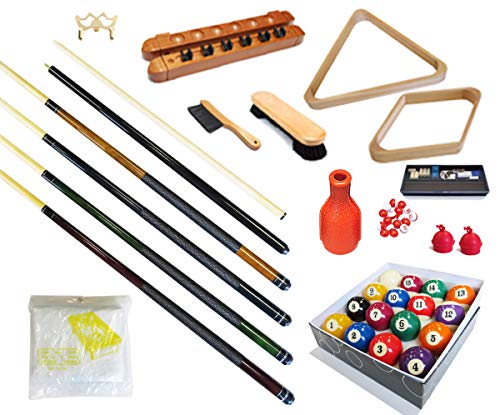
If you have a pool table then you need to get this accessory kit. It includes pool cues, extra pool balls, and all the gear you need to keep your pool table in tip-top shape.
If you are tired of your kids (or friends) ruining your good pool cue when they play then having these extra ones will keep that from happening (just be sure to hide your good one!).
Can teenagers play in pool halls?
There is a rule in which everyone should be following. According to the laws and regulations of most states, no manager permits or allows any person under the age of 18 years to be allowed in, remain in, enter, or visit such spots except if such individual is joined by his parents or by any of his legal guardians.
Many people are curious when they are in their teen years. They wonder if anyone can card them at the door or purchase them an hour at the pool halls. It’s because of the gaming passion that led them to ponder these questions occasionally. Many under the age of 20 get bored at the bowling alley tables, and are looking for more. They need to experience new things, but laws are laws you need to follow your state’s regulations first.
In some states, you can find the “Family Friendly” pool halls that allow anyone to come in and play a game. Some places are open for minors during the day before 8 or 9 PM. This gives the teenagers a place to come and play, while the adults can come and play later without any kids there. Every state has their own laws about what they allow and what if against the law. This is why before you leave, you should check to see what your state law is.
Pool halls limit around the world
In the US, there are pool halls which are also bars, and to enter there, you must be 21. Other cities in the United States though can let you in at 18 without any adult. All across the US though, anyone can go to the pool halls with their parents.
Although these rules are nice, this is not the case around the world. There are some places which have both pool halls, the one with the age restriction and other for kids under 20. Some countries it does not matter if your parents are with you or not, you are not allowed in no matter what your age is if you are under 21
Reasons why Pool halls have age restrictions
The minimum age limit in some countries to enter in a Pool hall is 15. However, this is only allowed if you go along with an adult.
“Historically, there was one specific reason for which the age limit was created and that was mostly because these places were sponsored by tobacco and alcohol companies.That was why the age restriction was made, and until recently it was the only reason for the age restrictions at the pool halls.
Generally, children and young people are permitted to remain out at public spots. However, some restrictions exist. All this age restriction at pool halls and bars, are only there to protect the kids from possibly beginning smoking and drinking at a young age. Parents are obliged to accompany their children when at these places. You can come along with your parents, but you are not allowed in if you are alone. These rules are followed for the protection of the children only because there are folks who try to sell drugs, alcohol, and other stuff at these places.
Some people have this theory in their mind that if they are good enough at something, they are old enough, but that’s not true. There are some famous people who started off their careers at an early age though Like Steffi Graf turned pro at tennis at 13. We don’t think anybody told her that she wouldn’t be able to cope mentally because she was ripping them up. Many people knocked down others by their age because they were kind enough, but they weren’t allowed to perform.
What is the best age to start playing Snooker?
Starting at a very young age and playing like a pro player requires a lot of practice. Determining where the ball is, where to hit, and so on. These questions pop up in every young player’s mind. This is why you must practice with a purpose every time you play in order to achieve your goal and beat the other top players.
Even with all this practice, you may not ever be an expert. We know individuals who have played for a long time who have no skill at all; these people typically win this game with their mind over their skill. Some people are born with knowledge, while others are just naturally good. Some people know some tactics from the start, but real greatness is a gift, and practice is mandatory.
Some Basic Pool Hall Rules
Pool halls normally vary from one another. Some general rules should be followed in every pool hall no matter the size though. Pool hall rules are the official rules that are governed by the Billiard Congress of America. You can show your actual playing skills by following the rules efficiently.
The one thing you can do is to enjoy your game entirely. If both the players are following the rules and playing honestly, you can enjoy your game.
- Be honest with your shots.
- Admit it was a foul.
- Avoid disputes.
- Call your shot before its place.
- Don’t distract other players.
- Remain quiet and respect while it’s their turn.
- Abide by the Pool halls rules. (different Pool halls have different Rules)
- If at any stage you don’t get the state, ask it right away.
- Do not sit on the Pool Table. Look around and stay calm in Pool Halls.
- A player may get upset if they have missed a shot try to encourage them.
- Do not place your drink near the pool table.
- Chalk can also play a significant role in running the table.
- No individual is allowed to hold the pool stick behind the head.
- If you hit another player with a pool stick, you will automatically be thrown out.
Conclusion
Now that you know that different states have different laws about being in a pool hall, you can know what your state allows in order to play pool as much as possible. You will find a variety of games in the pool hall along with Snooker, 8 ball, and many others.
If you are young and not allowed in a pool hall in your state, you may want to spend some money on purchasing your own pool table for you and your friends to play on in a safe environment. One of the best pool tables at the best price can be found here!