
*This post may contain affiliate links. As an Amazon Associate we earn from qualifying purchases.
Have you ever been playing pool, and you wondered just how heavy the tables are? Maybe you are going to pick one up and you are curious how many people you will need to lift it on your trailer. Well, in this article, we will go over everything you need to know about pool tables.
So are pool tables heavy?
Pool tables vary in weight quite a bit. A regulation top of the line pool table can be between 1,000-2,000 pounds, while a kids pool table that is simply made of plywood can be 50-100 pounds. A general rule of thumb is that pool tables that are extremely heavy are good quality tables.
If you want to know more about pool tables, you will want to keep reading. You can also watch this video to see exactly how a professional pool table is made and assembled which is why it is so heavy.
If you are looking to get better at playing pool one of the best ways to do that is by upgrading your pool cue. One of my favorite cues is the Viking Valhalla. It is available in a variety of colors and won’t break the bank. You can find it by clicking here.
What are pool tables made of?
Pool tables are made up of a lot of different components. It has a considerable quantity of wood, slate, cloth, and bolts to hold everything together. Pool tables are normally made to order. This means that the customer chooses what type of wood they want, as well as what color of stain and felt they want for their table.
Once the table is custom made for them, it will be delivered to their house. Although normal deliveries are made with the item assembled, a pool table has to be assembled exactly where the customer wants the table located because it is too heavy to move once it is all together.
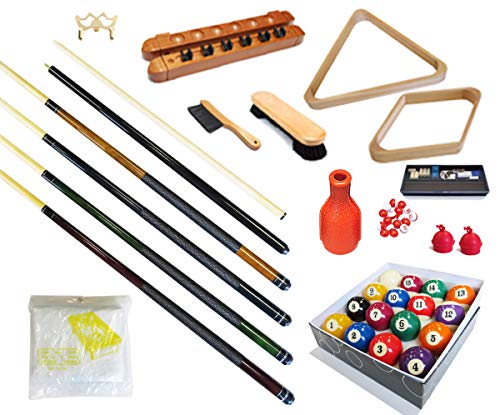
If you have a pool table then you need to get this accessory kit. It includes pool cues, extra pool balls, and all the gear you need to keep your pool table in tip-top shape.
If you are tired of your kids (or friends) ruining your good pool cue when they play then having these extra ones will keep that from happening (just be sure to hide your good one!).
How much do pool tables weigh?
The weight of the pool table depends from table to table. If you are using a table at home, then this standard quality table does not weigh that much. If you look at the professional pool table that is used by the legendary players though, it has almost twice as much weight compared to a home version.
Typically, an average quality pool table weighs between 450 to 800 pounds, whereas the high-quality pool table weighs around 1700 to 2200 pounds! Yes you read that right! A pool table can weigh over one ton!
The slate is the primary weight carrier in a pool table. Typically, the weight of one sheet of slate is between 400 and 600 pounds. The thicker the slate and bigger the table, the heavier the table.
An average quality pool table only contains one or two sheets of slate, while a high-quality table will include three or four sheets of slate.
People who have no idea about these materials often consider that the high quality pool tables have the average weight of a regular table. However, this is not the case. Pool tables are really heavy in nature because they are made up of heavy slate, wood, and other materials.
Why is the weight of a pool table important?
The weight of the Pool table depends upon a lot of factors. It varies from one table to another. It also depends upon the quality of the table. Knowing the weight in the early phase of the development can really help in deciding what table you want to purchase. If you want to install it at specific flooring and at a certain height, then it is essential for you to determine the weight that is going to be put there to make sure the floor is properly supported.
This can be quickly done by measuring the weight of the individual components that are used in Pool and then adding their own weight to determine the total weight. Another option is to figure out what pool table you will be purchasing and what size you want, and then ask the sales representative how much that specific table weighs.
There are a lot of things that go into figuring the weight including the thickness of the slate and the type of wood used for the table. This is why it is far easier to leave the weighing up to the professionals and just ask them.
Generally, pool tables are very heavy. Because they are so heavy, they are tough to move. People try different techniques to move a pool table, but most of the time they cannot do it on their own. Unless the pool table is not good quality, it will have to be taken apart in order to be transported.
Because of its heavy weight, they are generally developed at the places where it has to be installed. It is not something that can be delivered after it is fully assembled. The heavy weight forces its sellers to take out everything needed to assemble it to the destination.
The weight of the pool table depends upon things like its size and the quality of the table. The bigger the size of the table, the more weight it carries.
Weight of different styles of Pool Tables
The heaviness of the Pool table depends from table to table. Many different table pool table styles have been developed that contain different weights. Some popular styles are mentioned below.
The first table is the lightest of all the pool tables which are made of MDF. These weigh around 200 pounds. These tables do not weigh as much as the tables made of solid wood. It is light enough to be movable by just a single person. However, with the lightness, the quality also comes into play. In order to reduce its weight, no heavy slate is used on the table. These tables are not meant to be a professional or tournament quality pool table.
The second kind of table is the ones that are commonly found in pubs, bars, or general activity places. These are the typical English Pool tables. Most of them weigh around 500 pounds. They are heavier than the last as they normally contain a thin layer of slate.
The third table style is the wooden one that can be made by carpenters. Its weight depends on two things. The slate it uses and the type of wood used to make the table. These are decent pool tables and normally weigh around 1000 pounds.
The heaviest pool table available in the market is the one that is used in international pool matches, tournaments, and world cups. These tables can weigh all the way up to 2000 pounds and are made with high quality materials.
Determination of the weight of the pool table is important. If you want to buy the table or move the table from one place to another, you need to know how much it weighs so you know how to move it. If it is light, you will be able to move it with just you and one or two other people, but if it is extremely heavy you may need to take it apart and still have 4 people to move one piece of slab.
Conclusion
Now that you know pool tables are extremely heavy and can weigh upwards of 2000 pounds, you can decide what table you want to purchase. No matter what table you want to purchase, you can find the one for you here!
One more thing to consider is where the table will be placed. You will need to make sure that the flooring has enough strength to hold up the pool table you choose. No matter what table you choose, we are sure you will enjoy playing on the table as long as you get one that makes you happy and has the design you like.