
*This post may contain affiliate links. As an Amazon Associate we earn from qualifying purchases.
Have you recently been thinking about getting a pool table, but wondered if they were even still popular? Maybe you own one and you were going to sell it, but didn tknow if anyone would want to buy it? Well, in this article, we will go over everything you need to know about pool tables.
So are pool tables still popular?
Although some people do not play pool very often having a pool table is actually very popular even today! There are still tournaments for pool as well as championships all over the world!
If you want to know more about pool tables, and pool, you will want to keep reading. You can also watch this video to learn almost everything you need to know about playing pool in just a few minutes!
If you are looking to get better at playing pool one of the best ways to do that is by upgrading your pool cue. One of my favorite cues is the Viking Valhalla. It is available in a variety of colors and won’t break the bank. You can find it by clicking here.
Is pool popular around the world?
Although Pool is generally well known in America, snooker is generally what they play in the United Kingdom. Pocket billiards similar to pool are well known in Canada, Australia, Taiwan, the Philippines, Ireland, and China.
Beginning in the mid-nineteenth century, pool was one of the most well-known games. A hundred years back, there were hundreds of pool lobbies in the city of Chicago, while today, there are only a few. Although pool isn’t what it used to be, many people still own pool tables, and it is still a popular game everywhere.
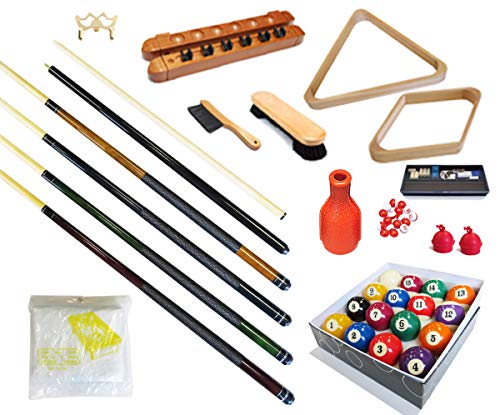
If you have a pool table then you need to get this accessory kit. It includes pool cues, extra pool balls, and all the gear you need to keep your pool table in tip-top shape.
If you are tired of your kids (or friends) ruining your good pool cue when they play then having these extra ones will keep that from happening (just be sure to hide your good one!).
Difference between Pool and Snooker
Pool is increasingly famous in the USA compared to snooker. Although Snooker tables are similar to pool tables, there are a few differences. The first is that Snooker tables are a little smaller than pool tables. The second is that pool table pockets are somewhat bigger than snooker pockets. The third is that pool balls are actually a little bigger than the balls used to play snooker.
In America, eight ball pool is well known as an easygoing social game to play at bars or pool halls. Many people call 8-ball “pool” since they don’t have any idea that there are different variants of pool. Pool is just one of the many sub categories of billiards.
Pool is well known in bars because most people don’t have enough space in their homes for a full size pool table. To fix this issue, some manufacturers have begun producing smaller pool tables for people to purchase. This is the best place to get a smaller pool table to play in your house. There are a wide variety of sizes available to fit your needs.
History or pool
Pool has a long and rich history starting in the fifteenth century. The game has been played by lords, ordinary people, presidents, mental patients, women, refined men, and tricksters the same. While some people would play pool for fun, others would use this as a new form of gambling and would gamble on who would win similar to cards.
Most people don’t know that pool started as a game similar to croquet. Playing the game moved inside to a wooden table with green material to mimic grass and an essential fringe was set around the edges. The balls were pushed, as opposed to striking, with wooden sticks called “maces.” The expression “billiard” was derived from the French language from the word “billet,” which was one of the wooden sticks.
A billiard table or pool table is a limited table on which billiards-type games (prompt games) are played. In the cutting edge period, all billiards tables (regardless of whether for carom billiards, pool or snooker) give a level surface typically made of slate, that is secured with fabric (generally of a firmly woven worsted fleece called baize), and encompassed by vulcanized elastic pads which were raised over the floor. As the years went on, the tables stayed similar, but were made with far better quality. Today if you go to purchase a real pool or billiard table, it will last a lifetime.
How do we make pool extremely popular again?
Although many people know what a pool table is, most people do not know how to play, or the first thing about any of the rules. In order to fix this and to make pool popular again, there are a few things that we can do.
The first step is to get the youth into it as soon as possible. Since pool only has a small image problem to overcome, and the sport is inexpensive to get into and not physically demanding, it should be pretty easy to get today’s youth to fall in love with it. Although you would think that since pool is mostly played in bars that younger people would have a problem gaining access to a pool table, that just simply is not true.
What is a pool table?
The pool table is a bounded table on which billiards games are played.
In the new era, all billiards tables (whether for carom billiards, pool or snooker) provide a flat surface. These smooth surfaces are usually made of quarried slate that is covered with cloth and covered by rubber cushions. More specific terms are used for particular sports, such as snooker or pool table. The balls also differ on these types of tables.
Pool Table vs. Snooker Table
Although pool and snooker are different games, they are very similar in a lot of ways. The main difference is the different size of the tables and the different size of the balls. In many ways though, both games are similar.
These games are played by doing the same thing on each one. You can play both of these games by using pool cues to pocket different colored billiard balls on the table. Snooker is a mind game that needs thoughtful attention and requires patience. Pool is similar in the fact that you have to not only think about your shot, but where you will leave the ball for the opponent’s shot and if you will leave him a shot or not.
Conclusion
Although here in America no one actually plays snooker, many people play pool, and they are very similar. Pool has come a long way over time, and it is one of the main games that has been around for a long time. While other games and devices come and go, pool has been able to stay popular. Although pool is not as popular as it once was, today, pool is still popular and loved by anyone that plays it.
Today there are many different types of pool tables people play on. Some are high end tables that can cost thousands, all the way down to miniature pool tables that can cost just a few bucks. No matter what table you are looking for, this place will have whatever table you are looking for.
Because pool is popular today, many people of all ages enjoy playing it and going head to head with each other. While the older generation normally plays pool in bars, the younger generation has been able to play in their own homes or the homes of their friends. Today pool is very popular as people of all ages love to play it, and even though it can appear hard, it is fun to learn and play no matter how old you are.