
*This post may contain affiliate links. As an Amazon Associate we earn from qualifying purchases.
Have you ever thought about buying a pool table, but you were not sure if you would ever play? Have you been looking for a while, but you just can’t bring yourself to spend the money on one? Well, in this article we will go over everything you need to know about pool tables and if they are worth buying.
So are pool tables worth it?
Although some people do not like to play pool, many people all around the world love the game and enjoy playing it! It is so much fun for people of all ages to play as well as a good pool table will last a lifetime! This is why pool tables are 100% worth it!
If you want to know more about pool tables and what the best one to get is, you will want to keep reading. You can also watch this short video to see all of the quality and workmanship that goes into a pool table being built.
If you are looking to get better at playing pool one of the best ways to do that is by upgrading your pool cue. One of my favorite cues is the Viking Valhalla. It is available in a variety of colors and won’t break the bank. You can find it by clicking here.
Where are pool tables popular?
Pool tables are trendy in almost all the bars and pubs that have room for them. People enjoy going to the pool halls at the weekend to enjoy some fun pool games.
Pool is a universal game that can be enjoyed with people of all different ages. There are tons of Pool categories, each offering multiple functionalities. To see if it is worth it or not, you will need to know about the price of the Pool table, quality, space requirements, installation cost and much more.
You can enjoy playing pool with your family, friends, or colleagues anytime you want if you own a table. IF you want to have the full experience of playing pool, you will not just be able to play one simple game and be done.
You will need to play quite a few to get the hang of the game, as well as to fully understand what all of the rules are. Once you have played a few games though, you will begin to quickly fall in love with the addictive style of the game as well as the adrenaline rush you get when you sink that 8 ball in the corner pocket.
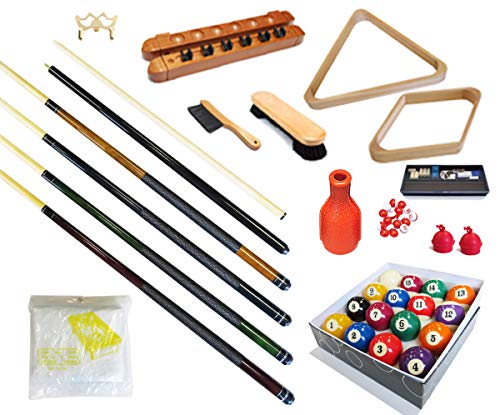
If you have a pool table then you need to get this accessory kit. It includes pool cues, extra pool balls, and all the gear you need to keep your pool table in tip-top shape.
If you are tired of your kids (or friends) ruining your good pool cue when they play then having these extra ones will keep that from happening (just be sure to hide your good one!).
Are pool tables fun?
You can enjoy Pool as a date, or you can get competitive with your friends to play a serious tournament. Since billiard games take so much time and you can engage in a lot of conversation within the game, it is considered as a social sport as well. Pool and billiard games are not just a two person game as there are many games that can be played socially and be fun for everyone.
You can invite your new friends and dates to these halls to break the initial conversation barrier. In this way, you can interact with each other during different moments of the game. This has been how many people have gotten to know other people very well without it feeling awkward.
Players can have drinks, different snacks, and can enjoy other activities as a new thing. Considering the number of things that this single cue game offers it can be fun for people of all ages. Because it makes a great first date, many people choose to take their dates to play pool as you can talk, drink, eat, and have fun while playing.
Pool, as compared to other games, does not pressurize the environment. It has a very light vibe, and can help keep the mood calm while you are playing it. This atmosphere can also be created by lights and music while playing. With dim lights and pleasing music, you can get your mind relaxed by focusing on this game.
Is owning a pool table expensive?
Although some people may think owning a pool table is expensive, they are halfway wrong. Although the initial cost of a pool table is expensive, there is no cost of maintenance of the table, and the table will last for a lifetime. This makes the table inexpensive over time, compared to other games and even gaming consoles.
Although buying a Pool table can be expensive, if you can’t afford it, you can always go to the local bars, pool halls and pubs nearby to play. Playing a simple game such as 8-ball, 9-ball, 10-ball, straight ball, etc. are all very cheap at those types of places.
If you can afford one and you have the room to put one, this is the best place to get one! They have a wide variety of tables as well as a wide variety of sizes available to fit your needs.
Since there can be many fun activities that can be done under the same price, deciding to buy the pool table can be a tricky choice.
Many people enjoy playing Pool from time to time, but when it comes to buying one, they often want to know if it is worth the price or not. Since it is not a cheap buy, you will thoroughly want to consider buying one.
Where did pool come from?
Pool belongs to the family of billiard games. These billiard games contain a lot of other games such as snooker, English billiard, carom billiards, etc. A lot of new and other artistic games are also being developed. Pool is simply a game with 6 pockets that the ball is hit into. The people who love to play this game spend almost all their free time either playing it in the Pool halls or if they are lucky, they may even have a pool table at their house!
Comparison of Pool Table with other Game Tables
There are many game tables available in the market. Cue games have such a massive quantity of variations. This is why having only time to play pool is a difficult decision to make.
Pool tables can be used to enjoy games like an 8-ball pool, a 9-ball pool, a 10-ball pool, straight Pool, and Bank Pool. Buying or taking charge of only one table can give you the perks of enjoying all these games. You can switch from one game to another, depending upon your interest and skill level.
Even if you put the number of games aside, you can have the ease of playing Pool as an advantage over other gamers. Many players and professionals have noted that even with all of these variations in the number of games, the rules of the pool games are quite similar as compared to other billiard games.
This is why people prefer to start from the bottom and work their way up in order to improve their game every time they play.
A lot of people give a response that Pool provides a mental satisfaction to them. It is true because it operated at such a moderate level. Although a lot of technicalities are concerned, the time to complete each game is still quite massive.
What are pool tables made out of?
Professional quality pool tables are made up of excellent quality of wood and marble. It is an incredibly complex process that takes a lot of time to make one single table.
Pool tables have to be made very specifically! The surface of the pool table must flat, its cloth must not have enough friction, and its pocket must be neither too small nor too big. When placing the table in the room, it also requires accurate setting up and execution.
Conclusion
Now that you know pool tables are worth getting, we hope you will get one and enjoy playing pool with your family and friends in the near future. No matter what size or quality table you get, as long as you get one that fits your needs, you will enjoy having it as well as playing on it for many years to come.