
*This post may contain affiliate links. As an Amazon Associate we earn from qualifying purchases.
A phonograph record (also known as a gramophone record, especially in British English), or simply a record, is an analog sound storage medium in the form of a flat disc with an inscribed, modulated spiral groove. The groove usually starts near the periphery and ends near the center of the disc.
At first, the discs were commonly made from shellac; starting in the 1940s polyvinyl chloride became common, hence the name vinyl. In the mid-2000s, gradually, records made of any material began to be called vinyl records, or simply vinyl.
So are vinyl records timeless?
There is no doubt that digital streaming services have made our lives much easier, but when it comes to producing quality sound; nothing beats vinyl record players. Vinyl record players are completely analog and in our opinion, timeless.
If you would like to know more about vinyl records being timeless, please keep reading or check out this video!
Do you love playing your vinyl records but your record player has seen better days? Well, you are in luck! There are tons of great record players that not only have great sound quality but also won’t break the bank. You can find them by clicking here.
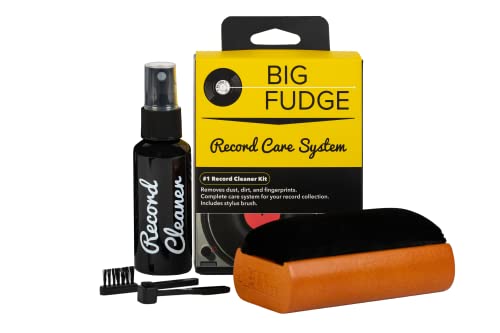
If you love records and record players, you must get a record-cleaning kit like this one. It is designed to ensure that your records stay in excellent condition to last you for decades.
Get this cleaning set and keep your vinyl records in perfect condition!
Vinyl Records
It doesn’t matter which generation you belong to, vinyl records seem to have something to offer everybody. The recent sales in the past decade have made the old school analog player a new star in the music world. Vinyl records made all-time high sales in the year 2018 and continue to be just as popular ever since. What makes vinyl records stand out over the digital streaming services?
Well, vinyl records have the unique sound that makes the music enthusiasts dwell in the nostalgic feeling. Even though vinyl records do not provide as much ease as digital services would, the nostalgic sound is worth the price. Vinyl record players are completely analog and timeless. It doesn’t even require an extensive amount of technical knowledge in order to use them. All you need is a decent turntable and you can start listening to your favorite record without any worries.
There is no doubt that digital streaming services have made our lives much easier, but when it comes to producing quality sounds, nothing beats vinyl record players. Despite launching iTunes; Steve Jobs preferred to use the vinyl record player. It has become more about the experience that you get when you listen to the music rather than how much bitrates you can produce with the modern codecs.
Analog Vinyl Records
There are now many kinds of record players, so it will depend on what kind of vinyl record player you have as to whether it is analog or not. In the old days, vinyl record players were all analog, thus, producing that distinctive sound that we all love. However, as technology has advanced further since then, new vinyl records are now closer to digital recordings. More and more artists prefer to record their albums in the new musical formats and then convert them into vinyl records.
It is no doubt that digital formats would produce a better quality of music and they provide more control to the artist, but the vinyl records would create that sound that is more vinyl-y.
However, it is even difficult to produce good quality sound in vinyl records if the album is over an hour long. The reason for that is because the grooves are much thinner in the long albums and it doesn’t produce as accurate sounds as CD would. Similarly, the vinyl records can produce good quality if the grooves are much thicker, so the needle could thread through that with ease.
In analog vinyl records, the high pitched sounds can be a real struggle. The needle would have a hard time trying to trace through the high pitched sounds and would produce distortion. Therefore, it is nearly impossible to produce modern dubstep music on the vinyl records, as they are always the mixture of high bass and irregular sounds that would distort the vinyl records.
Vinyl Records Verses MP3
Even though vinyl records have not changed much since the past 50 years, the prices of the vinyl records have certainly changed. Artists tend to produce their albums in vinyl formats even as they produce in the MP3 formats. Even from the monetary perspective, an average music listener does not own the MP3 formats whenever they buy it from iTunes or other platforms. However, when you buy a vinyl record; it stays with you.
Often, the prices go up and you can sell the vinyl record for a much higher price than you had initially brought it for. Similarly, for the artists, vinyl records cost more than the CD formats. However, vinyl records are the worst nightmares for the modern-day electronic music artists. This is because vinyl records are not designed to pick up on the high pitched sounds of electronic music. It will create this distinctive crackling sound that is not pleasant to hear.
This is why modern electronic music artists prefer to stick to digital streaming services and CDs. As for the rock bands, vinyl records are the holy grail of profit. Since vinyl records have re-emerged in the music scene, their prices have gone up ever since and artists tend to create more profit from the vinyl records.
Vinyl Records Verses Digital Formats
It all boils down to your preference. Often, MP3 formats are compressed to take less space in your phone, thus, it reduces the quality of the sound. You would not be able to hear the details of the music. In retrospect, vinyl records would sound the same. The quality of the sound will remain the same, even if you compress it.
Vinyl records will give you the best quality of sound, as the artist would have intended you to hear it. Vinyl records will give you the best quality of the studio recording. Whereas, in the case of MP3 formats, if you compress the audio file and digitally modify the sounds, then it loses its essence. Vinyl enthusiasts prefer the raw sound of the original music, and they don’t partake in the loud music war.
Furthermore, it is always an experience when you are searching for music in the record store. Sometimes it can be the start of a new friendship when you are discussing music with fellow enthusiasts. It is certainly a surprise to see the resurgence of the vinyl records, and it is getting bigger every year. It turns out, it wasn’t the high bitrates and loudness that people wanted, it was the life experience and nostalgic sound that only vinyl records could produce.
If you prefer the ease of the MP3 formats then you can find vinyl recordings of the music on the internet, it will give you the same audio quality as a vinyl record player would. If it is more about the experience for you then nothing beats the old school vinyl record player.
Conclusion
There is no doubt that digital streaming services have made our lives much easier, but when it comes to producing quality sounds; nothing beats vinyl record players. Vinyl records have the unique sound that makes the music enthusiasts dwell in the nostalgic feeling.
Even though vinyl records do not provide as much ease as digital services do, the nostalgic sound is worth the price. Vinyl record players are completely analog and timeless. It doesn’t even require an extensive amount of technical knowledge in order to use them. All you need is a decent turntable and you can start listening to your favorite record without any problems.