
*This post may contain affiliate links. As an Amazon Associate we earn from qualifying purchases.
Hey there music lovers! Are you looking to buy a shiny new jukebox (or multiple jukeboxes) to spice up your home or business? Look no further!
We’ve done the research and compared all the top jukeboxes (and brands) to bring you the ultimate guide to finding the jukebox (or jukeboxes) for your needs.
But before we dive into the details of each brand, let’s take a trip down memory lane and explore the history of jukeboxes. These musical marvels have been around for over a century, and they’ve come a long way since the first jukeboxes were introduced in 1889.
Back in the day, jukeboxes were all about the vinyl. You’d drop a few coins into the machine and out would come a 45 rpm record, ready to play your favorite tunes.
But as technology has evolved, so have jukeboxes. Nowadays, you can find jukeboxes that play CDs, stream music via Bluetooth, and even have karaoke options.
So whether you’re a vinyl purist or a digital music fanatic, there’s a jukebox out there for you. And that’s exactly what we’re here to help you find. So let’s dig into the greatest jukebox brands (and the features that they should have).
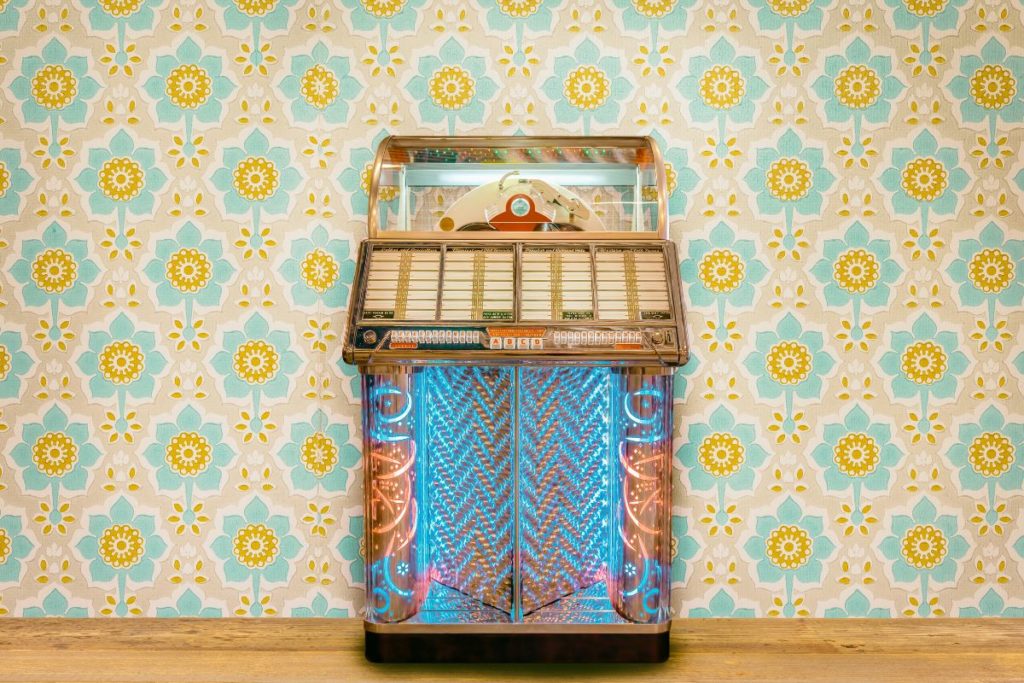

What to Consider When Choosing a Jukebox
Before you start shopping for your dream jukebox, there are a few factors you should consider to ensure you get the best one for your needs.
First, think about the size and location of the jukebox. Will it be a centerpiece in your living room or a subtle addition to your restaurant’s atmosphere?
Make sure you measure the space you have available and look for a jukebox that will fit comfortably.
Next, consider the type of music you want to play. Do you have a vast collection of vinyl records you want to showcase, or do you prefer the convenience of a digital music library?
Many modern jukeboxes have the capability to play both, but some are geared more towards one format or the other.
Of course, price is always a factor when making a big purchase. Jukeboxes can range in price from a few hundred to several thousand dollars, so it’s important to determine your budget before you start shopping.
Finally, think about any additional features you might want in a jukebox. Do you want the option to play karaoke? Do you need Bluetooth connectivity to stream music from your phone? Make a list of your must-have features to help narrow down your options.
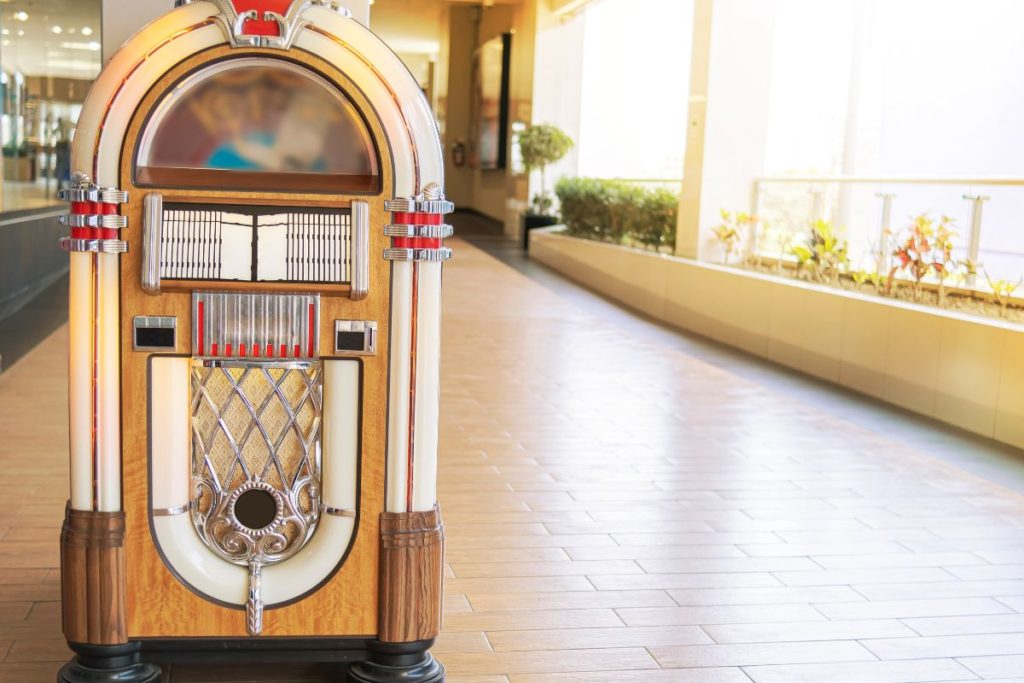
Top Jukebox Brands
Now that you know what to look for, let’s take a look at some of the top jukebox brands on the market. We’ll start with the OG of jukeboxes, Rock-Ola.
Rock-Ola Jukeboxes
Rock-Ola has been a trusted name in the jukebox industry for over 75 years. Founded by David C. Rockola in 1927, the company has a long history of producing high-quality jukeboxes that are built to last.
Some of their most popular models include the Rock-Ola Tempo II and the Rock-Ola CD8B. The Tempo II is a classic vinyl jukebox that holds 50 records and has a sleek, retro design. The CD8B, on the other hand, is a more modern option with the capability to play CDs as well as AM/FM radio.
One of the pros of Rock-Ola jukeboxes is their durability. These machines are built to withstand heavy use, so they’re a great option for businesses or homes with frequent jukebox action. They also offer a wide range of models to choose from, so you can find one that fits your specific needs and style.
However, one potential con of Rock-Ola jukeboxes is their price. They tend to be on the higher end of the spectrum, so they might not be the most budget-friendly option. But if you’re willing to splurge for a high-quality jukebox that will last for years to come, Rock-Ola is definitely worth considering.
Wurlitzer Jukeboxes
Next up is another jukebox giant: Wurlitzer. This company has been around for over a century and has a reputation for producing some of the most iconic jukeboxes of all time.
Some of their most popular models include the Wurlitzer 1015 and the Wurlitzer One More Time. The 1015 is a classic vinyl jukebox that holds 60 records and has a vintage, Art Deco design.
The One More Time is a more modern option with a sleek, futuristic look and the capability to play CDs and AM/FM radio.
One pro of Wurlitzer jukeboxes is their style. These jukeboxes are known for their eye-catching designs and can add a touch of retro glam to any room.
They also offer a wide range of models to choose from, so you can find the perfect fit for your space.
However, one potential con of Wurlitzer jukeboxes is their price. Like Rock-Ola, they tend to be on the higher end of the spectrum, so they might not be the most budget-friendly option.
But if you’re looking for jukeboxes that are as much of a conversation piece as they are musical instruments, Wurlitzer is definitely worth considering.
AMI/Rowe Jukeboxes
Next on the list is AMI/Rowe, a company that has been producing jukeboxes since 1909. They’re known for their high-quality, reliable machines that are popular in both commercial and home settings.
Some of their most popular models include the AMI Jukebox Model F and the Rowe AMI CD-100A. The Model F is a classic vinyl jukebox that holds 50 records and has a vintage design.
The CD-100A is a more modern option with the capability to play CDs and MP3s.
One pro of AMI/Rowe jukeboxes is their versatility. They offer a wide range of models to choose from, including both classic vinyl jukeboxes and more modern options with digital capabilities.
They also have a variety of sizes and styles to fit any space.
One potential con of AMI/Rowe jukeboxes is their availability. These jukeboxes aren’t as widely sold as some of the other brands on this list, so you might have a harder time finding them in your area.
However, if you’re able to track one down, they’re definitely worth considering for their high-quality and versatility.
Best Jukebox Features
Oh boy, where do I begin with the best jukebox features? These are my top picks that you will want to get in any modern jukebox that you buy.
First and foremost, let’s talk about the obvious – the music selection. I mean, what’s the point of having a jukebox if it doesn’t have a wide variety of songs to choose from? I want to be able to pick from the latest hits, throwback classics, and even some underground indie gems.
And let’s not forget about those sweet, sweet karaoke options. Because let’s be real, who doesn’t love singing along to the music of some cheesy pop tunes in front of a crowd of strangers?
Next up, we have the user interface. I don’t want to have to navigate through a labyrinth of menus just to find the music I want. Give me something simple, easy to use, and preferably that’s touchscreen operated.
And while we’re on the topic of displays, let’s not forget about the visual aspect. I want my jukebox to have a sleek, modern design that will make all my friends jealous. Plus, it’s always a plus if it has some fancy lighting effects to really make the party pop.
Finally, let’s talk about the best audio quality. I don’t want to have to put up with crackly, tinny sound. I want my music to sound crisp, clear, and loud enough to make my eardrums bleed (in the best way possible, of course).
And if you can throw in some additional features like Bluetooth connectivity and the ability to connect to external speakers, then you’ll have my undying loyalty.
In conclusion, the best jukebox needs a killer selection of songs, an easy-to-use interface, a visually pleasing design, and top-notch audio quality. And if you can add in some extra bells and whistles like Bluetooth connectivity, then you’ve got yourself a real winner.
So, if you’re looking for the best jukebox experience, then look no further than…well, I’m not sure where you should look, but when you find it, you’ll know you’ve hit the jackpot.
Jukebox Sound Quality (Is It Any Good?)
So, you’re thinking about getting a jukebox for your living room, huh? Well, let me tell you, the sound quality on these bad boys can be hit or miss. It really depends on the model you choose and how much you’re willing to spend.
But, let’s be real here, you’re not buying a jukebox for the sound quality (cause they don’t have the best sound quality). You’re buying it for the nostalgia factor and the ability to impress your friends with your vintage-inspired taste.
Now, if you’re expecting jukebox sound quality to be the best out there, on par with a high-end home theater system, you might as well throw that idea out the window. These things are built for nostalgia, not audiophile-level sound.
But, that being said, some jukeboxes do come with decent speakers and can provide decent sound quality. It’s not going to blow your socks off (or be anywhere close to the best), but it’ll be good enough to sing along to your favorite tunes.
On the other hand, if you’re comparing jukebox sound quality to the speakers in your car, well, let’s just say it’s not even in the same league. Car speakers are built for the road, so they have to be able to handle a lot of wear and tear. Jukebox speakers, on the other hand, are built for nostalgia, so they’re not exactly built to last.
But, hey, that’s the price you pay for nostalgia, right?
In conclusion, when it comes to jukebox sound quality, you should expect decent sound that’ll be good enough to sing along to your favorite tunes, but don’t expect it to be the best of the best (or anywhere close) And if you’re comparing jukebox sound quality to other types of speakers, well, let’s just say it’s not even in the same league.
But, hey, you’re buying a jukebox for the nostalgia factor, not for the sound quality. So, go ahead and buy that jukebox, and let the good times roll!
Should You Get A Countertop Jukebox?
So, you’re thinking about getting a countertop digital jukebox. Let me tell you, it’s a big decision. I mean, it’s not like you’re buying a new car or anything, but it’s still a pretty significant purchase. But before you go dropping all your hard-earned cash on one of these bad boys, let’s talk about whether or not it’s the right move for you.
First things first, let’s talk about sound quality. I know, I know, you’re thinking “but it’s just a countertop jukebox, how good can it really be?” Well, let me tell you, it can be pretty damn good. In fact, I would argue that the sound quality of a jukebox is pretty much on par with other types of speakers. Sure, it’s not going to compare to a high-end home theater system or anything, but it’s definitely not going to sound like you’re listening to music through a tin can either.
Now, I know what you’re thinking, “but I can just play music through my phone and it sounds just as good.” And you know what? You’re not wrong. But here’s the thing, a countertop jukebox just has that extra special something that can’t be replicated through a phone speaker. It’s like the difference between watching a movie on your phone and watching it on a big screen. Sure, you can still see the movie and understand what’s going on, but it’s just not the same experience.
So, should you get a countertop jukebox? Honestly, it depends on what you’re looking for. If you’re just looking for a way to play music in your home, then sure, go for it. But if you’re looking for something that’s going to take your listening experience to the next level, then maybe not so much. But let’s be real, who doesn’t want a little extra special something in their lives? I mean, come on, it’s a jukebox. How cool is that?
Is A Bluetooth Jukebox Worth Getting?
Well, let me tell you, if you’re looking for a way to take your party game to the next level, a Bluetooth option for your jukebox might just be the ticket. I mean, who doesn’t love a good old-fashioned jukebox? It’s like having your own personal DJ, minus the annoying comments and terrible dance moves.
But let’s talk sound quality, because that’s where things get a little tricky. Sure, a jukebox might look cool, but if the sound is crap, then what’s the point? I’m here to tell you that the sound quality of a Bluetooth jukebox is pretty darn good.
It’s not going to blow your socks off or anything, but it’s definitely better than your average Bluetooth speaker.
Now, if you’re looking for audiophile-level sound, then a Bluetooth option for your jukebox probably isn’t the best choice. But if you want something that will get the party started and keep the music flowing all night long, then having Bluetooth on your Jukebox is definitely worth considering.
Plus, it’s just plain fun to press buttons and watch the lights flash and stream music to your jukebox over a Bluetooth connection.
In conclusion, having Bluetooth in your jukebox may not be the best option for audiophiles, but it’s a great choice for anyone looking to add a little nostalgia and fun to their next party. So, if you’re ready to rock and roll, grab yourself a jukebox and let the good times roll!
How Does Bluetooth In A Jukebox Work?
Bluetooth in a jukebox is a real game changer. No more having to physically walk up to the jukebox and insert your hard-earned quarters. Now, all you have to do is connect your Bluetooth-enabled device and voila! You’re the DJ of the party ready to play all of the music that you love from your favorite artists.
But how does it all work, you ask? It’s simple, really. The jukebox has a built-in Bluetooth receiver that allows it to connect to any device that also has Bluetooth capabilities. Once connected, you can use your device to browse and select songs from the jukebox’s library.
And let me tell you, the selection is better than your ex’s playlist.
But it gets even better. You can also control the volume and even create custom playlists on your device via Bluetooth, all while sitting comfortably on the couch, away from the jukebox. So, you can sit back and relax while your friends fight over who gets to play the next song.
And don’t worry, you tech-phobes out there, it’s not rocket science. Just make sure your device’s Bluetooth is turned on and the jukebox’s Bluetooth is in pairing mode, and boom! You’re in the game.
In conclusion, Bluetooth in a jukebox is like having a personal DJ at your fingertips. So, go ahead and connect your device, find the music that you love, and get ready to rock the party like a boss.
Is A Branded Jukebox Better Than A Generic Jukebox?
It’s time to settle the age-old debate: are branded jukeboxes better than generic ones? Since you’re here reading this, I’ll give you my two cents on the matter.
First off, let’s talk about the obvious: brand recognition. Sure, having a shiny little box with a recognizable logo on it may make you feel like you’re in a fancy hotel or something, but let’s be real here, does it really make a difference in the music playing out of it?
I mean, it’s not like Coca-Cola jukeboxes are going to make your music taste better.
Secondly, let’s talk about functionality. Sure, branded jukeboxes may have more bells and whistles, but do you really need all those extra features?
Are you really going to use that built-in karaoke function? Let’s be real, if you’re at a bar or restaurant, the last thing you want to do is make a fool of yourself singing “Living on a Prayer” in front of a bunch of strangers.
And finally, let’s talk about cost. Sure, the branded jukeboxes may be more expensive, but is it really worth it? I mean, are you really willing to fork over a couple of extra bucks just to have a little logo on your jukebox?
I mean, if you’re that desperate for brand recognition, just go buy a designer handbag or something.
In conclusion, folks, whether you choose branded or generic jukeboxes, it all comes down to personal preference. But, in my humble opinion, it’s not worth spending extra money just for a logo on your jukebox.
Just focus on getting a jukebox that plays good music and makes you and your friends happy. Happy listening!
Final Thoughts
So there you have it, a rundown of some of the top jukebox brands on the market. Whether you’re a vinyl purist or a digital music enthusiast, there are jukeboxes out there for you.
When shopping for the perfect jukeboxes, be sure to consider the size and location of the machines, your preferred music format, your budget, and any additional features you might want. And don’t forget to have fun when picking the perfect brand of jukebox for you!