
*This post may contain affiliate links. As an Amazon Associate we earn from qualifying purchases.
Do you have pool cues that are bent or warped? Maybe you have considered if having a straight pool cue is actually important and if you can straighten them yourself. Well, in this article, we will go over these questions.
So, can pool cues be straightened?
Although pool cues can become bent for different reasons, straight pool cues are vital to a correctly played game of pool. If you discover a bent pool cue, there are ways that it can be straightened.
If you want to know more about straightening pool cues, you will want to keep reading. You can also watch this short video to learn step by step how to know if your pool cue is bent or straight.
If you are looking to get better at playing pool one of the best ways to do that is by upgrading your pool cue. One of my favorite cues is the Viking Valhalla. It is available in a variety of colors and won’t break the bank. You can find it by clicking here.
What are pool cues used for when playing pool?
Playing pool is one of the cue games famously known all over the world. Pool or some kind of its variety, has been in existence for about two centuries now. Originally, it was played outdoors, although it is now considered an indoor game.
The game requires a wooden table on which to play the game on. The top of the table is made up of a one or three piece slab of slate. Pool cues are used to push the object balls into the six ball pockets with the cue ball. Pool tips, as well as pool balls, are also needed. Without the pool cue, there would be no way of playing successfully.
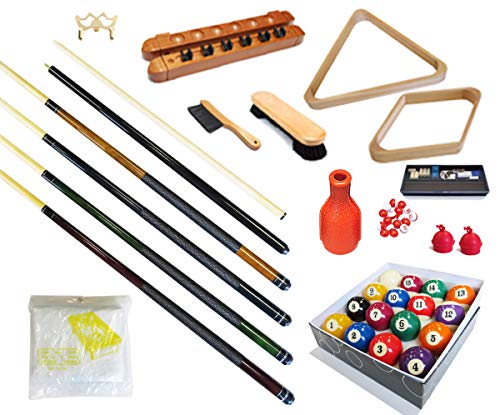
If you have a pool table then you need to get this accessory kit. It includes pool cues, extra pool balls, and all the gear you need to keep your pool table in tip-top shape.
If you are tired of your kids (or friends) ruining your good pool cue when they play then having these extra ones will keep that from happening (just be sure to hide your good one!).
Why is a straight pool cue so important?
A pool cue is an essential part of a pool game. Without a pool cue, it would be extremely difficult to play a pool game. Without a proper pool cue, it is also difficult to play the game well. When deciding on pool cues, it is important that you look for a straight one.
When using a straight pool cue, you can apply all types of different skill techniques. You will have the ability to have the proper power to use on pool balls. A straight pool cue will also offer you the ability to have perfect aim onto the tip.
You can possibly play with a straight pool cue that has minor deformities. It will definitely create problems, but they may not be as noticeable if you are especially skilled. There are even a handful of professionals who often play with a warped shaft. However, if you are still a beginner, playing with a deformed pool cue can cause major issues as you progress your learning.
How can you straighten a bent pool cue?
Sometimes, a pool cue will become warped or slightly deformed. At that point, it would be best to straighten them. There are options for a professional to straighten the pool cue, but before you move forward with that, it is best to ensure that your pool cue is in fact bent.
A pool cue can be warped for a number of reasons. In fact, some people like to keep their pool cues in soft cases, but this can actually weaken the integrity of the pool cue and subsequently, cause it to bend. You can also inadvertently bend your pool cue by leaning on it with your weight or leaning it against the wall with pressure pushing on it.
There is also the idea that you can bend a pool cue by breaking with it, however, this is often very rare and is usually the result of the player not using the pool cue correctly.
Even though there are ways a pool cue can become bent, there are also ways to straighten it. First, check your pool cue. Your pool cue may appear bent, even though it is just the tip that is misshapen. Additionally, the ferrule that holds the tip may appear bent, when in fact it is straight. You can lay it flat on a table and roll it side to side. If there are obvious issues with it rolling back and forth, you probably have a bent pool cue.
You should be cautious with this method, however, because sometimes, the table you lean the pool cue can be unlevel instead. Also, if there are indentations in the table, it can cause a bouncing of the cue which might damage the pool cue even more.
Instead of rolling the cue, you can also hold the cue at its butt end while resting the tip on the floor. Try and keep the stick at about a 60 degree angle to the floor. Slowly rotate the cue on its tip. Look for obvious curvatures in the pool cue. You can also look for a part that is curved towards you. If you discover a place that is curved towards you, you can easily determine that your pool cue is bent and that it needs to be straightened. You can hold the pool cue under a clear light to help you see your pool cue with more clarity.
Once you decide that your pool cue is in fact bent, you can try and straighten it. To fix a pool cue, you need to hang your cue in the air. You can try to attach it to a ceiling. You can leave it here motionless for several days, or even up to a week. This will help gravity to do your work for you and help straighten the pool cue by pulling the cue towards the earth. The weight of the pool cue is enough to help straighten the curvatures.
You can also try to manually straighten a pool cue by bending it back with your hands. If it’s just a small bend, this should fix the issue. Be careful to not use too much power where you curve it the opposite direction, or even break it. You can try to manually bend it back by setting the cue onto the floor with the tip touching the floor at a 60-degree angle. Then, pull it the opposite way the bend is leaning towards.
You do have to press down on the pool cue, but again, be careful to not use too much pressure. You will need to make sure that the pool cue is stabilized while on the floor. Try bending it slowly. You can apply a small amount of pressure, and then recheck the curvature to decide if you need to apply more.
Continue with this method until your pool cue is once again straight. Thus, it will take a few minutes to straighten the minor bends.
Sometimes, the extent of the bend is too much to be easily fixed using these methods. At that point, you can decide whether to continue to play with bent pool cues, knowing that it will affect your game negatively, or you can locate a professional who can help take care of the issue for you. Another option is to purchase a brand new pool cue. The best pool cues are available right here!
Conclusion
Although pool cues can become bent for different reasons, straight pool cues are vital to a correctly played game of pool. If you discover a bent pool cue, there are ways that it can be straightened. You can try to manually bend the pool cue back into it’s straight position, or you can even try to get gravity to work in your favor by hanging the pool cue from the ceiling. If these methods fail, there is always the alternative to buy a different pool cue or to have a professional repair done.