
*This post may contain affiliate links. As an Amazon Associate we earn from qualifying purchases.
Do you have a pool table where the felt needs to be repaired? Maybe you’ve had your pool table for a while but still want the felt to look as good as new. Well, in this article, we will go over everything you need to know to repair your pool table felt.
So can you repair your pool table felt?
Even if your pool table felt is old, ripped, torn, or beginning to peel, the good news is, it can be repaired. It is not an easy process but it is something that you can do yourself or hire done.
If you want to know more about pool table felt being repaired, you will want to keep reading. You can also watch this video to learn step by step exactly how to repair and replace the felt on your table.
If you are looking to get better at playing pool one of the best ways to do that is by upgrading your pool cue. One of my favorite cues is the Viking Valhalla. It is available in a variety of colors and won’t break the bank. You can find it by clicking here.
What part of the pool table is felt used on?
Playing pool is one of the cue games famously known all over the world. Pool or some kind of its variety, has been in existence for about two centuries now. Originally, it was played outdoors, although it is now considered an indoor game. The game requires a wooden table on which to play the game on. The top of the table is made up of a one or three piece slab of slate. Pool cues are used to push the object balls into the six ball pockets with the cue ball.
The pool table felt is important for the overall look of the table, and to ensure smoothness when playing the game. The object balls travel over the felt to the ball pockets and if there are any tears, or holes, it will cause disruption in the game.
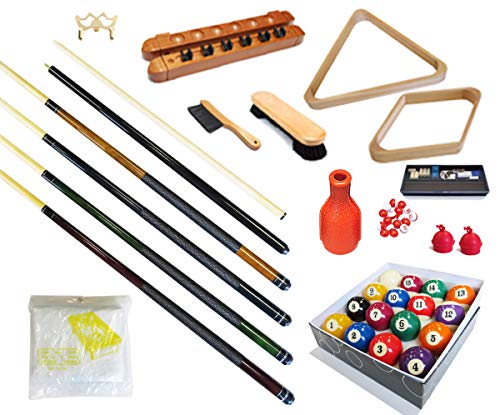
If you have a pool table then you need to get this accessory kit. It includes pool cues, extra pool balls, and all the gear you need to keep your pool table in tip-top shape.
If you are tired of your kids (or friends) ruining your good pool cue when they play then having these extra ones will keep that from happening (just be sure to hide your good one!).
Can pool table felt be repaired?
Can pool table felt be repaired in the case of a simple tear or likewise? Simply put, yes, it can. The felt on the top of the pool table slate may get torn or ripped quite easily over time. This can be a simple repair that does not require expert hands or a professional. You can quite easily repair the pool table by yourself, but you should first check to see if your pool table is covered through a warranty.
A completely new felt cover may be difficult to put together and can be costly. Repairing your pool table felt must be done carefully so as to not damage the material underneath the felt cover. If the material itself has become damaged along with the felt, then both need to be repaired as soon as possible and as skilfully as possible.
A table which has formed a tear on its felt top may also have a dip in the slate base and this will affect the roll of the ball during the game play. This is why it is important to ensure that both parts of the affected area are repaired.
How do you repair pool table felt?
There are in fact two different ways that you can easily repair felt tears and other problems related to the pool felt.
- The first option is to use scissors or a razor to repair your felt.
First, take a pair of scissors and then cut out the damaged pieces while holding the torn portion of felt. You can use a razor blade for the best effect. Use your razor blade to cut the damaged felt off. Don’t be concerned with neat corners and lines as long as you cut off the felt into a somewhat square shape.
After cutting the felt, slowly pull the felt off the table. Next, try to gently sand the slate beneath the felt hole where you made the incision. Use 200 grit paper, if available, to sand down all the corners where the cuts have been made and the area where the tear originated.
Next use a razor blade to cut a patch of the new felt in the general approximation size of the felt hole that is on the pool table. Be careful when you cut this new piece and just to be cautious, cut a little bit bigger than your hole is. You can always trim the piece with your razor blade to its exact specification if needed.
The next thing you will do is spread a very minuscule amount of contact cement over the space where the new piece is going to be held. You can take the old piece of felt and use that to smooth out the contact cement. Make sure that the cement is spread to each corner of the hole and is spread evenly. Be sure to even out the corners and the sides of the hole gently.
Finally, put the new piece of felt on the top of the cement that has been applied all over and press it down firmly. If any edges are found to be overlapping, you can trim those ends with the help of your razor blade. In fact, you can also use a pool ball much like a roller and move it over the new piece so that it settles down nicely.
Be sure to only use the natural pressure of the ball. You do not need to put any undue pressure onto the ball.
The goal is to have nearly invisible edges and it should look and feel perfectly smooth. Let the felt dry on the table top for the next 24 hours and then you are ready to rock and rumble with a new game. Just remember not to put any undue pressure with the pool cue where the hold had been for quite some time.
- Another way in which to treat a tear on the table felt is to use a curved needle and felt thread.
First, you will take the thread and thread it through the hole of a curved needle. You will need to Insert the needle about 1 inch away from the tear in the felt repair area. You will then pull the needle underneath the felt and towards the hole. Let one inch of the felt thread remain out on the other side.
Next, you will need to do the same on the other side of the torn felt. Continue doing this process until the entirety of the tear is covered. Finally, after the hole is finished being sewn up, bring the end of the thread together and cut them off. Press a hammer or even a cue ball or an object ball onto the seams to try to flatten them.
Do not press or put undue pressure as this may harm the materials underneath the pool table felt.
Conclusion
Even if your pool table felt is old, ripped, torn, or is beginning to peel, the good news is, it can be repaired. There are two different ways that your pool table felt can be repaired. You can use scissors, or a razor to remove the torn pieces, and then replace with new felt, or you can use a needle and thread to try and seamlessly repair your felt.
If you discover that there are other issues with your pool table, other than torn felt, you can address those as well. If you are not able to repair your pool table felt by yourself, you can also call a professional.