
*This post may contain affiliate links. As an Amazon Associate we earn from qualifying purchases.
Have you ever wanted to play Monopoly but had more than 6 players? Maybe someone suggested teams, but you weren’t sure if you could do it. Well, in this article we will go over everything you need to know about playing Monopoly, and playing with teams.
So can you play Monopoly with teams?
Although you can play the game with teams, it is not recommended to play with the team members both having a piece on the board as this is just confusing and does not work out very well. If you play using teams, both players will need to work together as one player for the game.
However, if you are wondering if players can team up to try and get another player out then there is nothing in the rulebook that doesn’t allow that. But just because it is allowed for two (or more) players to gang up on one player and try to beat them doesn’t mean that you should do it.
Games are designed for every player to have fun and Monopoly is no different in that regard.
If multiple players team up and only trade amongst themselves so they can then beat a certain player it really won’t be fun at all for that player. Plus once you do get that player out you will need to go head to head with the person that you had teamed up with.
Overall, playing together with someone else as a “team” (two people using one piece) can be helpful if you are helping a newer player learn the ropes. But if you are teaming up to try and beat a specific player, although it isn’t against the rules, it certainly won’t help anyone enjoy the game more.
If you want to know more about playing Monopoly as a team, you will want to keep reading this article. You can also check out this video to learn how to play the game of Monopoly the proper way.
If you love board or card games then you have to check out the game called Throw Throw Burrito! It is a fun fast-paced game where you throw squishy burritos at other people you are playing with! You can learn more by clicking here.
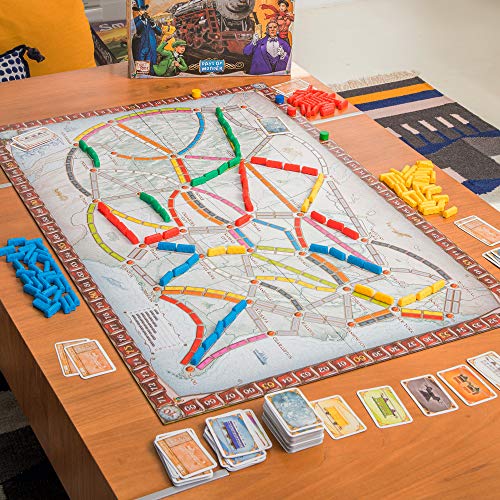
If you love games then you have to check out Ticket To Ride! This fast-paced board game will give you hours of fun with family and friends as you gather train cars and try to take over the board!
Ticket To Ride has many different variations as well so you can play across a variety of different maps.
How To Play Monopoly
Monopoly normally can be played with two to eight players. Each player brings their own points of interest and downsides so it is imperative to know them before you choose what number of individuals are going to play.
When the game is played with two players, it is advised to up the number of players because of the nature and mechanics of the game. Toward the beginning of the game, the two players will start with the same assets, but it will change as they continue to make their way around the board.
When somebody lucks out or makes an extraordinary move, they for the most part dominate the match without an opportunity for their rival to make up for lost time. Try not to let this stop you however in the event that you just have two players.
Even with just two players, playing Monopoly can still be quite fun.
When it is played with three to five players, it is usually a fun interesting game as each player will have their own strategy to win the game. Some people want to purchase all the land, while others prefer to gather money, while some prefer to only buy the railroads and utilities.
No matter what your game plan is, we all know a game can last for a long time. Even with a lot of players the game can easily last for hours. Although the game lasting a long time might deter some people from playing, it actually makes other people play it as they are trying to pass a lot of time with one game.
When this game is played with six to eight players, it brings so much fun yet can have a couple of issues. As just a single individual can dominate the match, more players implies there will be more bankruptcies. Moreover, there is a more drawn out hold up between turns.
This isn’t a big issue as Monopoly gives you a bunch of choices you can do when it’s not your turn. This is why you should always be looking and watching the other players to make sure they are not making trades, giving money over to other players, or collecting rent.
If you are playing Monopoly, you will need to pay close attention to every turn, know what properties are yours, and know when someone lands on them.
This game is one designed to be naturally played with four to eight players. More youthful players may not appreciate the game on the off chance that they don’t care to lose as the game requires some methodology to win.
It is said to help new and youthful players by offering tips and selecting a more co-usable playstyle.
How To Set Up The Monopoly Board
First you will need to open up the Monopoly board and lay it on a level surface. Next, you will want to make sure that every player has enough space to keep their cash and property deeds in front of them.
You should likewise spread out the Chance and Community Chest cards on the board. They are set on opposite sides of the middle of the board. Normally their spots are marked on the board.
Next, each person needs to pick a game piece. Every player gets a game piece to move around the board. It doesn’t make a difference what piece you pick as they all work the same, and hold no value in the game.
Next, the bank will give every player $1500. Prior to the game starting. Most players like to keep their money and property in front of them, however you can store your cash any way you want to keep it. Players may likewise trade cash for various bills of a similar worth.
For instance, offering $500 to the bank in return for 5 $100s.
What happens next is to pick a banker. This player is responsible for all the cash, property, houses, hotels and all parts of the game.
Most of the time, this person will be a player of the game and have to keep their own affairs in order despite also doing everything with the bank.
The broker can, in any case, play the game, however, they should make sure their own cash is independent of the banks. If it is simpler, the banker can put the case where most players can reach, permitting individuals to grab cash, houses and properties, giving that they possibly do this when they’re permitted to.
This variation to play Monopoly in teams, makes the game all the more intriguing rather than less. Even though the number of players has doubled, the token remains the same, and the teams have to cooperate together to make the right choices.
Because there are so many decisions in the game and each team has to make those decisions together, it is a great way to learn about compromise and how to act in a situation where the teammate made the wrong decision.
What you just need to do in a monopoly with teams is just to apply the normal monopoly rules. Share cash with each player, and let them trade normally. The only obvious variant is that players would belong to teams and they can come to various agreements as to trade within themselves.
Even though we have seen that monopoly with teams can be very interesting, some might argue that it is not a good way to play. It all depends on your preference. Both monopoly variations are equally interesting.
Conclusion
Did someone tell you that Monopoly with teams is not possible? You now know what to tell them. Of course, Monopoly can be played with teams, and in teams.
Even though you might be playing with teams, the normal rules still apply. It is just that teams can make an agreement within themselves so as to foster their business and trade.
Monopoly with teams is just as fun. Though some people might say it is not, it all depends on your preference.
If you have never played Monopoly with teams before, you may want to consider trying it the next time you play the game as it adds a different effect to the game. Playing with teams is far more interesting, and overall is extremely fun.