
*This post may contain affiliate links. As an Amazon Associate we earn from qualifying purchases.
Have you ever been playing Rummikub and wished that there was a way to play with more than 4 players? Maybe you have heard some rumors about how you can do it, but you want to make sure the game still works if you do them.
Well, in this article we are going to talk about how you can play Rummikub with 5 or 6 players.
So how many people can play Rummikub?
The normal Rummikub game can be played with up to 4 players. You can play with up to 6 players if you purchase a 6-player Rummikub set (also known as Rummikub XP) or up to 8 people if you combine 2 Rummikub games.
Conceivably you could play Rummikub with more than 8 people however the tiles laid out on the table would make the game go a lot faster and would change the game to being a lot more about luck than about skill.
Say for example you are the first player to “get out” so you don’t have anyone to play on. By the time it gets back around to you the person before you could have 8 or more people’s tiles to play on. At that point, it just comes down to being lucky enough to get out at the right time.
If you want to play with more than 8 people in Rummikub I would recommend doing it tournament style. If you have ten people who want to play Rummikub then split it up into two rounds of five with the best 2 or 3 players moving on until finally, it is down to the single winner.
That will be far more exciting and will make the game less luck-based than it would be with 10+ players.
If you love board or card games then you have to check out the game called Throw Throw Burrito! It is a fun fast-paced game where you throw squishy burritos at other people you are playing with! You can learn more by clicking here.
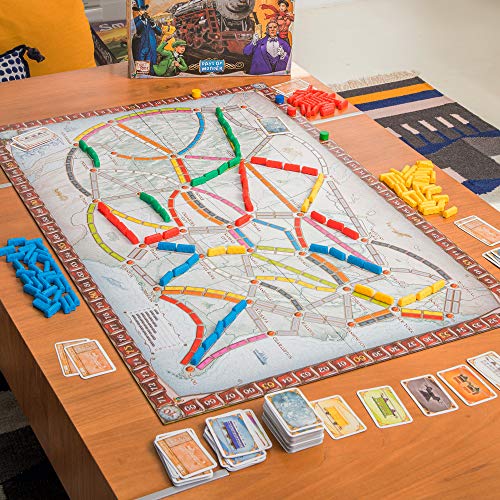
If you love games then you have to check out Ticket To Ride! This fast-paced board game will give you hours of fun with family and friends as you gather train cars and try to take over the board!
Ticket To Ride has many different variations as well so you can play across a variety of different maps.
How Many Tiles Do You Need When Playing Rummikub?
If you have two normal Rummikub games and want to play with 6 people you will want to remove some of the tiles as it will be far too many tiles otherwise. For up to 4 Rummikub players, you will need 106 tiles. For up to 6 Rummikub players, you will need 160 tiles. For up to 8 Rummikub players, you will need 212 tiles.
The 106 tiles for 4-player Rummikub consist of:
- 2 Joker tiles
- 2 sets of red 1-13 tiles
- 2 sets of blue 1-13 tiles
- 2 sets of black 1-13 tiles
- 2 sets of yellow 1-13 tiles
The 160 tiles needed for 6 players in Rummikub consist of:
- 4 Joker tiles
- 3 sets of red 1-13 tiles
- 3 sets of blue 1-13 tiles
- 3 sets of black 1-13 tiles
- 3 sets of yellow 1-13 tiles
The 212 tiles needed for 8 players in Rummikub consist of:
- 4 Joker tiles
- 4 sets of red 1-13 tiles
- 4 sets of blue 1-13 tiles
- 4 sets of black 1-13 tiles
- 4 sets of yellow 1-13 tiles
How To Play Rummikub With 6 Players
If you have 6 people who want to play Rummikub then you will have to either combine two full Rummikub games or purchase the new set of 6-player Rummikub. If you combine two games you will want to remove some of the tiles at set-up until you have 160 tiles with the correct sets of the different colors (as mentioned in the section above).
Once you have the correct number of tiles each person will begin to draw tiles from the pouch or table and put them on their racks. In both the 6-player version of Rummikub and when combining two different sets there will be enough racks where each person can have their own.
Once each player’s rack holds 14 tiles (how many you start each Rummikub game with) the setup if over and the gameplay begins.
To see who goes first each player will draw an additional tile and the person who has a tile with the highest value will go first. Play then begins and proceeds in a clockwise direction.
On their turn, the player can either play if they can “get out”, play on someone else’s tiles (if they have already played their initial meld), or draw a tile. The initial set that a person plays to “get out” must have a numerical value of the tiles of more than 30 points.
If a player cannot play on their turn the player draws and their turn is over. The player cannot play the tile that they just drew even if it plays with their other tiles or on the board.
They must wait until their next turn to play.
Each player takes a turn as the play proceeds around the table.
Some good strategy to use when playing Rummikub with 6 players is to not hold onto your high-value tiles if at all possible. Since you get a minus amount added to your score if someone else goes out before you you don’t want to end up with Jokers or other high-value tiles when the final tally is done.
Rummikub Scoring: How Does It Work?
Rummikub scoring is done the same way no matter if you are playing with 2 people or with 10 players. So at least you don’t have to learn anything new.
The only thing you will want to change when playing with a larger number of people is to change the winner’s total that is required to win the entire game. If you keep the total score to win at 300 when playing with 8 people you will likely surpass that in a single round which defeats the purpose.
How scoring works in Rummikub is the winner at the end of each round gets a plus amount added to their score which is a combination of the losers’ points that were left on their rack when the winner goes out. Each player adds up the tiles left on their rack and gets negative points that are equal to that total added to their score.
Say for example you are playing with 8 players and the 7 losers of a round had 30 points left on their rack. At the end of the first round, each of them would have a score of -20 while the winner would have a score of 140. The winner’s score from that round always equals the total of the minus scores from the losing players of the round.
As you can see the tile value that you keep on your rack matters quite a bit if you aren’t the one that happens to go out in a round. It should also be noted that Jokers have a penalty value of 30 points. So whatever you do, don’t keep a Joker on your rack as the game is winding down.
Once the score of that round is written down, the play proceeds to the next round with all of the tiles being mixed up and each player drawing 14 more tiles.
The rounds continue until a winner of the round surpasses the total score that is needed after adding in their score.
What Are The Different Versions Of Rummikub?
There are actually three different versions of the Rummikub game known worldwide. They are American, Sabra and International. Currently, modern Rummikub sets include only the Sabra version rules though.
Rummikub was invented by Ephraim Hertzano who was known to have made the first sets with his family in the backyard of his home. With time, Rummikub was licensed in other countries, and it became Israel’s game that sold the best via export.
In the year 1977, the game became a bestseller in the United States of America. Although very few people actually know this, back in the 1970’s Rummikub was actually called Rummikid.
Conclusion
Now that you know you can play Rummikub with 5, 6 (or more) players, you can go and enjoy this amazing game with more of your family and friends! Because the rules really do not change when you play with 5-8 players by adding a second game to the mix, many people are able to enjoy the game and have all of their family play at one time!
If you need to buy your second Rummikub game to add to your first game, this is the best place to get one.