
*This post may contain affiliate links. As an Amazon Associate we earn from qualifying purchases.
Have you been playing Atari recently, but can no longer find any of their consoles for sale? Maybe you heard a rumor that they are out of business, but that can’t be true. Well, in this article, we will go over everything you need to know about Atari and if it is still in business.
So did Atari go out of business?
Although Atari stopped making gaming consoles like they did originally, they are still in business, they just make different items than what they used to make. Today the Atari company is actually thriving with what they produce, and even recently put out an article that said they wanted to make a comeback in the gaming world.
If you want to know more about Atari and what their future plans are, you will want to keep reading. You can also watch this short video to learn all about Ataris history. You can also watch this short video to learn all about Atari and what they have done in the past as well as what they are doing today.
If you are an old-school Atari lover then you have to get a classic Atari T-Shirt to show it! To see the most popular Atari T-Shirt retro designs that will stay classics for years just click here.
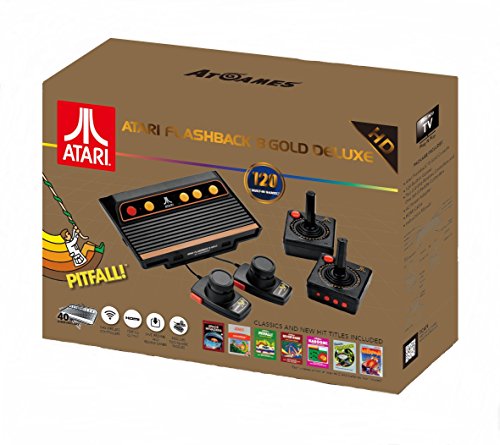
If you love all things Atari then you have to check out this awesome Atari Flashback console.
The Atari Flashback 8 comes with two wireless controllers (YES, WIRELESS!) two paddle controllers, and 120 authentic Atari games.
Where to start
The best place to start is where it all began. The Atari company was formed and founded in 1977 in partnership with Nutty Associates. They actually created the hardware components for the Atari consoles.
What is Atari doing today?
While Atari has been out of the media and off to the sidelines the last few years. A shocking announcement on their page suggests that they have big plans in the works. This announcement has made many people curious about what Atari has up its sleeve. The company is keeping the lid on this one and all they are prepared to say is that some of the product lines will be sophisticated while others will be common. We cannot wait to see what the developers have come up with as they were known to be part of the cutting edge of the 70s’ and 80s’.
The rise and fall
It is a widely known fact that Atari filled a landfill with its consoles. Well, like all things in life progression is the only way forward. This is why old ideas give birth to new imaginings.
One of the popularized re-imaginings is the ’70s and ’80s game that featured a sliding disc and a ball that you had to keep in motion. Although this game may have sounded simple, if you were not a pro you always lost.
You needed skill and determination to always win this game. This iconic game was then followed up by the other classic game called Space Invaders. So what is in store for the future of Atari? First, let’s find out how this company has made a come-back today.
1993, the end of an era.
A decade before the end of the company, the writing was already on the wall. It was the great video crash of the 80s that ultimately responcible for the fall of the Atari company. This was because video games took a turn in the late 80s early 90s to become more console-based.
It is confusing to think that Atari would fold as they were pioneers in the console world. With that being said, the company did make some poor investments. Following the cult film of the 80s E.T Atari and its partners threw enormous money in the development of the E.T game. Sadly though, this game was a major failure and left the company almost destitute. They even tried rebranding and then relaunching but at that point, the damage was already done.
This led to the company shares and stocks being sold and the company losing their main investors. This was the beginning of the end for the once iconic atari. To save face the company ultimately split up in two parts from the original Atari Inc to Atari Games Inc.
What does this mean for Atari’s future
In a recent statement made on the Atari website, it suggested that the company is set for a major comeback. If you were hoping for a new console, you will be sadly mistaken. The company announced that while the new product line will be innovative it won’t boast any new games or consoles.
The company is going in a new direction that is more involved in 21st century technologies such as voice and automation. This is very exciting news for those in the home and office fields. These technologies are reported to be the most cutting edge and on the forefront of technological innovation.
This is an amazing feat for a company that declared bankruptcy just a few short years ago. Evolution and growth are predicted to this company and like a Phoenix, it rises from its ashes.
Why is Atari so important today?
These corporations of the 80s are symbols for our generation. They act as beacons of beliefs for any person hoping to achieve their goals and visions. Anything is possible if you have enough determination and drive. We live in a world now where its instant gratification and who comments the most to show who and what is important. Today’s society is built on exposure.
Atari shows us that even catastrophic failures are new stepping stones to the beginning of something much greater. This giant has been around for almost four full decades and has no signs of slowing down any time soon. The future looks bright and will hopefully be paved with many Atari Apparel and voice services.
The tenacity the company has shown and the pure grit shows that this cpmpany will never give up no matter what is against it.
I know the name brings a lot of nostalgia along with it but that is what great brands are meant to do. They evoke an emotion that makes us feel more alive. The re-branding of the company is something that is extremely exciting, and something that makes the future of Atari very bright.
With the brand being so important in today’s society one thing is for sure; a four-decade-year-old company is not going anywhere and will continue to break barriers and boundaries of the past and bringing them into the future through innovation and bridging the gap of what was once believed to be impossible.
Conclusion
Now that you know that Atari is still around and is not going anywhere, you know what type of company it is. This is because Atari knows that no matter what happens, you do not give up on what things are important to you.
Even though Atari faced bankruptcy, they were still able to make a full come back. Even recently Atari has been creating Arcade 1Up machines that are a major hit and are selling out everywhere! These machines are ¾ scale arcade machines meant to be played in peoples homes and are only a couple hundred dollars. This is the best place to get your very own arcade 1Up machine.
There are many different arcade machine that you can choose from, depending upon what games you enjoy playing the most. These arcade machines are extremely afordable and make it possible for regular people to own their very own arcade machine! These machines have enables some people to have their very own arcade in their house that is full of these 1Up machines.
This type of innovation is what Atari has always had, and is continuing to use to show the competition what they are made of.