
*This post may contain affiliate links. As an Amazon Associate we earn from qualifying purchases.
Have you ever been playing pool and wondered if the pool balls ever needed replaced? Maybe you had been to a place that the pool balls were dirty, but you weren’t sure how old they were? Well, in this article we will go over everything you need to know about pool balls and if they get old.
So do pool balls get old?
Although pool balls are very strong, they do actually still age. Because they age, they also can begin to show wear and tear. Depending upon how often you play and how you take care of your pool balls, will depend how long they last and how long you can go until they should be replaced.
If you want to know more about pool balls getting old and when you should replace them, you will want to keep reading this article. You can also check out this video to learn about exactly what is in the middle of a pool ball.
If you are looking to get better at playing pool one of the best ways to do that is by upgrading your pool cue. One of my favorite cues is the Viking Valhalla. It is available in a variety of colors and won’t break the bank. You can find it by clicking here.
What is a pool ball?
First and foremost, we want to get to know what a pool ball is. A pool ball is a small, sturdy ball that is often used in cue games. Notable of a pool ball is the fact that it varies in specifications, the size, color, type differs according to the specific type of game it is being used to play. More so, we should also note that the lifespan of a pool ball depends upon its sturdiness, endurance, and also its friction characteristics.
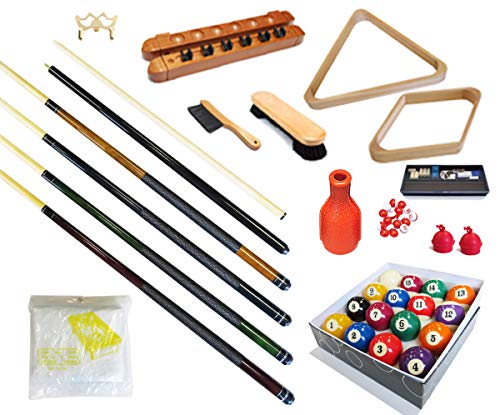
If you have a pool table then you need to get this accessory kit. It includes pool cues, extra pool balls, and all the gear you need to keep your pool table in tip-top shape.
If you are tired of your kids (or friends) ruining your good pool cue when they play then having these extra ones will keep that from happening (just be sure to hide your good one!).
What makes a pool ball get old?
Below we will go over everything you need to know about pool balls and what causes them to appear old, and begin to show use and age.
- Frequency of Play
Pool balls get old when played as many times as possible. The rate of play makes them lose sturdiness, and they thereby become small when compared to the other balls that are not played as frequently. Let me give an example. Let us assume we have three pool balls, and within a year we play one of those three balls far more frequently than the other two. The result is that the one we play more frequently would get older over those twelve months. Why does this happen? This is because we exert our touch, hit, friction, and stress on that ball more often than the other two.
Cue balls quickly come to mind at this point. If you make it a point of observation to take note of them, you would most likely observe that after frequent play, they begin to get old because of the constant friction and always being hit as they are used in playing games. The sticks hit them often; thereby, they begin to wear off and get smaller than ones that are not frequently played or are not even played at all.
So, we can see from our consideration of “frequency of play“ that pool balls get old from the simple economic “law of diminishing returns.”
What is the Law of Diminishing Returns?
It is an economic law that states that when something or someone has been in use for a reasonably long period, the efficiency and productivity of such thing or person reduces as time goes on. Likewise, pool balls, they also exhibit the result of the law of diminishing returns. When they are in use for a reasonably long period, they will get old from use and friction. The cue balls would not always continue to be resistant to strikes and hits as it would get weakened from frequent strikes. This repeated use and hits would, in turn, make the balls get softer and more tender as the components wear off.
Friction with Board Fabric
This subheading deals more with pool balls, which are, most of the time, passive and not really in use. Balls that are most times put on the board would get old from friction with the fabric. This is especially severe when the fabric is not cleaned.
The dirt from the material stays put on the body of the ball, and the ball not only wears off by gaining part of the fabric color, but it also wears off by acquiring the fabric’s dirt. So, a pool ball that is always left on the board gets old from friction and dust. From our exposition on how pool balls get old, we can see that it is inevitable for our pool balls to wear out as long as they are in use.
What is usually another striking cause of the ball gaining the fabric’s color apart from the friction with it? This comes into play when the fabric is made with a bleachable material that can rub off its color on another surface. This is why most times, you see a pool ball that is just placed on the board surface without any frequent movement or use to gain the color of the fabric.
What then happens when a pool ball wears off and gets old?
You would notice that such a ball would become a lot easier to draw but very difficult to follow. Also, the styles and design on the ball would fade off, and if you are on who studies that particular ball thoroughly, you would be able to tell such a ball, among others. When you are striking an old ball, it will reel off much faster than the others that are not as old, because it is much lighter and tender. Also, an old pool ball which does not quickly move other balls when used in games, as it has lost its sturdiness, weight, and quality due to wear off, is very visible and makes the newer balls more durable.
What then can you do to minimize your pool balls getting old in a short period of time?
It is no doubt that your pool balls would eventually wear off, but what can you do to prevent them from doing so within a short period? You should have a variety of pool balls at your disposal. By this, I mean, you should have a lot of pool ball sets so that you can interchange within weeks for use. You can do this by having five sets of pool balls, then you use a set for two weeks and change to another set, and go on in that manner. This way, you would be reducing the workload and friction on each ball set, as they would not be in use every time.
Conclusion
From this article, we now have the knowledge that pool balls get old, and this is due to friction and frequent usage. We also know that we can prevent this by getting a variety of pool balls. Although this will make the pool balls last longer, it is also expensive to have multiple sets of pool balls for one table. This is why most people will just play with one set until it needs replaced, and then purchase a new set of pool balls.
Many people find this far easier as they do not have to keep multiple sets around or purchase multiple sets when they first get their pool table. If you are looking for a new set of pool balls though, this is the best place to get them.