
*This post may contain affiliate links. As an Amazon Associate we earn from qualifying purchases.
Have you ever been to a pool hall and wondered if they make money? Maybe you noticed that there are not as many pool halls around anymore compared to what they used to be, so you wanted to know if they were making money.
Well, in this article we will go over everything you need to know about pool halls and if they make money.
So do pool halls make money?
Pool halls do in fact make money. Although a lot of pool halls have closed over the years, they only closed because the market for pool fell into a serious decline in the 90’s as more and more people began to game online. A pool hall today though can make as much as $200,000 in a month. It all depends upon overhead, sales, location, and many other factors.
If you want to know more about pool halls making money, you will want to keep reading this article.
If you are looking to get better at playing pool one of the best ways to do that is by upgrading your pool cue. One of my favorite cues is the Viking Valhalla. It is available in a variety of colors and won’t break the bank. You can find it by clicking here.
What Is A Pool Hall?
It is first of all important that we get to know what a pool hall is. A pool hall is a place where people go to play cue sports. These cue sports include carom billiards, snooker and the likes. It is sometimes called a pool room or pool club. Notable about most pool halls is the fact that they sell alcoholic beverages alongside their pooling ventures and they also most times add a bowling room to the pooling room. Most pool halls also incorporate football games, arcade games and some card games.
Now, how do we know that this venture is a profitable and lucrative one? Do pool halls make money from their ventures? Let us consider some peculiar features of the venture to ascertain its lucrative nature or not.
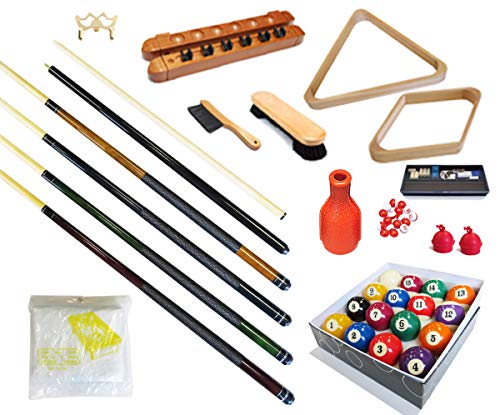
If you have a pool table then you need to get this accessory kit. It includes pool cues, extra pool balls, and all the gear you need to keep your pool table in tip-top shape.
If you are tired of your kids (or friends) ruining your good pool cue when they play then having these extra ones will keep that from happening (just be sure to hide your good one!).
How Do Pool Halls Charge?
In most recent times, pool table rentals charge $8 to $12 dollar per hour for a snooker table while they charge $6 to $10 per hour for an eight-ball table. That’s some cool cash, you would agree with me.
So, if you do your calculations correctly, if you have ten pool tables, you can earn as much as $200,000 in revenue a year. That’s quite lucrative!
Let us not also forget that pool halls most times combine other ventures like alcohol sale, football games and so many more.
Let us then do a kind of a rough sketch. If a pool hall has three football game arenas, it could make close to $90,000 from it yearly.
- Then, five arcade games, that could fetch more than $100,000 a year.
- Then, a dart hall which could bring in more than $30,000 a year.
- Then, a bowling arena which brings more than $40,000 a year.
- To top it all up, a bar which sells alcoholic beverages could take up more than $300,000 a year.
Do your calculations! From a realistic point of view, a pool hall could be making close to a whooping $700,000 per year. So, if you would ask me, I would say pool halls really make a lot of money.
The problem is, a whole lot of work is involved in starting it up. You are going to need between $10,000 to $50,000 to actually start it up.
So you need a substantive amount of cash and also time to devote to this venture to bring the best out of it and make it really lucrative.You will also need a great location, a large area, the money to buy all of the equipment, and then all of the money for advertising of your location.
All of this money will add up fast, and by the time it is said and done, you will probably be in the hole a whopping $100,000 before you even open your doors.
Logistics of a pool hall.
You then need to draw out key logistics and plans to make sure you pool house sells big. Let us look at some of the logistics you have to put in place.
Target Customers
You have to target the right customers for this business. You cannot go about advertising to people of all sorts, you have to streamline your advertisement to maximum productivity.
You have to look for people that have a lot of interest in pooling games, people that have a lot of interest in unwinding after the day’s work. You might also want to look for people with a lot of interest in games.
Also. people who like to visit the bar and also club at the tail end of the day.
Why is there the need for all of these specifications? It is because it is this set of persons that would sell your venture maximally, not only because they would pay but also because they have an interest, and would pay whatever is your asking price.
This is not to say you would not advertise to other sets of persons. You should because they would also patronise you in their free time. What the described set of people would give you is frequent patronage.
They would patronize you very often because they have an interest.
Location
Your pooling venture must be situated in an area more likely to attract people with interest in pooling and other related games. If you are going to set up your pooling venture in an area where people do not appreciate such, then you are not ready for sales.
You must be ready to target areas that would attract pool gamers. Likewise, people that love pleasure and fun. You might want to try targeting a youthful area, as youths are much more inclined to pleasure.
Therefore, good locations to set up include, strip joints, industrial parks and other industrialized locations in modern districts.
What are some major pitfalls of starting up your own pool hall?
Of course starting a pool hall is not all roses. There are certainly some things that you need to watch out for when considering opening a pool hall. Some common pitfalls are:
Not taking note of competitors
You must be well aware of the activities of your competitors in the pooling market. You cannot just afford to neglect their activities as this would tell on your sales. You have to take note of the improvements and subtractions made by competitors and improve on them.
Why is this so? It is because unknown to you, most of your customers actually visit all the pooling ventures in your axis and when they get better services than yours, they would leave you.
So you just have to be up to date.
Neglecting customer surveys
You must never underestimate the power and productivity of carrying out customer surveys. Why are they important? This is because they help to get a better view of what your customers like and what they dislike. You get to know their standards in choosing a pooling service(s).
That would in turn always help you to meet the needs of your customers and reduce the risk of losing customers.
You might say, “ I have carried out a survey this year and I do not need another this year.” Let me get it to your notice that you are making a huge mistake. Why so?
Customers’ preferences always change. What they like today might be different from that of next week, so you have to be current about your surveys.
Conclusion
Now that you know that there is a lot of money that can be made by owning a pool hall, you probably want to go out and start your own. Although there is money to be made, there is also a lot of money to be lost by simply making one mistake.
This is why there are so many businesses that fail every year, and only a few that make it.