
*This post may contain affiliate links. As an Amazon Associate we earn from qualifying purchases.
Have you ever on the pool table but you wanted to make sure that everything was in good condition before you sold it? maybe you replace the felt but you were not sure if the bumpers of the pool table ever went bad. Well in this article we will go over everything you need to know about pool table bumpers and if they go bad.
So do pool table bumpers go bad?
If you perform proper maintenance on your pool table and do not allow it to get wet or damaged then the pool table bumpers will last as long as the pool table itself last. If you have a cheaper pool table though it is possible that the bumpers will not last very long and they will need replaced at some point.
Do you want to know more about pool table bumpers and how long they last you will want to keep reading this article.
If you are looking to get better at playing pool one of the best ways to do that is by upgrading your pool cue. One of my favorite cues is the Viking Valhalla. It is available in a variety of colors and won’t break the bank. You can find it by clicking here.
Is a pool table important to play pool?
A pool table is one of the most important parts of the pool game. Without a table, it is not possible to play a pool game. The wooden pieces that surround the area of the pool table are called pool table bumpers. They are also known as table rail or cushion. It is a piece of rubber as well. Although they generally last for twenty to twenty-five years, that can be extended or Pool balls bump on to the bumper at the time of playing.
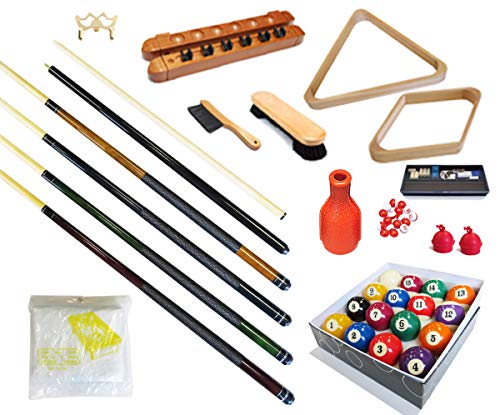
If you have a pool table then you need to get this accessory kit. It includes pool cues, extra pool balls, and all the gear you need to keep your pool table in tip-top shape.
If you are tired of your kids (or friends) ruining your good pool cue when they play then having these extra ones will keep that from happening (just be sure to hide your good one!).
Importance of table bumpers
Pool table bumpers are an important part of pool tables. They are made of vulcanized rubber. Vulcanized rubber is a special type of rubber that is prepared with a mixture of sulfur. It is more durable as well. It is very important to bump a pool cue ball during playing. As the bumper do that job, it becomes easier to play a pool game. Even, the objective of the bumper is to rebound the pool balls. Thus, the pool cue balls get their kinetic energy returns. As a result, the ball will bounce off at the same speed that is provided.
It never restrains the speed of the ball. That’s why table bumper causes a great effect on pool games. For this, the quality of the table should also be good. There are several types of bumpers available such as K55, K66, U23, U56 and so on. Including them, K66 is the best because of its quality. But nowadays, because of the industrial trickery, table bumpers are prepared weaker in the configuration. This is not a good sign. It will reduce the significance of the performance of the table bumper.
Do pool table bumpers go bad?
A Pool table bumper is a piece of rubber that bumps the pool cue balls at the time of playing. It rebounds the pool balls and provides similar kinetic energy. It never becomes an obstacle against the speed of the ball. That’s why it makes easier to play a pool game. But it also goes bad. I can mention the manufacturing problem as a reason. It is much needed to prepare a bumper using the right elements.
Vulcanized rubber is the key material to build a table bumper. For industrial trickery, manufacturers are using some cheap materials to prepare a table bumper. That’s why it goes bad earlier compared to recent years. It also goes bad, if it is hit badly by any solid things, except the pool game materials. The table and its bumper need to wash properly with a proper dusting agent. If anybody ignores doing that, their table bumper will go bad. Even, for using glass cleaner and ammonia type products, your table bumper will also go bad. Besides this, the lack of proper maintenance may cause harm to the table bumpers. At that time table, the bumper will go bad. That’s why it is important to cover the table while you are not playing.
The most common reason for which the table and its bumper get ruined is damaged cloth, and liquid spills. Because of the careless players, table bumpers will sometimes get wet. Sometimes soft drink also falls on the table. That’s why it also gets damaged. The quality of cue balls is also responsible for the damage. If it is not good in quality, then it may hit onto the bumper and it will get ruined. Moving a table by carrying the table by the bumpers is another thing that will cause damage.
Lack of lighting is also responsible. But it is an indirect fact. For the lack of proper lighting, players will not be able to see the game area properly and may cause any harm to their table bumpers. You should also care about the extra damaging materials. If there is something in the table pocket, it will get connected with the ball when the ball goes inside the pocket. After that this ball will cause damage to the bumpers as well. Moreover, it is easy to detect whether your table bumper is gone bad or not. If it goes bad, it will not provide enough bump. As a result, your ball will not get adequate kinetic energy and will not run properly. At that time, you may hear some “thudding” noise. Thus, you can detect whether it has gone bad or not. In a word, it can be said that a table bumper will go bad for several reasons from manufacturing to careless efforts.
Replacing a table bumper
It is very important to have a good table bumper for playing a pool game. This is because without a good one, it is not possible to play properly. That’s why, when a table bumper goes bad, you need to replace it with a good one. For replacing you may need to undergo some important steps, But at first, be sure all the necessary supplies are available to you.
The important supplies are listed below. New bumpers, adhesive, staples and staple gun, Rail felt, and facings. After having them, you can replace your table bumper with the newest one. To do this, you need to remove the feather stick, remove the felt cloth, and stapes. You can use a scraper to displace any extra glue. By doing this, you can dislodge the older bumper.
Now for attaching a new bumper, you need to glue on new rubber bumpers, cut the bumper to length, attach rubber ends, and staple new clothes over the bumper. Thus, you will be able to replace the worn-out bumper with a new and good one.
Conclusion
The table is an essential part of the pool game. On top of that, a table bumper is a crucial part of the pool table. The importance of the table bumpers to play the pool game is pretty obvious. This is because nothing can last forever, table bumpers also go bad for many different reasons.
Reasons vary from manufacturing to others. Causing thud sound a table bumper stops to work properly. By simply following some crucial steps, we can replace a table bumper with a new one. We also can keep our current one enough good from getting damaged as much as possible.
Now that you know how to replace your pool table bumpers if they go bad as well as what causes them to go bad you can be sure to keep your pool table bumpers in good working order. You will want to do this so that way you can always play pool whenever you want and not worry about the table being damaged.