
*This post may contain affiliate links. As an Amazon Associate we earn from qualifying purchases.
If you need more excitement in music, you can enjoy a significant amount of deep and punchy bass while listening to music. Bass will add some nice sound quality to any music that you are listening to.
If you have a record player though you might be wondering if record players even have bass?
Record players do have bass but how much is normally determined by the speakers and other portions of the player. If you have a cheap record player with built in speakers you will have much less bass than on a player with connected high quality speakers.
Bass is something that some people prefer a small amount of while others love listening to their music with the bass turned all the way up! How much bass you want your music to have is a very personal opinion and can even vary depending on the situation.
For example, I love to listen to music in the car with the bass cranked all the way up, however when i’m listening to music in my house I just want it to be normal. That is why higher quality (and price) speakers will have a way for you to adjust the bass as a person’s preference can change quite often.
Do you love playing your vinyl records but your record player has seen better days? Well, you are in luck! There are tons of great record players that not only have great sound quality but also won’t break the bank. You can find them by clicking here.
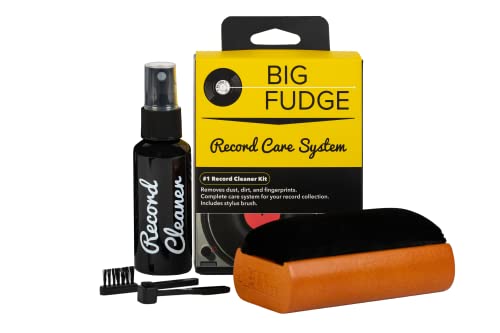
If you love records and record players, you must get a record-cleaning kit like this one. It is designed to ensure that your records stay in excellent condition to last you for decades.
Get this cleaning set and keep your vinyl records in perfect condition!
Balancing your sound
When you have bass in your music, you should make sure it is balanced between the sound level and the bass proportions to make the music balanced overall. Bass can make your music sound very nice but if it is overpowering it can be the only thing that you hear in the entire song.
Bass sounds the best when the ratio is perfect between the bass and other audio.
How to get more bass
If your record player isn’t putting out as much bass as you would like or you can’t hear the base at all then there are a few different things you can do to get more bass from your player.
#1. Increase the stylus tracking force
If your record player is adjustable, you should have access to change the tracking force of your stylus/needle. By changing the tracking force, you can adjust the weight of the stylus while it is reading the grooves. The range of tracking force varies from the stylus to stylus but the standard range is about 2.0 grams.
If you need more bass to your record, you can increase the tracking force and that should help but be careful that you don’t increase it too much.
If you increase the tracking force too much it can damage your records or could seriously shorten their life span.
You can increase the force by up to 20% more than it is normally set at. So if your player is normally at 2.0 grams then you can safely increase it to 2.4 grams without any issues.
When you increase the tracking force you should be able to notice an increase in the bass from your player. It is normally best to increase the tracking force a little at a time until you get the desired sound quality. Rather than just going straight to 2.4 grams you might go to 2.1 and see how it sounds first.
#2. Upgrade to a new cartridge
If you need extra bass sound, you might need to upgrade your cartridge. Each cartridge has a capacity limit to produce bass so if your player isn’t producing the bass that you want then upgrading to a higher quality cartridge or one that is specifically designed for more bass should help immensely. In most cases the more expensive the cartridge is, the better sound quality that your player will be able to produce.
#3. Upgrade your speakers
If after doing the first two steps if your bass hasn’t increased to a level that you like then it is time to look at upgrading your speakers. If you are just using the speakers that came with your record player than you will probably never be able to coax some great sound quality out of them. Also, just because your speakers are huge, that doesn’t mean that they are good quality.
There are obviously a lot of speakers on the market and deciding which ones are the best is virtually impossible. What I always do is go read the reviews on Amazon for bunch of different speakers that are designed to give the sound quality I’m looking for.
You don’t always get what you pay for with speakers but if you are paying $10 for a pair, don’t expect the sound quality to be very good.
Sometimes, people focus on size, not quality. The speakers that are designed for large amounts of bass don’t necessarily have good overall sound quality. Thus, the recommendation for you to make sure that the quality of the overall sound is good.
If you need mid-level bass, you can purchase standard speakers. If you want higher quality bass, you should purchase wide-ranged and more expensive speakers.
Most people don’t need that much bass so going with a high quality speaker will provide good sound quality and good bass as well.
#4. Use a subwoofer
If you set up a subwoofer with your record player, you can enjoy more bass in your music. You can also listen to music without bass if you want to simply by turning off your subwoofer. If a record or person prefers extra bass then you just have to turn it back on.
Since the subwoofer will normally come with an amplifier, it can produce a much tighter & deep bass sound. Thus, it would help if you upgraded your amplifier and the subwoofer if you want more bass.
Just as the case was with the speakers, the more expensive subwoofer doesn’t necessarily mean that it is better. I would recommend that you go with the middle of the road in regards to price as the high end one normally has you paying more because of the brand than the quality.
#5. Upgrade your platter mat
If you want to increase the turntable’s bass level, you need to upgrade the platter mat of your player. The platter mat is a mat made of rubber that can have the capacity to increase both the bass level and the audio performance of the record player. The easiest way to increase the bass and sound quality on your player is to upgrade the platter mat.
#6. Upgrade the receiver
If you need more bass from your records, then it is a good idea to upgrade to a stereo or receiver with tone controls. This will allow users to adjust their tone or volume level for bass, treble, etc. according to their needs. Of course this doesn’t add an unlimited amount of bass but it allows you to control the base you have.
You can adjust the bass based on your personal preferences or even when you change to a different record with more or less bass.
Upgrading your receiver to one that is adjustable is a great way to have more control over the bass that your player produces.
Conclusion
Record players do have bass but there are a few different things that you can do to increase the bass if you don’t like the amount of bass that your player or record has.
For most people, upgrading the speakers, receiver, and cartridge will have the best results but those are also the most expensive methods to increase the bass.
Only you can decide if the extra bass is worth the added cost of upgrading those items or if you just want to go with the cheaper upgrades and fixes and be happy with that.