
*This post may contain affiliate links. As an Amazon Associate we earn from qualifying purchases.
Record players are comprised of several components i.e. turntable, tonearm, platter, needle, amplifiers, speakers, etc. These components are delicately placed in order to make the record player work properly and produce as good of sound as possible.
But with time, or with the misuse, the turntable of a record player can become unbalanced. This can cause your record to skip or the music to not sound as good.
If your player is not level then there is also a possibility of your records getting damaged by the needle if it jumps out of the groove.
Now to the main question, do record players need to be level? Record players should always be kept as level as possible. That is true whether you are moving the player or playing records on it. If your record is only slightly off it shouldn’t cause any issues but if it is not level enough it can quickly cause problems.
Checking to make sure that your player is level is something that you should do every time you move the player. This also means that you should use your record player on a soft surface like a bed as when someone sits on the bed it could cause the player to get way off level.
This in turn could damage your record when the needle jumps out of the groove and skips across it. The best way to avoid this is to always keep your player flat.
Do you love playing your vinyl records but your record player has seen better days? Well, you are in luck! There are tons of great record players that not only have great sound quality but also won’t break the bank. You can find them by clicking here.
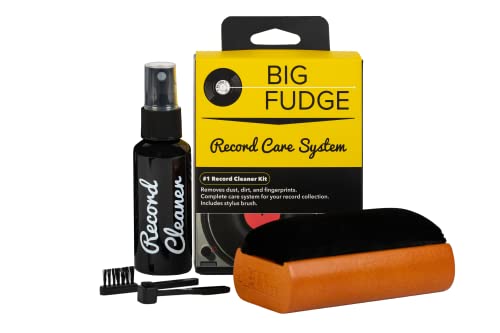
If you love records and record players, you must get a record-cleaning kit like this one. It is designed to ensure that your records stay in excellent condition to last you for decades.
Get this cleaning set and keep your vinyl records in perfect condition!
How To Tell If Your Record Player Is Level
If you are a beginner and are having trouble checking whether your record player is level or not you can do it just by listening to the music.
Check for any unevenness in sound or bumps on the rotating platter. If the platter is not spinning at its intended speed it means that you probably need to level your record player.
Since many modern versions have digital displays of speed too, accurate speed can be easily noted to check whether the rotation rate is accurate.
How To Level A Record Player
Even though we can find the latest record players with improved functionalities and features, maintenance and proper care is still required no matter the age of your player.
Sometimes, a newly bought record player needs adjustment before you even use it for the first time.
Leveling a record player is neither hard nor very time consuming. There are multiple ways, tools, and techniques to level your record player. Its leveling depends upon many factors such as the model of the record player, the person using it, etc.
There are several new techniques and small equipment on the market that can help in leveling your record player.
You can find a variety of precision bubble levels that are quite inexpensive but will allow you to keep your record player level all the time.
With the development of these types of inexpensive small adaptors, you do not need to learn any hard techniques or become an expert in platter leveling. Just put a simple auto-adjustable adaptor between the plinth and platter to keep your player balanced.
You can get a small spirit or bubble level tool to help to level your record player if you prefer instead. These will often look like a 2 foot or 4 foot level but just be much smaller.
The video below gives some great tips on how to properly level your record player’s platter. It is a pretty short video but chalked full of good advice.
New Record Player Leveling
There are some new record player models that can automatically adjust/level itself. These models have built-in auto adjustable platters so that you do not have to do any of the leveling yourself.
These designs may also have auto-adjustable feet that can be rotated to move the player up or down.
Also, some of the latest models have an auto-adjustable tonearm that handles the pressures by itself so you don’t have to manually adjust it.
Problems With Unleveled Record Players And How To Fix Them
Since a record player is a collection of multiple sensitive components, there are a lot of adjustment aspects. Not all players will require leveling however, a good knowledge of it can be beneficial if you discover that your player is not level.
Usually, a slightly uneven surface causes two problems.
Firstly, it causes the tonearm to fit incorrectly into grooves. As a result, the platter gets out of whack and will need to be balanced.
Secondly, the bearings holding the platter rotate unevenly. This can result in permanent damage to the record player because it changes the speed of the turntable.
These glitches can be resolved by placing your record player on an even surface or by moving it up or down a little using the above-mentioned methods. To prevent situations like these, it is always a good idea for your record player to have a separate place of its own so it does not have to be moved very often.
Another thing that will sometimes need adjusting is the tonearm. The tonearm operates at a specific pressure. If they have too much weight/pressure the sound from your records will become distorted.
This problem can only be solved by taking the time to adjust the tonearm so it is putting the correct amount of pressure onto the record.
The video below has some great information about setting up your turntable as well as how to adjust the tonearm properly.
Record Player’s Sensitivity
As mentioned before, these sensitive record players are prone to environmental maladies. They can get out of balance because of their constant vibrations and even when they are placed on a slightly crooked floor.
Therefore, some people have a set place that is checked and well-balanced that they leave their player at all the time. If you have the space and play records often then having a designated spot where your player is never moved is an excellent idea.
Does Leveling A Record Player Increase/Amplify The Sound?
You will notice a complete change in sound between a leveled and unbalanced record player.
It is a common myth that leveling increases/amplifies the sound but this is not true.
Leveling only places the platter in its original position therefore the only actual sound is heard that was expected of the record. This is the sound that was originally intended and will be of much better quality than the sound of an unbalanced player but it won’t be louder.
How Does A Record Player Work?
A turntable is a very delicate, fragile, and precise instrument therefore its adjustment is almost always necessary after you move it. Every turntable has a specific speed with which it is rotated.
The records and the needle from the cantilever or tonearm are designed in a way that they can be easily adjusted to fit perfectly in the grooves. Since these pits and bumps or grooves are incredibly small, the tip of the needle needs to hit exactly into them to produce the best quality sound.
Otherwise, a slight movement will cause the needle to hit other parts of the record which will result in the scratching of the record and a bad sound.
Conclusion
If you just bought a record player and got it home, before you play your first record it is important to make sure that it is level. Ideally your new player will be self leveling and you won’t have to do any of the work to get it level.
If your player isn’t self leveling then you should get a precision level to make sure you can get it as level as possible.
The last thing you want to do is have your new player damage your record collection because the player was never properly leveled.