
*This post may contain affiliate links. As an Amazon Associate we earn from qualifying purchases.
Have you ever wondered about playing during your turn when you play Rummikub? Maybe you want to know if you are required to play all the tiles you can on your turn. Well, in this article we will go over all the stuff you need to know about playing Rummikub.
So do you have to play if you can in Rummikub?
If you can play in Rummikub, you do not have to according to the rules. If you have more than one set in your hand and you want to hold onto it until the next round so you do not have to draw, you can.
However, If you wait to play too long and someone else goes out those points that you did not lay down will count against your final score of the round.
If you want to know more about the rules of Rummikub, you will want to keep reading. You can also check out this video to see exactly how to play Rummikub.
If you love board or card games then you have to check out the game called Throw Throw Burrito! It is a fun fast-paced game where you throw squishy burritos at other people you are playing with! You can learn more by clicking here.
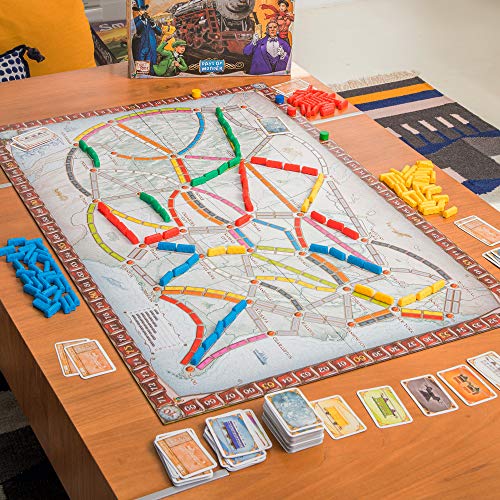
If you love games then you have to check out Ticket To Ride! This fast-paced board game will give you hours of fun with family and friends as you gather train cars and try to take over the board!
Ticket To Ride has many different variations as well so you can play across a variety of different maps.
Is Rummikub Fun?
Rummikub is one of the best tile based games in the world. This game is where you compete between 2-4 players. The game is basically a combination of two games known as Rummy and Mahjong.
Those who are an expert at these two games can easily outsmart their competitors. A lot of people think this game is more about luck and that there is very little skill involved in playing but that is not true.
The game actually involves quite a bit more than just luck. Even if you have all the “good” tiles, you can still lose the game. If you have skills but you don’t have great tiles on your rack, you can still win the game by paying attention and making smarter moves than everyone else.
The game is completely unpredictable and you have to understand that once people start to play, you cannot take a break for one minute. Once you have all the rules and regulations in your mind, you can play the game with confidence and can beat your opponents if you stay focused on what moves you plan on making on your turn.
If the pool runs out of the tiles, then you will have to play with the tiles you have on your rack.If there comes a point where no one is able to play anymore the person with the lowest total score on their rack is the winner.
Once one person lays down all of their tiles, everyone will have to count the score left on their rack. Any tiles left that you haven’t played yet will count as negative towards your score and the winner will get the sum of the negative points of the losers but a positive score.
In order to win, you will need the most points after a certain number of rounds or be the first to reach a specific point total.
Rules Of Rummikub
There are several rules that you will need to follow in order to make sure that you don’t make any mistakes during the game.
- Rummikub can be played with two to four players.
- There are a total of 106 tiles (including two jokers). Jokers are the special tiles of the game. These two tiles are worth 30 points at the end of the game if you have not played them.
- Before the game starts, one player shuffles all the tiles and then distributes them among the other players.
- The tiles consist of numbers 1-13 with 4 different colors (Red, Blue, Black and Orange)
- There are two main melds of the game known as sets and runs. A set means that you have three or four tiles that contain one number with different colors. The run means that you have numbers with sequences using the same colors.
- You can use the two jokers in one meld (although it isn’t a good idea) and you won’t want to keep the joker on your rack for very long. This is because if you are stuck with it when another player goes out, you will get a penalty of 30 points.
- At the end, the player with the highest score after a certain number of rounds or the first person to reach a predetermined score will win the game.
The objective of the game is to play all of your tiles as quickly as possible. If you are the first person out then you will get the total of the points that your opponents had left on their racks. If you are the loser of the round then any points remaining on your rack will get you negative points.
We all know that Rummy is similar to Rummikub. So, how about sharing the rules of Rummy? Below are the rules of Rummy so you can see the similarities between the two games.
Strategies To Win Rummikub
There are a few different strategies, tips and tricks that you can use to beat your opponents when you are playing Rummikub.
- Never celebrate your win before you make the final move. Things often change before it is your turn.
- Always look for any possibilities. You can use any of the tiles that are played on the table and sometimes you have to move a few different melds around to use the most tiles from your rack.
- Utilize your two minutes of time wisely. Whenever you make a move, make sure that you make the perfect one or ones for that turn.
- Play the joker as soon as you can but do it smartly. If you play it too early you are giving your opponents an advantage. If you play it too late it will add an extra 30 points negative to your score and 30 additional points to the winner’s.
- Good players are masters at splitting and manipulating the melds. Try to learn everything first by playing online or on a board practicing to see what you know before you challenge someone.
Conclusion
Now that you know the rules of Rummikub, you can clearly see that even if you have a tile that you can play, you are not required to play the tile. Many people use this strategy at the beginning of the game to play a couple rounds and not have to worry about drawing when everyone else is.
This can sometimes give a player a 3-4 tile lead depending upon how many matches the person has.
Even though there are similarities between Rummikub and Rummy, you can tell that they are not the same game.
This game has a championship in Israel, and they use every trick imaginable to play as well as get their opponent distracted from the game. They do this to try and win the game and the tournament.
Although you do not have to think very many moves ahead in Rummikub, you still do have to plan ahead to know what tiles you will play where on the table. Because this changes from person to person though, you will need to constantly be looking at the board trying to figure the best way to manipulate it.
Rummikub is a fun game, and it is loved by many people from all over the world. If you follow the rules of the game and do not cheat, Rummikub can be fun for everyone playing.