
*This post may contain affiliate links. As an Amazon Associate we earn from qualifying purchases.
Have you ever been playing pool and noticed that you were beginning to sweat? Maybe you are trying to lose some weight and you want to see how many calories you are burning by playing pool. Well, in this article, we will go over everything you need to know about playing pool and exactly how many calories it burns when you play.
So does playing pool burn calories?
Although there is not a lot of physical exercise with playing pool or much physical strength required, you will burn calories playing pool. The average pool player will burn around 200 calories an hour by simply playing pool. So the next time your wife asks what you are doing, you can simply say that you are exercising instead of playing pool.
If you want to know more about playing pool and burning calories, you will want to keep reading this article. You can also check out this video to learn all the official rules of playing pool.
If you are looking to get better at playing pool one of the best ways to do that is by upgrading your pool cue. One of my favorite cues is the Viking Valhalla. It is available in a variety of colors and won’t break the bank. You can find it by clicking here.
What is pool?
Pool is a game played indoors that is part of the cue games. It requires a table top, a pool cue and 16 balls in total, one being the cue ball with which to push the other 15 object balls into the ball pockets along the rails of the wooden cabinet. It is covered with a slab of pure slate either in one or three pieces and covered by a felt cloth usually green in colour to celebrate its history of being an outdoor game in the very beginning.
It used to have a lot of physical exertions in its older avatar as the game used to be played with huge mallets and balls much like croquet and that too outside in the garden. There was quite a bit of running and stretching and it quite possibly burned a lot of calories. While the exact specification is difficult to say, they must have lost quite a bit of calories playing the game like this. What about now though when the game has transferred inside?
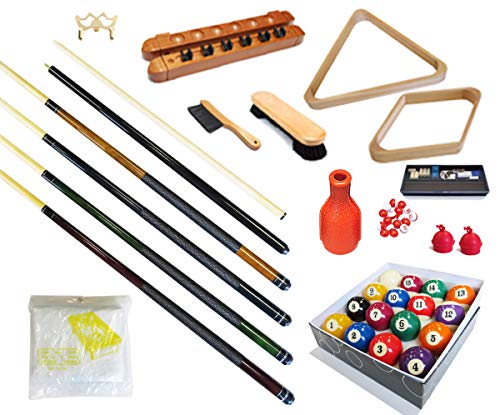
If you have a pool table then you need to get this accessory kit. It includes pool cues, extra pool balls, and all the gear you need to keep your pool table in tip-top shape.
If you are tired of your kids (or friends) ruining your good pool cue when they play then having these extra ones will keep that from happening (just be sure to hide your good one!).
How does playing pool burn calories?
Yes, playing pool does burn calories. There are movements in playing pool that put exertions on the human body that burn calories. By an estimate, when a person walks for an hour they lose 250 calories. By the same calculation a person will lose close to 200 calories by playing pool for the same period of time. There is not much running but there is an incredible amount of stretching that is normal to the human body.
This is why it is the stretches themselves that give the game the exercise that is responsible for the losing of a considerable amount of calories within a short amount of time. When one remembers that the stretching takes place during a very short amount of time as the players will want to stand just planning their game play. This is how you can burn off calories by playing pool, either as a novice or a professional.
How to burn calories playing pool
So, playing pool does burn off calories, but, how to do it precisely? The following are the ways in which both a player and a non player can burn off calories by playing or acting like playing pool.
- Walking
The sheer amount of walking that a player does while playing pool is really astounding. They keep on going around the table again and again trying to get the best angles and keep the calories off like this. They may round the table maybe even hundreds of times if they are a novice. So basically walk like a player because players walk a lot and lot around the table.
For non players, it is not necessary that you walk around a table to systemically copy the same effect. Simply walking a good enough distance is good enough for non players. Just keep the gait straight and the speed steady. When you are flushed with the endorphins and sweating like a pig, you will know that you are on the right track to lose the perfect amount of calories.
- Stretching
A pool player will stretch over the table, hovering without any support and sweat a drop here and one there and wipe it off in the televised events. A novice will struggle to hold their position without any support and will find it even more difficult to use the pool cue in such a situation. Strenuous action like that is wont to burn quite a bit of energy and calories.
For a non player, exercising with lots of stretches will have the same effect. Trying to touch the toes or the sole of the feet or even the ground while you are standing and doing it repeatedly will give one ample chance to lose a whole lot of calories. Keep at it and you will not only have lost quite a bit of weight but also have trimmed the muscles a bit as stretching tends to streamline the line of the muscles on different parts of the body.
- Aerobics
While not as apparent as the other two, aerobics is another sphere of exercise where a player excels at while playing pool. Aerobics is fast and fluid movement, usually with very positive music on. When a player does it there is certainly no music but there is that fluidity of motion as they go from standing to suddenly bending over the table at a drop of a pin. They do it so gracefully that it does not even catch the eyes.
For non players, they can go the traditional route with the classes showing on laptop or screening onto the TV and you dancing to the music very fluidly and effortlessly. Aerobics increases cardiovascular health, lowers blood pressure, regulates blood sugar, reduces chronic pain and asthma symptoms, and many many other things. All of these benefits are provided by the use of aerobics in daily life.
Conclusion
This is why it can be said that playing pool is a very good mode of exercise and people can pick up the cues from these players and exercise like them even if they don’t exactly play like them. So get on the health train. Exercise. Walk. Stretch. Do aerobics, and enjoy your own time while doing all of these and you will not only have a good body to show off you will have learned the work ethics of a pool player and seen just how hard they work at their games.
Although many people don’t think it, you now know that you can lose those extra calories by simply playing pool. You can also burn off that excess fat. If you use your time and your life opportunities well you will notice that over time you will begin to feel better.
This is why it is important to stay active throughout the day. Even though you may only be walking around instead of sitting on the couch, small little changes like this can greatly improve someone’s life. This is why people who play pool can be in great shape. Depending upon what they eat, they may also be in not so good of shape. No matter what shape they are in, if they are playing pool, they are burning calories.