
*This post may contain affiliate links. As an Amazon Associate we earn from qualifying purchases.
Have you ever been playing the Gameboy and wondered where the name came from? Maybe you heard a rumor about the Gameboys name and wanted to see if it’s true. Well, in this article, we will go over everything you need to know about the Gameboy.
So how did the Gameboy get its name?
Although most people do not know this, the Gameboy name wasn’t actually conceived by Shigesato Itoi and he has even said so himself.
Although the origins of the term Gameboy aren’t entirely clear many people believe it was a play on Sony’s popular Walkman name of that era. Since the Walkman was used for men who were walking, Nintendo named their game system for children the Gameboy.
If you want to know more about the Gameboy, you will want to keep reading. You can also watch this video to learn all about the Gameboy you will want to watch this video.
Are you a huge Nintendo fan? Then you have to check out the Mario and Nintendo gear that you can get. Whether you want a Mario wallet, a Nintendo sweatshirt, or a classic NES hat there are plenty of choices to choose from. You can find them all by clicking here.
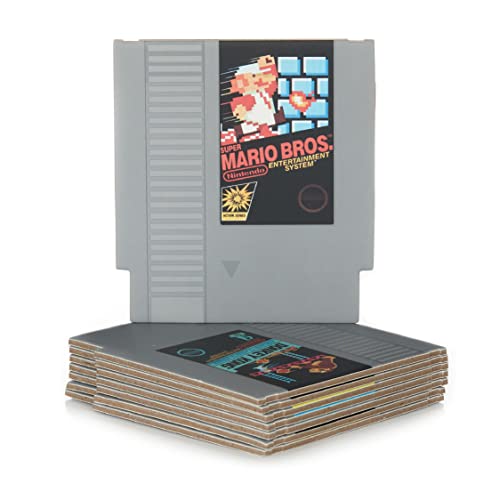
Do you love Nintendo? Then you have to check out this amazon NES cartridge drink coaster set!
This set includes 8 double sides drink coasters that look just like the classic NES cartridges.
This set is a perfect gift for the gamer in your life!
Is the Gameboy popular?
In this tech world of apps and iPads, there is an old portable game console known as the Gameboy. Many years ago, Nintendo released its first Gameboy in Japan, which caught the hearts of many people. A little later it was released in the United States and was a big success here as well.
This gaming console was fun for everyone to play from children, to teenagers, and even many adults as well. Actress Lisa Kudrow stated that she never left home without hers back in 2000. She was not the only one either. There were millions of people who would not leave home without their Gameboy.
About the Gameboy
Although the screen was tiny, the Gameboy was incredible and fun at the same time. The limited graphics and shades of grey made its dull, boring green background more appealing while you are playing it in a corner alone. The green colored screen made the games a little bit easier to see in different light as well.
Portable video games were not available when the Gameboy first launched. The Nintendo Gameboy was an outstanding console to help pass the time no matter where you were, but they were very limited in what you could do on them.
Although they were fun and cool for their time, today they are not very popular and do not even come close to being able to do what a simple phone can do.
The Nintendo Gameboy was a revolution at the time of its launch. Although the version looks so boring to you now, back then, it was the best of the best handheld gaming console for everyone!
It was unimaginable and incredible all rolled into a tiny gaming console. It was an ingenious gaming equivalent of the personal stereo. Nintendo really took their time in developing this device, and it clearly shows.
Do people still own Gameboys?
The Grandfather of the handheld video game world, the Nintendo Gameboy, came into existence over 25 years ago. Although not many people today have ever even seen the Gameboy and all that it has to offer, there are still quite a few of them still being played every single day all over the world.
The Gameboy was the most addicting device of its time. The portable, two-tone console initially invented the modern mobile gaming era when it hit the market in Japan on April 21, 1989.
The legacy created leaves a mark on every heart, no matter if you still have your Gameboy in your old dusty drawer or not. When it comes to portable handheld gaming, no other device could beat the mobile handheld gaming device by Nintendo. The Gameboy earned success by its functionality and addictive games that it offered.
Right after it made its debut in the market, this Gameboy was set to receive popularity and success as well. It destroyed other competitors and grabbed everyone along the way to success.
When the Gameboy was released, everyone was talking about it! Not only were they talking though, they were buying and playing games on it! Even today some people still play their Gameboy on a regular basis.
Hearing this brings many people back to their childhood where they would spend hours playing this device that today doesn’t seem special at all. Today, if a child looks at a Gameboy, they will probably not recognize it, but there is probably not one single adult that would not be able to remember the Gameboy and how fun it was to play.
Facts about the Gameboy
- Something about the Inventor
The legend who invented the Gameboy was known as Gunpei Yokoi. Before he created that Gameboy though, he was hired by Nintendo to do some simple maintenance work.
He tried to make the Gameboy in his free time while he normally built toys for kids. Everything in his life changed though when the president of Nintendo, Hiroshi Yamauchi, saw the toy he was making. He helped him turn it into the Gameboy.
This is how the Gameboy was invented by a lowly maintenance person.
- Most Expensive Game Boy
Back in 2006, Asprey’s of London offered a limited edition 18k gold plated Gameboy with diamonds that will cover the surroundings of the screen. The cost of this was $25,000. It weighed six times more than the original Game Boy.
- First Game you can play in Space
Yes, you read that right, you can bring the Gameboy into Space. An astronaut did just that back in 1993. Mr. Aleksandr A. Serebrov, at his visit to the MIR space station spent some of his time playing with the Gameboy.
He brought the Gameboy and in space played Tetris on it.
Both system and console were in orbit for 196 days. After his return to earth, from being around the World, he auctioned it off. No place can be lonely for you if you have a Gameboy with you.
- Creepy Camera
Do you know that you can buy a Gameboy Camera, which could be combined with the Gameboy Printer to become a walking photo studio? It is possible, but there are two things you might not know about this camera.
The first thing is that this is the smallest digital camera in the World. This camera was even featured In the Guinness Book of World Records.
Secondly, it has a haunted part. When the Gameboy camera came preloaded with little mini-games, sometimes a scary-looking face will show up. The notification would say “What are you running from?” Developers of the Gameboy were not able to solve this bug, so many people assumed that it was haunted!
- Gameboy or Gamegirl?
Despite its name, this device was the first game that targeted the male audience only. Back in 1995 though, half of Gameboy’s audience was actually the ladies. It was reported that females account for 46% of Gameboy’s consumers.
Some people even thought that Nintendo should change the name of the device, but they felt the Gameboy was the best name since it was already so well know so they kept it for multiple generations of the handheld console.
Conclusion
Now that you know how the Gameboy got its name, and how the inventor of the Gameboy was just a maintenance guy, you can clearly see why people say that if you put your mind to it, you can accomplish anything.
This is why many people create items that change the world!
If you knew that you could invent the next Gameboy, you might work a little harder at that project you have been working on, or that invention that you just started on.
No matter the reason, we can all agree that the Gameboy is the best handheld device that has ever been made!