
*This post may contain affiliate links. As an Amazon Associate we earn from qualifying purchases.
Did you recently find an old Gameboy and you wondered how much a game was for it? Maybe you are wondering if the games are cheaper today than when they were first released. Well, in this article we will go over everything you need to know about Gameboy games.
So how much did Gameboy games cost?
When the Gameboy originally released, the budget titles were $20, while most games were $30. If you wanted the best of the best games, the premium titles were around $40.
If you want to know more about the best Gameboy games ever made, you will want to keep reading. You can also watch this video to see the best Gameboy games of all time that you can own!
Are you a huge Nintendo fan? Then you have to check out the Mario and Nintendo gear that you can get. Whether you want a Mario wallet, a Nintendo sweatshirt, or a classic NES hat there are plenty of choices to choose from. You can find them all by clicking here.
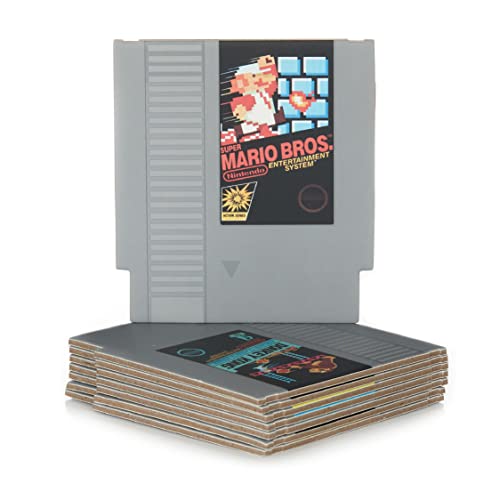
Do you love Nintendo? Then you have to check out this amazon NES cartridge drink coaster set!
This set includes 8 double sides drink coasters that look just like the classic NES cartridges.
This set is a perfect gift for the gamer in your life!
What is a Gameboy?
The Gameboy is an 8-bit console that was launched by Nintendo in 1989. A rare console that grabs the attention of game lovers everywhere. After this, the company expanded and released different handheld consoles like the Gameboy Color and the Gameboy Advance.
The very first original Gameboy was Nintendo’s second handheld console, which had a green dot-matrix screen along with several buttons on its body. This console was discontinued in 2003 but remained the favorite console of retro gaming geeks.
The Gameboy was an essential part of history as it leaves his marks on many people’s hearts by its addictive features and green display. It was a nostalgic handheld console for gamers. Addictive gameplay for the people who grew up in the 1980s and 1990s, the games for this console have become pretty collectible. Since this console came into existence about 30 years ago, not many people know about it today.
Rare Gameboy Games Prices
King James Bible ($662)
This one is one of the rarest games of the Nintendo Gameboy. It is an expensive game, as well. It isn’t a game; however, it’s a cartridge that allows the user to read the King James Version of the Bible.
It allows you to read you through different verses of the Bible whenever you want. Just this one game can be anywhere from $650-$1000
Knight’s Quest ($610)
In 1992 this Knight’s Quest Gameboy game was a fantasy RPG. In this gameplay, the player controls a brave character named Sir William. The leading knight tends to travel around the kingdom in a top-down view.
After the knight encounters an opponent, he must fight with the weapons that you can easily purchase from shops around the country. This game has become popular in recent years.
F1 Pole Position ($658)
Don’t get confused with the NES games. As these games are of the same Era. The game boy F! Pole Position was released in 1993. This game is based on the localization of Japanese game Nakajima Satoru F-1 Hero GB ’92: The Graded Driver.
In this game, players race around different tracks in an F1 car to reach the finish line first.
A scarce game, in which the Japanese stories are attached to it. Buying the cartridge only for this game is costly enough, but picking up the full game will cost you about $658.
Toxic Crusaders ($850)
Toxic Crusaders is known as the Side-scrolling, beat them up-style game that was released on the Gameboy, the Sega Genesis, and the NES exclusively in North America in 1992.
This game was based on the 1991 cartoon by the same name. This game was released in a single region. This game was also released on multiple consoles by selected retro game collectors.
Kid Dracula ($910)
Released in 1993, this Kid Dracula is a Gameboy game that was a sequel to the game Akumajō Special: Boku Dracula-Kun and is a gothic-themed platforming game. It was exclusively released on the Game Boy in Japan and North America.
Just the cartridge for this game will cost you around $100, which is pretty expensive.
Jimmy Connors Tennis ($1,337)
Sports-based games have been top-rated for a longer time. The sports games were released on almost every semi-modern game console.
Sealed Gameboy Games Recent Sales Prices
Like NES, the Gameboy has its fan following and market of Gameplays. We have compiled up a list of all the expensive Gameboy games with their cost.
Castlevania Adventure: $500
Pokemon Red: $188 – $450
Legend of Zelda: Link’s Awakening: $200 – $418
Mega Man: $325
Pokemon Blue: $158 – $305
Metroid II: $274
Pokemon Yellow: $172. $185, $193, $260 , $300
Double Dragon II: $218
Final Fantasy Legend III: $200
Micro Machines: $200
Tetris: $200
Terminator 2: Judgement Day: $149 – $200
Kirby’s Dream Land: $175
Super Mario Land: $140 – $150
Super Mario Land (Greatest Hits): $170
Teenage Mutant Ninja Turtles: $150
Pokemon Silver: $143
Super Mario Land 2: $103
Soccer Mania: $110
Additional Valuable Gameboy Games
Below are the games that aren’t rare, but are quite collectible; resulting in high resale value, especially for sealed copies. These were popular among most adults.
Felix the Cat: $20 – $50
Adventure of Lolo: $20 – $40
Gargoyle’s Quest: $20 – $20
Captain America: $19 – $30
Metroid II: $18 – $274
Kirby’s Dream Land 2: $17 – $46
Bomb Jack (PAL): $17 – $30
Stop That Roach: $16 – $190
Jeep Jamboree: $16 – $30
Spiritual Warfare: $15 – $30
Buster Bros: $14 – $18
Mega Man: Dr. Wily’s Revenge: $13 – $325
Sumo Fighter: $13 – $150
Final Fantasy Legend III: $11 – 200
Castlevania II: Belmont’s Revenge: $10 – $159
Mega Man II: $9 – $80
Mega Man III: $9 – $60
Cool World: $10 – $20
The Punisher: $9 – $61
Dragonheart: $9 – $15
Is Gameboy or Gameboy Advance better?
Although both are great Nintendo devices, some people prefer that original Gameboy over the Gameboy Advance. On the other hand, you have people that prefer the Gameboy Advance over the Gameboy and say that the Gameboy is old and outdated.
Well, if you think that newer is always better, than the Gameboy Advance is for you.
If you think that originals are better than remakes, then the Gameboy is the best console for you. No matter what console you choose, you are bound to have fun playing on it and playing all of the games for that device.
Conclusion
Now that you know all about the Gameboy and what games are actually valuable, you can search your collection and try to locate one or more of these games as they are so popular, as well as highly collectable.
Even though Gameboy games started as fairly inexpensive today they can sell for as high as a couple of thousand. The items that are collectors items, have become more and more scarce and have in turn made the prices go up.
Although there are some games that are expensive, there are many games that people have that are not that expensive. These games are the ones that most people own and that everyone loves to play.
The games for the Gameboy are very special and loved by so many people. The Gameboy has some great games as Nintendo does a great job caring about what games they release. The Nintendo Gameboy has many different games, and no matter which one you play, you will be able to have fun playing on them.