
*This post may contain affiliate links. As an Amazon Associate we earn from qualifying purchases.
Do you own an Atari, and have considered selling it if the price was right? Maybe your parents have a few of these old gaming consoles lying around the house and you are wondering if they are worth a small fortune.
Well if that is you then you are in the right place! In this article, I will give the current value for each type of Atari and then take a deeper look at each console’s value.
So how much is an Atari console worth?
Because every different Atari console has its different values, each one is worth a different amount. Here are the top models and what they are worth.
- The Atari 2600 sells for around $50-$60
- The Atari 5200 sells for between $80 and $150
- The Atari 7800 sells for between $100-$150
- The Atari XEGS sells for between $300-$500
- The Atari Jaguar sells for between $250-$500
One important thing that you have to watch out for is Atari has made many classic consoles that come preloaded with games.
Although it seems those would be worth more they are actually not so if you are looking at an Atari Flashback (the remakes) those are typically only worth $10-$30 in used condition.
The worth of an Atari will normally vary from model to model and also by overall condition. Another thing that will drastically affect the value of your system is the rarity of the included games. The prices mentioned above are for just the Atari consoles themselves so if you have some game cartridges that are incredibly rare you could have a truly valuable Atari on your hands.
For example, when it comes to Atari games a few of them are the veritable holy grail. The 10 most valuable Atari 2600 games are:
- Air Raid (worth $13,900)
- Red Sea Crossing (worth $13,800)
- Birthday Mania (worth $6,500)
- Gamma-Attack (worth $6,000)
- Karate Ultravision (worth $2,000)
- Pepsi Invaders (worth $800)
- Mangia (worth $700)
- Eli’s Ladder (worth $650)
- Lochjaw (worth $600)
- Gauntlet (worth $600)
In this article, we will try to shed some more light on the worth of each of these models so if you want to know more about all the Atari models and what they are worth, then you will want to keep reading.
You can also check out the video below if you prefer to learn that way.
If you are an old-school Atari lover then you have to get a classic Atari T-Shirt to show it! To see the most popular Atari T-Shirt retro designs that will stay classics for years just click here.
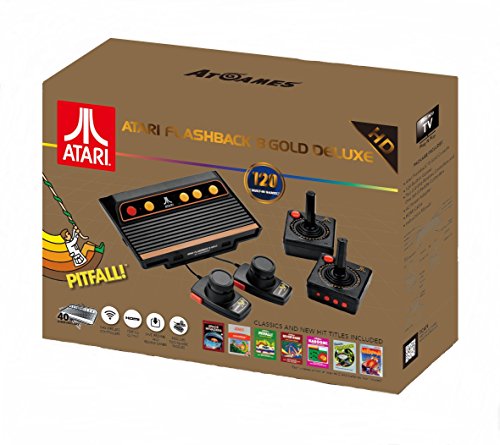
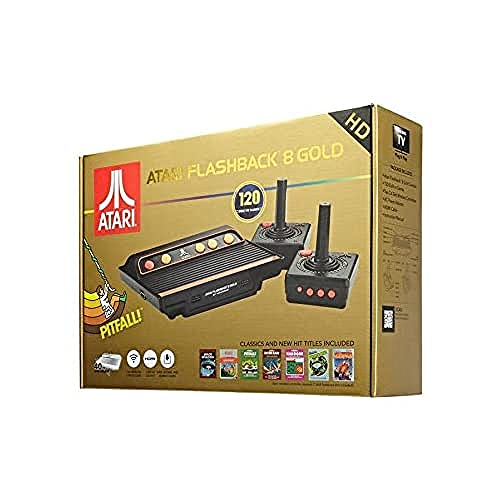
If you love all things Atari then you have to check out this awesome Atari Flashback console.
The Atari Flashback 8 comes with two wireless controllers (YES, WIRELESS!) two paddle controllers, and 120 authentic Atari games.
Atari 2600 Value (and recent sale prices)
This is a home video game console that was introduced and released on September 11, 1977, by Atari. This Atari has about 470 unique games that could be purchased for it however, the value of this console depends on the Atari 2600 model you have and more importantly what games are with it.
From its release in 1977 to its discontinuation in 1992, the Atari 2600 came in several models. The original six-switch woodgrain Atari 2600 generally fetches higher prices than the Atari 2600 Jr model which is in a smaller, all-plastic form.
There are a handful of other models that carry the 2600 signature including the four-switch “wood veneer” version, the all-black “Darth Vader” version, and myriad licensed clones from third-party manufacturers.
If you have a Four Switch Woodgrain console, an Atari 2600 Jr, or a “Darth Vader”, they’re worth approximately 30-50 dollars.
A Heavy Sixer is probably worth upwards of 60, whereas a Light Sixer will be about $40-$50.
Regardless of the version you have, the value is usually higher if the box is still in mint condition or if you have some rare games with it.
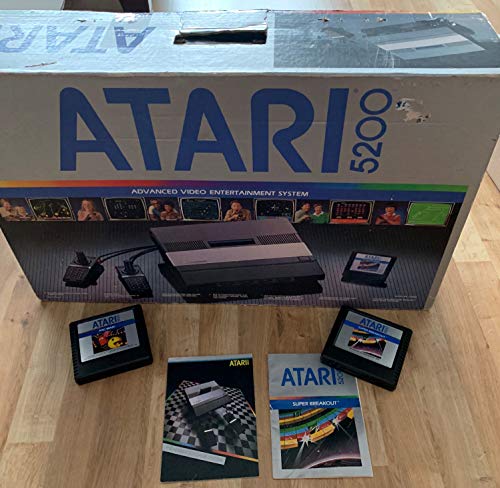
Atari 5200 Value (and recent sale prices)
This is a home video game console that was introduced in 1982, following the 2600 Atari version. This Atari was initially created to compete with Intellivision but ended up competing with ColecoVision.
The Atari 5200 was originally called the “Atari Video System X – Advanced Video Computer System” in its prototype stage and was codenamed “Pam” after a female employee at Atari, Inc.
It is also rumored that PAM actually stood for “Personal Arcade Machine”, as the majority of games for the system ended up being arcade conversions. It had several differences which made it distinctive from the other Atari.
These differences included:
- A lack of a computer keyboard
- The Atari computer’s 10 KB operating system was replaced with a simpler 2 KB “monitor program”.
- A number of important registers, such as those of the GTIA and POKEY chips, appear at different memory locations.
- The purpose of some registers changes slightly on the 5200.
- The 5200’s analog joysticks appear as pairs of paddles to the hardware, which required different input handling to the traditional digital joystick input on the Atari computers
On May 21, 1984, it was announced in a press conference to company executives that the Atari 5200 will be discontinued upon the release of the Atari 7800. The Atari 5200 cost about $269 in 1984. Atari sold over 1 million consoles before the 5200 was discontinued.
The value of the Atari 5200 varies depending on the condition and if you have any games for it.
The console by itself will typically sell for between $80-$150 with many consoles that are working but with nothing besides the console selling for around $100.
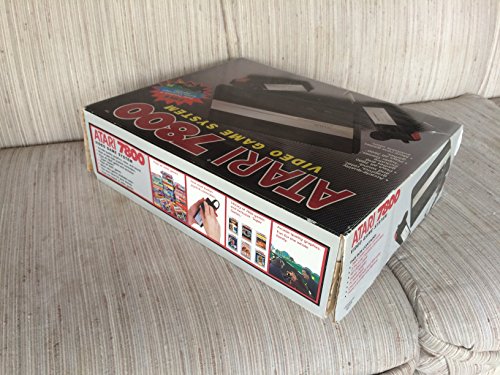
Atari 7800 Value (and recent sale prices)
This Atari is a home video game console that was introduced by Atari Inc. in 1986. It was the first console to have backward compatibility without using any additional modules.
The Atari 7800 ProSystem was the first console from Atari, Inc. designed by an outside company, General Computer Corporation (GCC).
The project was originally called the Atari 3600, but later changed to the 7800 before its release. The Atari 7800 introductory price was $140 which is equivalent to $327 today.
The Atari 7800 has a memory of 4KB RAM, 4KB BIOS ROM, 48KB Cartridge ROM Space, and a display of 160×240, 320×240 (160×288/320×288 if PAL), 25 on-screen colors out of possible 256. The graphics are a MARIA custom chip at 7.16 MHz. Even though it uses the same audio chips as the Atari 2600, it has significantly improved graphics over it. The Atari 7800 also has a different model of the joystick from 2600 and the media was stored in a ROM cartridge.
The 1986 launch is sometimes referred to as a “relaunch” because the Atari 7800 was originally announced on May 21, 1984, to replace Atari Inc.’s Atari 5200. Sadly due to low sales, the general release was stopped. The Atari 7800 was discontinued on January 1, 1992, and succeeded by Atari XEGS.
The value of the Atari 7800 varies based on condition and games just like any Atari console will.
The value of this console is normally $100-$150 for the console by itself in normal condition. Non-working models will still typically sell for $30-$50

Atari XEGS Value (and recent sale prices)
This is a home video game console that succeeded the Atari 7800. It was released in late 1987 by the Atari corporation. The introductory price was $159 which is $357 in today’s money.
The media is also stored in a ROM cartridge and has a memory of 64KB RAM with a display of 384 x 240 (overscan) 256 color palette.
The XEGS release was backed by new games, including Barnyard Blaster and Bug Hunt, plus cartridge ports of older games, such as Fight Night (Accolade, 1985), Lode Runner (Broderbund, 1983), Necromancer (Synapse Software, 1982), and Ballblazer (Lucasfilm Games, 1985).
This version was discontinued in 1992 along with the rest of Atari’s 8-bit computers as well as the Atari 2600 and Atari 7800.
This console is much rarer to find used so the prices for it are higher as well.
Typically you could expect to pay between $300-$500 for a used console with a few games but finding any of these consoles is rare which means the value can fluctuate a lot!
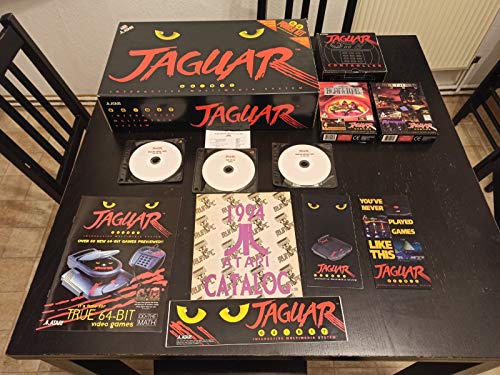
Atari Jaguar Value (and recent sale prices)
This is the final home video game released by the Atari company in November 1993. At its introduction, the Atari Jaguar cost $249.99 and about 250,000 units were sold before it was discontinued in 1996. The Atari Jaguar also had a ROM cartridge to store media with a memory of 2MB RAM. It also has an internal RAM cartridge storage.
Atari advertised the Jaguar as the first 64-bit video game console while competing with the existing 16-bit consoles (Sega Genesis and Super NES). The Atari Jaguar’s best-selling game was Alien VS Predator which had about 85,000 sales.
Atari attempted to extend the lifespan of the system with the Atari Jaguar CD add-on and marketed the Jaguar as a low-cost next-generation console, with a price that was over $100 less than any of its competitors.
However, when the Sega Saturn and Sony PlayStation were released in 1995, the sales of the Jaguar took a giant hit and continued to drop, ultimately selling no more than 250,000 units before it was discontinued in 1996.
On top of the financial crisis, the Jaguar had some technical difficulties as well. The Jaguar’s underlying hardware was crippled by a flaw in the CPU’s memory controller. This prevented code execution out of the RAM.
Other defects that were not really severe included a buggy UART. The memory controller flaw could have been mitigated by a mature code-development environment, to unburden the programmer from having to micromanage small chunks of code.
This commercial and technical breakdown affected Atari in such a tremendous manner and pushed Atari to leave the video game console market altogether so they haven’t created a new console since this one besides the Flashback models with preloaded games.
This console is typically worth $250-$500 but again it is far rarer than the older consoles so the value can change quickly and quite drastically depending on the condition as well as the games and accessories that are included.

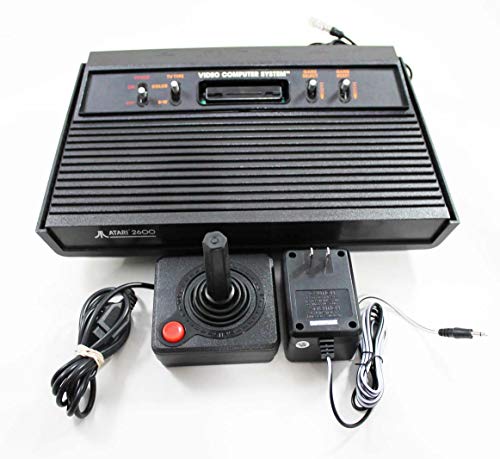
What Is The Value Of An Original Atari?
When you own an original Atari, knowing the value is extremely important, especially if you are a collector. It can even change your life if you are just cleaning out a basement and you find an old one.
The original Atari has sold recently for $30 for ones that are in rough condition and nearly $190 for ones that are like new in the box. The average sale price is around $100 for an original Atari with the box.
If you happen to find one of these games in your basement, you may be considering selling it to get some extra cash.
That is not a bad idea especially if you are being paid to clean out the basement and you can keep any items.
It would basically be just a bonus for you to sell this console and because it has some value, you would not even have to hold onto it for long in order to sell it.
The original Atari is still extremely popular for collectors as well as people who want to relive their childhood.
Many people want to own the original Atari just so they can play the games they grew up on, on the console that they have known since their childhood.
What Is The Most Valuable Atari Game?
If you have a bunch of Atari games sitting around, you may want to go through and look at all of the titles as some of these games can be worth a good amount of money.
Just how much money, you might wonder? It all depends on the title and the condition of the game.
The most valuable Atari game is Air Raid for the Atari 2600. This game without the box sells for over $3000 and if it is in the box, can sell for over $31,000!
This game was released by Men-A-Vision and has a very distinctive case with a blue ‘T’ shaped handle. There are believed to be only 2 of these games with the original box owned in the entire world. One of these two has the manual with it, and is believed to be the only one in the world with the manual as well as the box.
The purpose of the game was to protect the city from invading alien ships. You would do this by destroying the ships before they destroy the city.
This game was extremely fun to play and was extremely popular even though not many people owned it. If you were lucky enough to own one and you still have it, you may want to look into selling it as they can be quite valuable.
Why Are Atari Games So Cheap?
When looking at games for older collectible gaming systems, you have probably noticed that some of them are quite expensive while others of them seem to be fairly cheap.
What makes some games for consoles such as Nintendo so expensive while Atari games are so cheap?
Atari games are cheap today because they did not have any initial scarcity to cause the price to go up. Even today there are plenty of Atari games on the market as they do not break easily which keeps the prices for the games cheap.
Even though most Atari games are cheap, there are a few that are extremely valuable as there are only a few of each title known to exist. This is why many Nintendo games and consoles have become collectible items and are more valuable than Atari games and consoles even today.
Nintendo consoles and games normally have a scarcity at the beginning of their release and people will be able to sell these games and consoles for as much as 2-3 times as much as they originally paid for them.
This is not true with the Atari console as there has never been a scarcity for them, and most games are readily available today.
There are a few Atari games that are not readily available though, and those sell for quite a bit of money. These games include Air Raid, Red Sea Crossing, and many others.
Atari Games Values (How Much Are They Worth?)
Since Atari games range in value from worth just a few dollars to a few thousand dollars giving an exact price for the vintage Atari games can be difficult. On average, most Atari 2600 games will have a value of between $10-$20 dollars.
The only thing that will raise their prices higher than that is if they are still sealed and graded as that would make them a collectible item.
In the rest of this section, I will give some specific Atari games and what they are currently worth.
Atari 2600 Pac-Man Game Value
The Pac-Man game for the Atari 2600 is unfortunately not very valuable. The Pac-Man Atari 2600 game is only worth between $7-$15 even if it has the original box as well.
Atari 2600 Pong Game Value
The original Pong game for the Atari 2600 unfortunately is not very valuable either. Recent sales of the Ping game have sold for between $10 and $15.
The $15 sale was with the original box as well so if you don’t have the original packaging for your Pong game then it will likely sell for around $10.
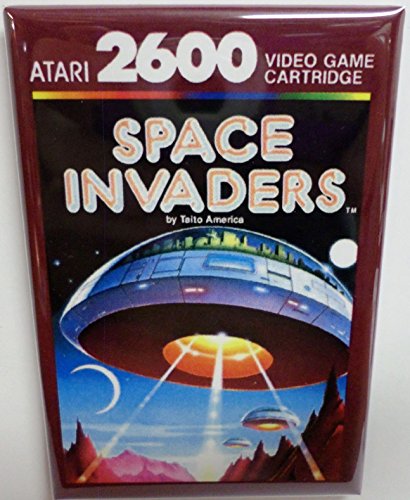
Atari 2600 Space Invaders Game Value
The Space Invaders game for the Atari 2600 has two different versions. The red box version is slightly more valuable than the black box version.
The red box Space Invaders game for the Atari 2600 is worth $40-50 if opened but if still sealed and graded it recently sold for over $300! The black box version of the Space Invaders game is only worth $10-$15 however.
Atari 2600 Asteroids Game Value
Another popular Atari 2600 game is Asteroids. But is this game very valuable?
The Asteroids game for the Atari 2600 is worth between $5 and $10. If it has the original box then it will be worth slightly more than that.
However, the recent sales prices of this game have been around the $5 mark WITH FREE SHIPPING. That means that the seller of those games only made a dollar or two after paying the shipping cost.
Atari 2600 Combat Game Value
The Combat game come out for the Atari 2600 in 1977 but how much is it worth almost 50 years later?
The Combat game for the Atari 2600 is worth approximately $8-$10 even if it is complete with the box. It would be worth more if still sealed and graded, however.
Despite this game being incredibly popular and fun to play it isn’t currently very valuable.
Atari 2600 Pitfall Game Value
The Pitfall game for the Atari 2600 was released in 1982. The Pitfall game currently has a value of between $8 and $15 based on recent sales.
Despite being a popular game it just isn’t worth that much. Matter of fact, the Pitfall 2 game is worth considerably more than the original Pitfall game.
Atari 2600 Pitfall 2 Game Value
Although it is surprising the Pitfall 2 game for the Atari 2600 actually sells for more than the first one. The Pitfall 2 game for the Atari 2600 is worth between $20 and $70.
Just the game cartridge of Pitfall 2 is worth $20 where if you have the instruction booklet or box it is worth $70 or more (depending on condition).
Atari 2600 Adventure Game Value
The Adventure game for the Atari 2600 was released in 1980. despite being over 40 years old this game is surprisingly not very valuable.
The Adventure game for the Atari 2600 is worth between $15 and $30. Just the cartridge for the Adventure game sells for $15 while if you have the box and the game it is worth $30.
Atari 2600 Frogger Game Value
Who doesn’t love playing Frogger? Well it’s hard to believe but there was actually a Frogger game for the Atari 2600. But how much is it worth?
The Frogger game for the Atari 2600 is worth between $8-$12 for the cartridge. If you have the original box as well as the game it is worth between $25-$30.
Atari 2600 Ms. Pac-Man Game Value
Ms. Pac-Man was released for the Atari 2600 in 1981.
The Ms/ Pac-Man game is worth around $10 when it is just the cartridge. If the game is in the original box it is worth $40-$50.
As with pretty much all of the other Atari 2600 games the more of the original things you have with it the more valuable it is. If you have the original box and everything that came with the package originally it will be worth more than just having the game cartridge.
Atari 2600 River Raid Game Value
The River Raid game was released in 1982. But how much is this game worth?
The River Raid game for the Atari 2600 is worth $10-$20 depending on the condition and whether it is in the original box. Even in the original packaging it is only worth $20 though.
Atari 2600 Atlantis Game Value
The Atari 2600 Atlantis game was released in 1982. However it is not very valuable at all.
The Atlantis game for the Atari 2600 is only worth between $5 and $10. That pricing is with shipping so after subtracing the cost of shipping the real value of the Atlantis game is only $3-$8.
Pretty sad that such an amazing retro game doesn’t have much value.

Will The Atari 2600 Work On A Modern TV?
If you have an Atari 2600 and you still like to play the old school games you are probably wondering if you have to have an older TV to play it on.
After all, the newer TVs only have HDMI ports and are not made the same as the older TVs that the Atari 2600 was made to work with.
The Atari 2600 will work on a modern TV if you have an adapter. These adapters are normally just a few bucks and work extremely well.
If you do not want to use an adapter or deal with purchasing one you can also just purchase the Atari 2600 flashback console. These consoles plug into a modern TV using an HDMI port and come preloaded with different games that were popular for the Atari 2600.
If you prefer the feel of the original Atari 2600 gaming console you will need an adapter if you want to play it on a modern TV. You can purchase an adapter for your Atari 2600 by clicking here.
Once you receive your adapter in the mail all you need to do is simply plug your adapter into your Atari 2600 and plug the other end into your TV. There are no special instructions to set up your Atari with this new adapter.
Which Atari Flashback Console Is The Best?
Because there are so many people that like the original Atari console when they were remaking it they made quite a few different flashback versions. Each version comes with different games which makes every version of the flashback different.
The Atari Flashback 9 is the best Atari Flashback console! This console comes with two wired controllers and 110 classic games!
One of the biggest advantages of having an Atari Flashback console rather than the original console is the fact that they plug directly into a modern TV without any issues. The other big advantage is that they have over 100 games pre-loaded onto the console when you buy it.
The Atari Flashback 9 has all of the top games as well as a bunch of games that you may have forgotten about but are extremely fun to play. It is the most sold Atari Flashback that has been created.
Although you can buy an Atari Flashback 9 in most stores such as Walmart, they are normally cheaper online. You can purchase an Atari Flashback 9 by clicking here.
Conclusion
Now that you know the value of the different Atari models, you can make an informed decision on if you should get one to sell, or you should sell the one you have been holding on to.
Ultimately they aren’t making any more of these classic consoles so it’s possible that the value of the rare models will continue to go up.
The Atari Flashbacks have taken a good amount of the market since they are quite cheap so if Atari releases a Flashback for the rare consoles it could actually hurt the value of those consoles as well.
No one knows the future but if you have a rare console and don’t ever play it anymore it might be worthwhile to sell it and get the cash!