
*This post may contain affiliate links. As an Amazon Associate we earn from qualifying purchases.
Do you own an Atari and wondered how their games were even programmed? With the console being so old, programming was fairly new, and the Atari was no exception. So if you want to know about the Atari and how it worked, you will want to keep reading.
So how were Atari games programmed?
Although the answer could be very complex, the simple answer is that the programmers used a series of 0’s and 1’s in the form of binary features to program the Arati games.
If you want to know more in depth about how the Atari games and the Atari are programmed, you will want to keep reading. You can also watch this video to learn how to program you very own Atari game!
If you are an old-school Atari lover then you have to get a classic Atari T-Shirt to show it! To see the most popular Atari T-Shirt retro designs that will stay classics for years just click here.
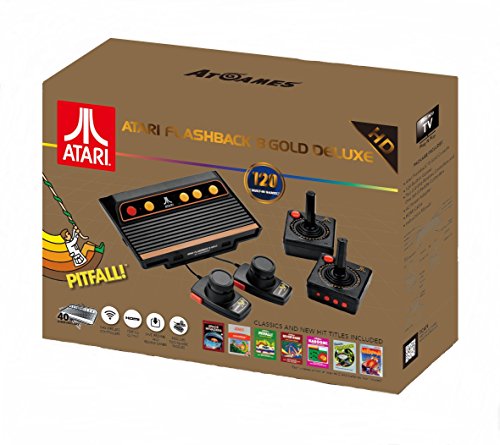
If you love all things Atari then you have to check out this awesome Atari Flashback console.
The Atari Flashback 8 comes with two wireless controllers (YES, WIRELESS!) two paddle controllers, and 120 authentic Atari games.
History of Atari
The Atari was originally released in 1977. This was the most popular and widely used video gaming console of its time! The first Atari game is pong which is gaining popularity due to its advanced and beneficial features. Other popular Atari games include PacMan and Space Invaders.
Programming of the Atari games or the Atari 2600
The first step is the installment of 000001010 00101000 00000000 1100101. This code of 0’s and 1’s is in the form of binary representation. The development and programming of the Atari can be done by following the following steps. For this purpose, multiple tools, sample codes, and documents are used. For programming, you must be aware of the general procedure of programming, execution, etc.
CENTRAL PROCESSING UNIT
The CPU utilizes the different kinds of processors like Apple, Nintendo NES, and home computer of Atari. They are applicable to approximately all types of machines because their manufacturing is less expensive. In addition to being less expensive, they have a very effective and simple procedure of programming. In this programming, we need to program 6502 microprocessors.
MEMORY
If the availability of RAM AND ROM is not sufficient for programming then you need to buy additional storage devices which can be a bit expensive. The overall ram of the Atari is 128 bytes while the ROM is 4K so these spaces are not normally sufficient. So for this purpose harmony cartridges are necessary.
INPUT AND OUTPUT
The input and output can be done by using the joystick, paddle controllers, and controlling various switches and buttons of the console for the input and output functioning.
Display regions
There are six different display regions we will outline below.
- PROGRAMMING
In this category you can also instruct your computer stacking region
- Computer Stacking Region
In this category you can get temporary results from your current programming
- UTILIZATION OF VARIABLES
In this region you can use the variable items for the programming of your Atari game.
- OUTPUT REGION
In this category you get the outcome of your executing program by running your console or pc.
- THE STATUS
This region shows how much memory is needed or available during the process of programming
- GRAPHICAL REGION
Two-colored squares are available in graphical representation.
Source code
The source code consists of several text files. These files can be created with the help of tools and graphics. In these text files, a number of instructions and commands are mentioned for making and programming of games. After that you will need to convert the instructive data into binary data. The transformation can be done by using the assembler. This data can be stored in the form in the cartridge of the ROM.
Text editor
For the alteration and edition in the source code for this purpose, you need a text editor. If you want, you can also choose another editor mode instead of a text editor. Different packages are available according to features and facilitate in developing. After the alteration, the speed of Atari consoles is much faster than before. You can easily play the games in a short duration. In the case of developing studio integration you just need to double click on the error then the editor automatically works on the error and resolving it.
Assembler
The assembler plays an important role when it is used for the transferring of source code into binary formation. For this reason, the perfect assembler is necessary. It is necessary because it does the conversion of the source code into binary format efficiently. The most popular and widely used assembler is DASM. This assembler was first introduced in 1988 and processed by Matt Dillon. This assembler is available online so it’s the first choice of every to use and get benefits free of cost. All the information of using and execution are mentioned in the assembler.
Emulator
For the quick procedure, the first step is building the binary image. Secondly, you can convert the binary format into EPROM. The next step is executing the EPROM on the cartridge of Atari. Then you can easily plugin it into the Atari game console.
Nowadays the highly recommended 2600 emulator is widely used for this purpose. If you have an error or issue, you will need to go back to the source and correct them. After that the whole process is repeating like conversion of source code into binary through the assembler then applying it to the emulator.
What is the best emulator out there?
There are several emulators available in the market but the most popular are the following.
STELLA Z 26 -this is an excellent and efficient working emulator for programming and other functions. According to a survey they are highly recommended and error-free in performance. So after the emulation, the next step of programming proceedings of documentation and sources where you get information.
Documentation
After the completion of the above mentioned procedure, the next step is the documentation. For this purpose the complete guideline of Atari hardware and software is necessary. You will also need the specification of the Atari’s different types of models like the Atari 2600, Atari 5200, Atari 800 etc.
Guidelines of steller program
The guideline can be available in two forms which are HTML version and PDF version. If you want to execute another language like PHP, C++ then you need to learn different modes.
Overall summary of programming
Here I summarize the complete procedure of programming and developing of an Atari game. The procedure can be completed in the following steps.
- The first step is editing in your text file according to your choice
- Secondly, you need to convert source code into the binary format by utilizing the best and excellent performing assembler. For this purpose DASM is highly recommended and popular
- Thirdly, you need an efficient and quick emulator for this purpose mostly because people use the Z 26 and Stella.
- PROGRAMMING GUIDELINE FOR STELLA- after that, all you need to do is to learn all the language associated with Stella then execute it.
Conclusion
Hopefully now you have a better understanding of how the Atari games are programmed. No matter if you are just starting out, or if you have already programmed before, the Atari is a great way to begin to learn. If you like playing the Atari games, then once you finish coding your game, you should be able to play it and test it out.