
*This post may contain affiliate links. As an Amazon Associate we earn from qualifying purchases.
Have you ever been playing on a pool table and realized that what you were playing on was not slate? Maybe you didn’t realize that there are pool tables made out of more materials than slate. Well in this article we will go over everything you need to know about pool tables and what they are made out of.
So if a pool table is not slate, what is it?
If a pool table is not made out of slate, it may be made out of plastic honeycomb, permaslate, or plywood if it is cheaper. None of these materials have the density of slate, but they are also cheaper than slate.
If you want to know more about pool tables and slate, you will want to keep reading. You can also watch this short video to learn exactly how a pool table is made.
If you are looking to get better at playing pool one of the best ways to do that is by upgrading your pool cue. One of my favorite cues is the Viking Valhalla. It is available in a variety of colors and won’t break the bank. You can find it by clicking here.
4 Alternatives To Slate On A Pool Table
If slate is not used for a pool table there are four other basic types of materials that you will be likely to find. I will go into detail about each of these products below.
1. Plastic Honeycomb
Honeycomb as they call it also looks like one. It is made of polypropylene which is a viscoelastic material. This means it exhibits both viscosity properties and elasticity when it is undergoing a deformation process.
They are sandwiched by layers. Structurally, the meshes are supported on its side by plastic.
This is a good alternative because its cost is just around 1000 dollars. The downside is that it is not as long-lasting as slate, but it is much cheaper than it as well.
If the players for your pool table are children, then this might be better for them. It might be less distorted as it holds up better to wear and tear. They are also considered to give a less smooth surface for playing than any other slate alternative.
This requires a lot of effort during its assembly.
2. Permaslate
This alternative is popularly known as the slatron. This is the most common alternative for real slate. This is composed of a type of particleboard that is covered with layers of plastics.
It is a good alternative for slate because it also has a smooth surface that is similar to a real slate. It can also survive extreme pressure or shock. Slatron has a glass smooth playing surface that is denser than particleboard.
It is considered more durable than any other form of alternative to slate. It is not as heavy as a real slate so slatron made pool tables are not extremely stable. It can also be flipped easily because it is lightweight. Bec
ause it is so lightweight, some people add heavier railings to weigh down the table. Over time though, this plastic will distort and need replaced.
3. Medium Density Fiberboard (MDF)
MDF is made from 82% wood fibers, 9% urea-formaldehyde resin glue, 8% water, and 1% paraffin wax. It is also referred to as a hardboard that is also used for flooring. The wood fibers are from chips and pulped wood waste.
MDF is an extremely versatile building product that is chosen because of its strength, affordability, durability and consistency. It has many uses aside from being a pool table. It includes furniture like cabinets and shelves, flooring, decorative projects and many more.
Its main advantage against slate is of course its cost-effectiveness since it is cheaper compared to a slate. MDF is similar to slate because it is consistent throughout. It also has a perfectly smooth surface, same as slate.
Another advantage of the Medium Density Fiberboard is that it can be easily cut unlike slate that needs an extensive way of cutting. This board can be cut using a band saw or any other simple saw machines or gadgets.
The downside to medium density fiberboard is that it takes in water and other liquids just like how a sponge absorbs liquid. It will swell unless it is tightly sealed. It is also very heavy.
You cannot put paint on it as well, because it will only absorb it making it saggy. Since it is made of wood particles, those small particles do not hold screws very well. And most of all is the health problem that it might cause during cutting.
Since it has formaldehyde when cutting you have to make sure not to inhale any particles from it because it might cause nausea and vomiting to the extent that you might faint from inhaling those particles.
4. Accuslate
Another popular product that you will find in a pool table that doesn’t use slate is something that is called accuslate. I mean it has the word slate in it so is it closer to real slate or what exactly is accuslate?
Accuslate is simply fiberboard that has a thin coating of plastic on top of it. Accuslate will hold up a bit better than any of the normal options mentioned above because of the layer of PVC on top of the fiberboard.
Because of this plastic layer the fiberboard is less prone to warping because of humidity, spills, etc. but it is still a long ways away from the durability of an actual slate pool table.
However, if you aren’t wanting to spend a small fortune on a real slate table then a pool table with accuslate is not a bad option at all. It won’t last as long as a real slate table but should still give you many years of use as long as you keep the pool table inside and don’t constantly spill drinks on it.
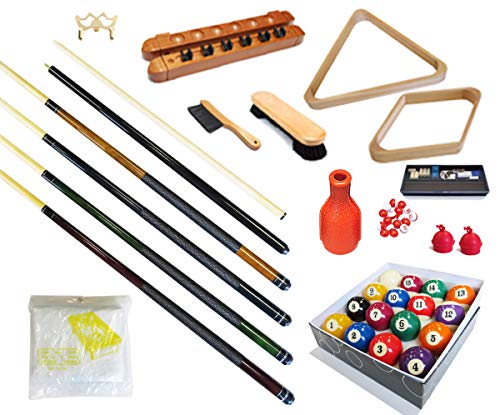
If you have a pool table then you need to get this accessory kit. It includes pool cues, extra pool balls, and all the gear you need to keep your pool table in tip-top shape.
If you are tired of your kids (or friends) ruining your good pool cue when they play then having these extra ones will keep that from happening (just be sure to hide your good one!).
What Is Pool Table Slate?
Slate is a rock that is fine-grained and foliated. It is a metamorphic rock that was derived from an original shale type sedimentary rock that is composed of main clay or volcanic ash. It is a bluish grey colored rock that splits into broad flat segments.
Shale or mudstones is where slates originated, wherein these rocks experience extreme heat and pressure beneath the Earth’s surface. According to Mohs Scale, the hardness of this rock is 2.5 to 4.
It means that it is an average hardness. Its hardness is almost the same with marble and limestone though not as hard as granite and natural quartz.
These rocks can be polished perfectly into a flat surface. Slate can be found all over the world, however, Italy, Brazil, China and India are the main exporters of these stones.
It was known that the best slate for a billiard table is from northern Italy in the Ligurian Region.
Slate is universally accepted as the industry’s standard for a high-quality pool table. This is because slate is very durable. A hard material is perfect for pool tables since they will need to withstand a lot of heavy balls hitting and bouncing on them.
Slate can also be leveled to a precision tolerance within 0.0001 inches. In games like pool, the ball cannot just randomly roll around. That is why slate is used to make very good pool tables.
However, because of its promising characteristics, it is very costly. That is why several alternatives have been used to replace slate on a pool table. Below are the three alternatives of slate as pool tables currently available.
Conclusion
For the non-slate pool table, its greatest problem is that they distort easily and do not have the durability to maintain its flat surface for a long period of time. This part is very crucial since the surface is important for pool players to make the right shot and for the pool balls to roll across the table like they should.
Pool balls cannot roll randomly otherwise it will throw off the entire game.
The table must always be 100% level which means it must be leveled with the lowest precision tolerance possible.
Pool tables that are made with an alternative slate cannot be fully compared with a real slate table as there are simply too many differences. Although these alternatives do cost less, they will not last a lifetime, like real slate will.
If you are just looking for a cheap table for your kids to play and have fun on though, a slate alternative is something you should definitely look into.
No matter what they are made of or what surface you choose, you have to make sure that all players who will be playing on your pool tables will never scratch the surface of the pool table. Your pool table is something that is very important to you, and it is something that you will want to keep in good condition to make it last as long as possible.