
*This post may contain affiliate links. As an Amazon Associate we earn from qualifying purchases.
Monopoly is a fun game that everyone loves to play. But when it comes to certain rules of the game sometimes people will get confused.
One such rule that many people are confused by is mortgaging the properties that you own in Monopoly.
Can you mortgage them? Do you need to do anything specific before you are able to mortgage your Monopoly properties? How do you unmortgage them?
In the game of Monopoly you can mortgage any of your properties at anytime as long as they don’t have any improvements on them (houses or hotels). If any of those properties have improvements those must be sold before you can mortgage the property.
When you mortgage a property in Monopoly you get money from the bank. When you are ready to unmortgage your property you simply pay back the loan (with interest) to the bank and your property is unmortgaged.
While a piece of property is mortgaged no rent is ever due from anyone who lands on it. So for most people mortgaging a property in Monopoly is a last resort.
If you would like to know more about if you can mortgage a property in Monopoly, you will want to keep reading this article. You can also check out this video to learn the official rules of playing Monopoly.
If you love board or card games then you have to check out the game called Throw Throw Burrito! It is a fun fast-paced game where you throw squishy burritos at other people you are playing with! You can learn more by clicking here.
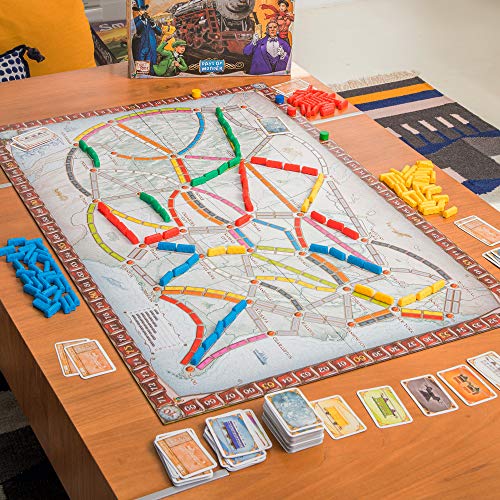
If you love games then you have to check out Ticket To Ride! This fast-paced board game will give you hours of fun with family and friends as you gather train cars and try to take over the board!
Ticket To Ride has many different variations as well so you can play across a variety of different maps.
Mortgaging Property In Monopoly
Now, what is the obvious reason for mortgaging a property in Monopoly? The most common reason for someone choosing to mortgage a property in Monopoly is to pay off a debt.
Say for example you land on someone’s property that has multiple houses or a hotel on it. Rather than selling houses or hotels that are on your property to raise some money you might want to mortgage the unimproved property first to raise some cash.
Another reason why you might want to mortgage a property is to raise funds so you can build improvements on a set of properties that you own.
Anyone who has ever played Monopoly knows that the way to win the game is by getting houses or hotels on your property so that your opponents have to pay you a lot of money every time that they land on one of your properties. Some people will mortgage all of their other properties to ensure that they can build houses or hotels as soon as possible.
However, this method can be risky as if you land on someone else’s houses or hotels before they land on yours you could be forced to sell those houses or hotels at a discount (50%). Since you only get back 50% of what you spent on the houses and hotels, leveraging yourself to the hilt by mortgaging all of your properties to build houses and hotels can be a dangerous way to play Monopoly.
Paying Back The Mortgage In Monopoly
I have already covered the fact that you can mortgage properties in a Monopoly game and how this is done. I also mentioned that mortgaged properties do not bring in any rent, and as a result, no profit.
Well what if your fortunes have turned and you are ready to pay back that mortgage on a property?
To pay back the mortgage on the property in Monopoly, all you have to do is pay back the amount that you borrowed plus a 10% interest payment. So if you received $180 when mortgaging a property then you have to pay the bank back $198 to unmortgage the property.
If you just barely have enough money to unmortgage a property it is often best to leave it mortgaged until you are on a more stable footing in the game. You will be required to pay the 10% interest every time that you pay back a mortgage in Monopoly so make sure that you have enough money to pay any rents that might come up as you go around the board before paying off the mortgage.
How To Play Monopoly
Monopoly is a board game currently published by Hasbro. In the game, players roll two six-sided dice to move around the game board, buying and trading properties, and developing them with houses and hotels.
Players collect rent from their opponents, with the goal being to drive them into bankruptcy. Money can also be gained or lost through Chance and Community Chest cards, and tax squares; players can end up in jail, which they cannot move from until they have met one of several conditions.
In order to win the game, all you need to do is to make all of the other players file bankruptcy.
The game has numerous house rules, and hundreds of different editions exist, as well as many spin-offs and related media. Monopoly has become a part of international popular culture, having been licensed locally in more than 103 countries and printed in more than 37 languages.
Conclusion
From this article, we have seen that properties can be mortgaged in the Monopoly game. We have also seen the conditions under which you can take out a mortgage on your Monopoly property.
It’s also important to know that you have to pay the mortgage fee and the 10% interest for every mortgage that you pay off.
We have also seen the effect that mortgaging has on a house in the Monopoly game. If one of your properties is mortgaged and you own the set, you will not be able to build any houses until the mortgage is paid off of the one property. This is how a mortgage can not only affect the property, but it can also affect the house, and the building of houses on your property.
Most of the time, games are won and lost by building houses on your properties. If your properties are mortgaged though, you will not be able to build any houses. This is why it is important to make sure that you know the rules of the game you are playing and what the specific rules of the version of Monopoly are when referring to mortgaging your property.