
*This post may contain affiliate links. As an Amazon Associate we earn from qualifying purchases.
Have you ever been playing on the Gameboy and wondered if it was more powerful than the NES? Maybe one of your friends said that the Gameboy was better and more popular than the NES.
Well, in this article we will go over everything you need to know about the NES and Gameboy.
So is the Gameboy more powerful than the NES?
The NES is superior to the Gameboy in virtually every way possible. The main reason NES is preferred is that it uses an actual TV screen, which makes it more significant in size, backlit display and gives you excellent sound quality as well. You get better visual effects by a bigger screen, and the games were far superior on the NES.
If you want to know more about the Gameboy and the NES, you will want to keep reading. In this article we will go over everything from specs to games for the two systems.
Are you a huge Nintendo fan? Then you have to check out the Mario and Nintendo gear that you can get. Whether you want a Mario wallet, a Nintendo sweatshirt, or a classic NES hat there are plenty of choices to choose from. You can find them all by clicking here.
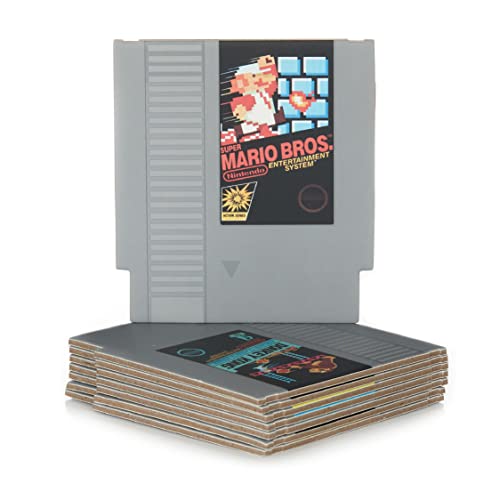
Do you love Nintendo? Then you have to check out this amazon NES cartridge drink coaster set!
This set includes 8 double sides drink coasters that look just like the classic NES cartridges.
This set is a perfect gift for the gamer in your life!
Why Do People Compare The NES And Gameboy?
There are many reasons for the comparison of these two consoles. Although the original Gameboy doesn’t have a sound game library, there are a sheer number of NES games and Gameboy color games that compete.
When you compare the games from the two systems it always seems that NES games always come out on top.
The Gameboy’s life span was extremely short compared to the NES as well. This was because the Gameboy didn’t innovate anything, and they just had the games that were available at the launch. They were one of the only gaming handheld devices that never produced any new games for the system at all.
However when they created the Gameboy Advance and Gameboy Color, they did create new games for those.
Games from the Gameboy Color versus the NES.
Below are the top games for the gameboy color. As you will notice some of the games are even a simple remake of games that were on the original NES.
Game Boy Color games
1. Batman Beyond: Return of the Joker
2. Bionic Commando: Elite Forces
3. Commander Keen
4. Crystalis
5. The Legend of Zelda: Link’s Awakening DX
6. The Legend of Zelda: Oracle of Ages
7. The Legend of Zelda: Oracle of Seasons
8. Mega Man Xtreme
9. Mega Man Xtreme 2
10. R-Type DX
11. Resident Evil: Gaiden
12. Super Mario Deluxe
13. Tetris DX
14. Wario Land
If you look at all of these games compared to the NES games, you will be able to see that they have quite a few that are remakes of original NES games. Also if you simply just compare Mario to any of these games it is clearly better.
You can also watch this short video comparing the two systems games.
Gameboy Vs. NES Technical specs
You might see over the internet that everyone has their own opinion related to Game Boy and NES but the technical specifications are the important things.
We have seen people talk about the relative strength of handhelds versus their contemporaries on the console side from which we acknowledged that people don’t know about the difference between the Gameboy and NES.
We know that many tech specs are available all over the place, but that doesn’t always provide us with all of the information. So here are the real specs. NES has a 1.7~ MHz processor with a 5~ MHz PPU, while on the other hand, the Gameboy has a 4.1~ MHz processor.
Although the Gameboy seems better, they do not mention that the PPU of the Gameboy is actually only 1.05 MHz PPU. This is almost five times less than the NES!
How Many Games Were Made For The Gameboy & NES?
The Game Boy had 384 games that were made for the system. On the other hand, the NES has 512. The plus of for the NES is that it is color as well and the original Gameboy was not.
As we discussed before the Gameboy games were a lot of remakes from the NES. This clearly makes it seem like the NES is far superior to the Gameboy.
Gameboy VS. NES Sound Quality
If we compare these two games with the sound quality, the NES always seems to have better sound quality as it is hooked up to a tv and the Gameboy was its own system. Even though Televisions did not have amazing sound on them like they do today, the speakers on them were far superior than the ones that were put on the Gameboys.
The size of the two simply made the TV far overpower the tiny little speakers on the Gameboy.
Because the speakers could not handle the sound the same as the TV speakers could, when they remade games from the NES for the Gameboy, they actually had to change some of the sounds on some of the games so the game would still work on the Gameboy and not blow out the speakers.
Can All Games From The Gameboy Be Compared To The NES?
Although there are many games that can be compared on the two systems, many games cannot be compared to each other as they are not equal in terms of power and speed.
Sometimes the developers would lower the speeds as the device was a handheld and not an actual system.
Conclusion
Now that we know the NES is better than the Gameboy in all these different areas, it is clear to see why many people prefer to play on the NES rather than on the Gameboy.
Although the Gameboy is handheld and is better to be taken with you places when you are on the go, the issue with all of the slower processing speeds as well as the games, and the original Gameboy not even having color or being backlit caused many people to not like the Gameboy at all.
If you grew up with the Gameboy then you know how much fun the games can be to play, and even though you had to wait a little longer and the speakers were not as good as the sound you could get with the NES, it was still fun to play.
If you grew up with the NES console then you remember searching for the cheat codes to help pass levels as well as hidden spots in all the Mario and Super Mario games. Playing these games as a kid was something that was always fun that we all looked forward to as soon as we got home from school.
It didn’t matter what game we were playing we were able to sit down and have a blast playing these games.
When the Gameboy came out it looked really cool, but the people that got it ended up not liking it near as much as the NES as the NES was more powerful, had better games, and overall was just a better gaming console.
Even today there are many gamers and collectors alike that prefer the NES over the Gameboy. From the games to the controllers the NES was something everyone could love.
Even today they have remade the NES for the newer generation of gamers to play on high definition tvs as well as a bunch of the older games.