
*This post may contain affiliate links. As an Amazon Associate we earn from qualifying purchases.
As we all know, Monopoly is a game in which players acquire landed properties and aim to send their opponent(s) into bankruptcy. Now the question here is playing Monopoly fun with two players?
From the way the game is played, it can be fun with three or more players depending on how good and experienced the players are. Monopoly is played in such a way that the principles are muddled, and numerous players have their own varieties that aren’t recorded in the authority rulebook.
Figuring out how to set up the load up, play by the official standards, and end the game at a sensible time will assist you with figuring out how to adore the game!
So is Monopoly fun with only two players?
Monopoly can be fun to play with only two people however, the more players you have the more fun it will be. Trading properties with only two players can be difficult which in turn can make the game last far longer and it won’t be quite as much fun.
When Monopoly is played with two players, most of the time, it might not be interesting if it is played by players who are not experts. This is because a losing player might not be able to catch up as a result of the natural way Monopoly is played.
If both players are experts though, the game not only can be interesting, but it can also be extremely fun.
If you would like to know more about if Monopoly is fun with two players, you will want to keep reading this article. You can also check out this video about the best two player Monopoly version.
If you love board or card games then you have to check out the game called Throw Throw Burrito! It is a fun fast-paced game where you throw squishy burritos at other people you are playing with! You can learn more by clicking here.
Let us firstly consider how Monopoly is normally played. This game can be played with two to eight players. Each number of players brings its own points of interest and downsides so it is imperative to know them before you choose what number of individuals are going to play.
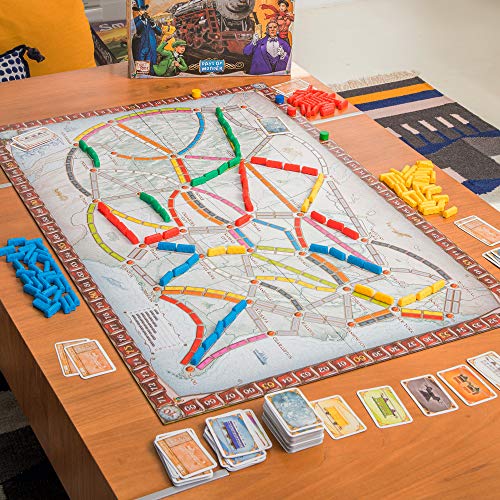
If you love games then you have to check out Ticket To Ride! This fast-paced board game will give you hours of fun with family and friends as you gather train cars and try to take over the board!
Ticket To Ride has many different variations as well so you can play across a variety of different maps.
Playing Monopoly With Two Players
While the game of Monopoly can be played with two players, it is a good idea for more people to play if at all possible. With only two people playing a game of Monopoly the winner has a lot more to do with luck than skill.
For example, if one player gets a match and the other does not then the player with a match just has to last long enough for their opponent to start landing on their matching property.
That can quickly turn the game into a long slog rather than the fun entertaining game that Monopoly normally is when there are more players.
Playing Monopoly With Three To Five Players
When Monopoly is played with three to five players, it is far more fun than with only two people. Adding a few extra people into the mix means more trades will need to be made to get matches of a specific property type. With 3-5 players the game of Monopoly will also be far more unpredictable.
That is because a single player that is losing can make some massive trades to try and get back into the game. Blockbuster property trades just simply aren’t possible when only two people are playing Monopoly.
When playing Monopoly with 3-5 players you could even have a trade that includes every single person getting and giving some property or money.
Being able to have these massive trades helps add more strategy to the game and in turn makes it far more fun to play than with only two people.
Playing Monopoly With Six To Eight Players
Although playing with extra people (and more than two people especially) will add a lot of additional fun to your Monopoly game once you get up to 6 or 8 players the length of the game will become far longer.
Getting matches with this many people is incredibly difficult so trading becomes a must.
Also with 6-8 players, playing Monopoly will likely take many hours as each time a player goes bankrupt new trades will likely be proposed and made. This is especially true if the players have any experience playing Monopoly.
So, although playing Monopoly with more people is a lot of fun, playing with 6-8 people will likely mean a much longer game. So be sure and plan your next game night accordingly.
Monopoly Setup
Playing Monopoly is loads of fun (or frustrating depending on your friends and family) but that doesn’t mean that setting everything up is simple. Although it is necessarily hard to get the game going there are specific setup rules that you have to follow.
To set up the Monopoly game, open the Monopoly board and lay it on a level surface. Ensure every player has enough space to keep their cash and property deeds in front of them. You will then want to mix the Chance and Community Chest cards and place them on the board.
Each player will need to pick a game piece of their choice. Please don’t fight over the car or horse!
The next thing you will need to do is give every player $1500. Often this money is distributed in smaller bills but if you want to save some time on setup you can also just give each player 3 $500 Monopoly bills and have them exchange them with the bank as they need to.
For instance, you can exchange $500 to the bank in return for 5 $100s if you have a rent due.
What then goes next is to pick a banker. This player is responsible for all the cash, property, houses, hotels, and exchanging the cash with players as needed.
The banker can play the game of course but they need to actually be honest and know how to do math (to make exchanging the money, property, houses, etc. faster).
If it is simpler, the banker can put the case where most players can reach, permitting individuals to grab cash, houses and properties, but that is rarely done since it makes cheating a little bit too easy.
It is then time to roll the dice to pick the first player. Whoever rolls the highest number goes first, and play at that point proceeds clockwise around the game board. You can utilize two dice or one for this first roll but most of the time people will just roll both.
If you are trying to get to the game faster an easier option is for the youngest or oldest player to go first. This avoids the dice rolling and truthfully who goes first doesn’t really matter that much.
Conclusion
Playing Monopoly with only two people can be loads of fun but how much fun it is really depends on the players and how lucky they are. If one of the two players gets a match and the other one doesn’t then that can make the game last forever and the winner be a foregone conclusion.
Personally I prefer to play with a minimum of 3-4 players as I like the dynamics far better with the extra players and also the fun trades that can be made with more players.
Just remember, the more players that you have playing the game the longer your Monopoly game will last (most of the time). So if you are playing with four people the game might last an hour or two. But if you are playing with 6 or 8 people the game might last many hours longer.
Although playing Monopoly is loads of fun, playing it for 4-6 hours… isn’t.
So if you have a bunch of people you might want to start the game off by rolling for properties to help speed the game up and get right to the actual gameplay, trades, and moving around the board.
Doing something like this will speed up the game significantly while still allowing you to have a lot of fun playing Monopoly with family or friends.