
*This post may contain affiliate links. As an Amazon Associate we earn from qualifying purchases.
To understand whether it would be fun with three players, first, we should look at how the game itself is naturally being played. Monopoly is played in such a way that the principles are muddled, and numerous players have their own varieties that aren’t recorded in the authority rulebook. Figuring out how to set up the game, play by the official rules, and end the game at a sensible time will assist you with figuring out how to enjoy the game!
Monopoly is a game that can be played with a considerable number of players. Most people want to know though what happens when we cut the number of players involved to three? Would it still be as enjoyable and fun? In this article we will go over everything you need to know about this and so much more.
So is Monopoly fun with three players?
Although some people prefer to play with four to eight players, other people prefer to play with only two to three. This is because depending upon your skill and luck in the game, will depend upon how many players you prefer to play with. No matter if you play with three or eight people Monopoly will always be fun.
If you would like to know more about if Monopoly is fun with three players, you will want to keep reading this article. You can also check out this video to learn about the rules for playing Monopoly.
If you love board or card games then you have to check out the game called Throw Throw Burrito! It is a fun fast-paced game where you throw squishy burritos at other people you are playing with! You can learn more by clicking here.
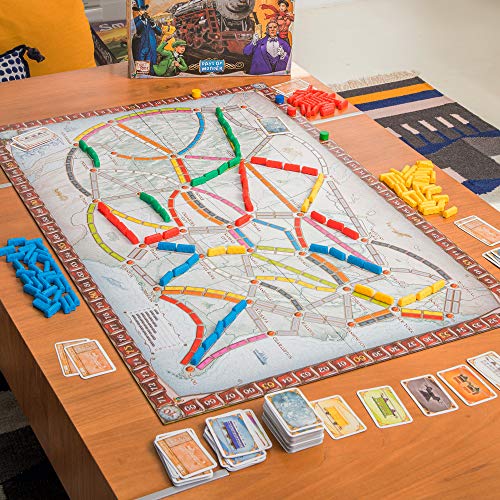
If you love games then you have to check out Ticket To Ride! This fast-paced board game will give you hours of fun with family and friends as you gather train cars and try to take over the board!
Ticket To Ride has many different variations as well so you can play across a variety of different maps.
Monopoly Setup
Let us first consider how Monopoly is normally played. This game can be played with two to eight players. Each number of players brings its own points of interest and downsides so it is imperative to know them before you choose what number of individuals are going to play.
Two Players
When the game is played with two players, it is advised to up the number of players because of the nature and mechanics of the game. Toward the beginning of the game, the two players will be equitably coordinated and locate the game to keep going quite a while. When somebody lucks out or makes an extraordinary move, they for the most part dominate the match without an opportunity for their rival to make up for lost time. Try not to let this stop you however in the event that you just have two accessible players. It can at present be entertaining.
Three To Five Players
When it is played with three to five players, it is usually incredible on account of their harmony among decency and delight. Games can last more than two hours if players are equally coordinated and when somebody has all the earmarks of being winning, there’s a great deal of space for the losing players to remain in the game.
Six To Eight Players
When this game is played with six to eight players, it brings so much fun yet can have a couple of issues. As just a single individual can dominate the match, more players implies there will be more washouts. Moreover, there is a more drawn out hold up between turns, yet this isn’t a lot of an issue as Monopoly gives you a bunch of choices you can do when it’s not your turn.
This game is one designed to be naturally played with eight players and more. More youthful players may not appreciate the game on the off chance that they don’t care to lose as the game requires some methodology to win. It is prescribed to help new and youthful players by offering tips and selecting a more user friendly playstyle.
In The Beginning
Now the board will need to be set up. Open the Monopoly board and lay it on a level surface. Ensure every player has enough space to keep their cash and property deeds before them. You should likewise spread out the Chance and Community Chest cards on the board. They are set apart on the inside.
Everyone will need to pick a game piece. Every player gets a game piece to move around the board. The game allows each player to decide its own piece, but you can likewise play with any little article. It doesn’t make a difference what piece you pick as they all fill a similar need.
You will want to give to every player $1500. Prior to the game beginning, the investor gives everyone their beginning cash. It should be $1500. Most players like to keep their money arranged in front of them, however, you can store your cash any way you want to for what it’s worth before you. Players may likewise trade cash for various bills of a similar worth. For instance, offering $500 to the bank in return for 5 $100s.What then goes next is to pick a banker. This player is responsible for all the cash, property, houses, lodgings despite everything having a place with the bank. The broker can in any case play the game, however they should make sure their own cash is independent from the bank’s. If it is simpler, the banker can put the case where most players can reach, permitting individuals to grab cash, houses and properties, giving that they possibly do this when they’re permitted to.
It is then time to roll the dice to pick the primary player. Whoever rolls the most elevated number goes first, and play at that point proceeds clockwise around the load up. You can utilize two dice or one, whichever you like. An easier option is for the youngest or oldest player to go first. This avoids the underlying dice rolling and gives them a little favorable position. After the main turn, play goes to the player on the left in a clockwise fashion.
From our analysis of the way Monopoly is played with scenarios of different numbers of players, it is clear that Monopoly with three players is real fun! Because the number is more than two, it makes the game last longer and gives more time to a losing player to catch up. Though this is dependent on the understanding between the three players. The cordiality of the knowledge of rules makes for a very interesting game between the three players.
Conclusion
From this article, we can see that truly a Monopoly game with three players is very fun depending on the agreement between the players. When the three players understand the rules that they have come together to lay down and follow through, it will be a fun game.
This Monopoly format also gives enough time for the losing player to catch up. This game can last up to two hours, and for many people all that time will be fun playing the game. Even though at some point two people will become losers, as the game begins to unfold and players begin to make trades and plays and build their houses and hotels, it is even fun for the loser. This is because even though at one point in the game they may be behind, with three players, there is a chance for them to catch up.
This is because when one player goes bankrupt, there is a chance for the losing player to get some of the properties, and get a match of their own. This can dramatically change the game and put the odds back into the other players favor.
No matter how many people you play the game with, Monopoly should always be fun for all the people playing, and if you follow the rules then everyone will have fun.