
*This post may contain affiliate links. As an Amazon Associate we earn from qualifying purchases.
Have you ever been looking at a Pool table and you saw a different table that someone called a Billiards table? Maybe you are looking to buy one, but aren’t sure if they are the same or different? Well, in this article we will go over everything you need to know about Pool and Billiards.
So is Pool and Billiards the same thing?
Although Billiards does include Pool as one of the games, Billiards is far more than just Pool. This would mean that they are not the same thing as Pool is just one specific Billiard game out of many that you can play.
If you want to know exactly what all of the Billiard games are, and the difference between them and Pool, you will want to keep reading. If you don’t like to read you can also watch this short video that will explain everything about Pool and Billiards.
If you are looking to get better at playing pool one of the best ways to do that is by upgrading your pool cue. One of my favorite cues is the Viking Valhalla. It is available in a variety of colors and won’t break the bank. You can find it by clicking here.
What is the difference between Pool and Billiards?
When you are enjoying the local club, sports arena, or a bar, you often see Pool tables. Some refer it to them as Billiards while some confuse it with the Snooker game, but what exactly is it? Well, here is the difference between the two.
- Billiards refers to all the games that are played with a cue stick and cue ball. The primary purpose is to strike the intended coloured balls with the cue ball. The cue stick is the stick that has a shaft and is used to hit the cue ball, which is generally white. Billiards typically contains a long list of games such as snooker, 8-ball, 9-ball, Chinese Snooker, English Billiards, etc.
- On the other hand, Pool is a game subset of Billiard games that only includes games such as 8-ball, 9-ball, 10-ball, Straight Pool, Bank Pool, and Black Ball.
Since both of them follow the same system of play, use the same cue sticks and general rules, people consider all of them the same. However, there are a lot of differences between the two.
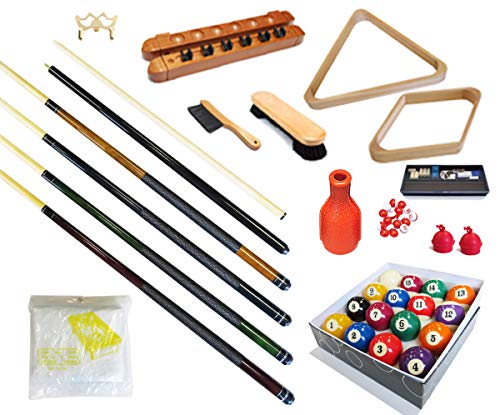
If you have a pool table then you need to get this accessory kit. It includes pool cues, extra pool balls, and all the gear you need to keep your pool table in tip-top shape.
If you are tired of your kids (or friends) ruining your good pool cue when they play then having these extra ones will keep that from happening (just be sure to hide your good one!).
Types of Billiard Games
There are many Billiard games invented each day. Some are short, such as just putting one or two balls in the pocket. While some are so big that significant countries participate in it to play tournaments each year.
Based on game type, billiard games are divided into the following categories:
- Carom Billiards
- Pocket Billiards
Carom Billiard is the simplest of its kind whereas the pocket Billiards is further divided into categories like:
- Pool
- Snooker
- English Billiards
People often confuse Pool with Billiards. This is because of the misinterpretation or lack of attention to names and giving more interest to actual games. However, Pool is a subcategory of Billiard games, also called cue games.
All the games played with a cue stick are Billiard games. This is why Pool is a part of Billiards. But that does not mean that every Billiard game can be regarded as Pool. Pool games have separate rules and regulations that differentiate it from other ball games.
On the other hand, the main conventional game that was initially developed in England was named Carom Billiards. This one is the most different and because it required an exceptional level of skill and patience, it has almost gone out of style.
Today, entertaining levels of games such as Billiards, artistic Billiards, Pool, and other games are more preferred than the old ones.
The difference in setup and rules
When you see a Pool and Snooker game, you cannot differentiate between the two because both of them have almost the same type of table, cue stick pockets, and cushions. However, Pool games typically have big sized balls as compared to other Billiard games that usually contain small balls. Also, Pool balls are categorized into two categories. Most everyone knows that these categories are stripes and solids.
Snooker or other Billiard game balls have all solid-colored balls that do not contain a stripe of different colors. They are also small in size and more significant in number. But this is not a case for Pool, which includes numbered balls of both solid and stripes colors.
The number of balls in Pool can vary from 8, 9, 10, to actual quantity, which is 15. Because of the difference in the number of balls, the playing setup also varies. However, the number of pockets in each game remains the same.
The Pool subcategories differ only based on the number of balls. Everything else remains the same, even the rules and regulations.
Pool
You will see that most clubs, bars, halls, and gaming arenas have Pool tables instead of Snooker or other Billiard games. This is because of the reason that generally Pool games are easier to follow as compared to other Billiard games. There are fewer rules involved and a comfortable scoreline to follow in Pool.
In contrast, other Billiard games like Snooker follow a detailed set of rules and guidelines to follow. For example, each ball in Snooker is assigned a different point depending upon its color. The score will vary depending upon the situation of the game, etc. They also have more playing time.
Therefore, other Billiard games are given a formal perspective as compared to Pool, which is just a mood lightening game.
Billiards
Billiards, also referred to as cue, includes all the games in which the ball is hit with the cue stick. The word “Billiard” originated from France. The number of games in it has evolved over time. Some new games are being played now, while some are entirely replaced.
Today, games such as Snooker and other artistic forms of Billiards are the most popular.
Differences in Playing Tables
All Billiard games are played on different tables. They differ in size, color, number of pockets, and indication marks. Even the temperature of the surface is different. A Pool table is typically 7-9 feet in size, whereas other Billiard tables are more substantial, having the size of 10-12 feet.
A Billiard table can have 4 or 6 pocket cushions. It depends upon the game you are choosing to play. A Pool table is specifically higher than other tables. Also, its surface is mostly colored to differentiate it from other games.
A Billiard table can have 4, 6, or no pockets at all. Except for Snooker, all other billiard games, including Pool, have large ball pocket cushions.
Both Pool and Billiards are different, but they require the same level of technique. The primary playing method is also the same since both of them fall under the same category.
Conclusion
Now that you know the difference between Pool and Billiards, you can know exactly what game you’re playing, what table you are playing it on, and best of all, simply correct all of your friends when they say that they are the same. If you do not correct them, then no one will, and they will go through their life never knowing the truth.
The sad thing is that most Americans actually go through their entire life and never are informed about the truth on a lot of different subjects. This causes many people by the time they are well into their adult years to just start to learn about things that they should have known years ago.
No matter if you call it Pool, or a Billiards game, if you are playing it, then you are bound to have fun with the people you are playing the games with as playing pool is extremely fun!