
*This post may contain affiliate links. As an Amazon Associate we earn from qualifying purchases.
Cue chalk or the chalk used in playing pool, since at least 1807, helps the tip better grip the cue ball on a stroke and prevents miscueing, as well as permitting the player to impart a great deal more spin to the ball, vital for position play and for spin-intensive shots, such as massés.
In the 1800s, true chalk (generally calcium carbonate lumps, suspended from strings), and even plaster was often used, but players experimented with other powdery, abrasive substances, since true chalk had a deleterious effect on the game equipment, not only discoloring the billiard cloth but also allegedly damaging the fabric.
So is pool chalk poisonous?
Even though pool chalk comes in various brands and different colors, it mostly is comprised of the same chemical composition. Even though there are substances in pool chalk that are poisonous, as long as you do not eat or sniff pool chalk constantly, it is not poisonous.
If however someone or something has ingested pool chalk you should certainly contact a doctor or veterinarian immediately!
If you would like to know more about if pool chalk is poisonous, please keep reading!
If you are looking to get better at playing pool one of the best ways to do that is by upgrading your pool cue. One of my favorite cues is the Viking Valhalla. It is available in a variety of colors and won’t break the bank. You can find it by clicking here.
Preferred Pool Chalk
If you are a pool enthusiast, then you already know the significant importance of pool chalk in the game of pool. The main use of pool chalk is that it coats the tip smoothly in such a way that it allows maximum grip, as it permits you to hit the ball with maximum velocity.
The frequency of how you chalk your cue tip is entirely dependent on your shooting rhythm and your preferred type of chalk. The issue of whether cue chalk determines the grip with which one hits the ball is very debatable. However, the best solution is to look for chalk that works best for you. If your chalk permits you to hit the ball with maximum velocity then it’s a good one.
In general, the best pool chalk for you is one that gives you that internal confidence as you play. There are quite a number of preferable cue chalks for various reasons. For instance, the Magic chalk is mostly preferred because of its prolonged ability to stay on the cue tip. The Kamui chalk also possesses the ability to stay on the cue tip for a long time. This means that you can go for several hits producing high spin shots without having to worry about chalking your cue.
Another advantage of this chalk is that you don’t need to apply a lot as you chalk your tip. Nevertheless, some people find it sticky and messy and above all, it can be quite expensive.
On the other hand, the Master chalk is preferred and trusted as it’s been in the market from way before. It is a very good quality type of chalk. This chalk, however, requires you to increase the consistency of how often you chalk your tip in between shots, as it does not stay on your tip for long. While this is not really an issue for many people it is worth considering.
The last most preferred chalk is the Predator chalk. With this chalk, you don’t necessarily have to chalk your cue after every shot. Nonetheless, you have to do it often and it’s highly conducive for high spin shots. You also apply less as you utilize it.
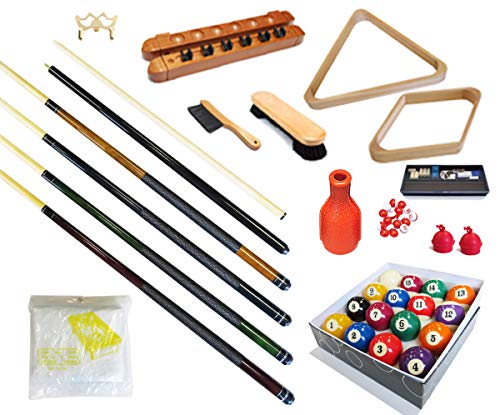
If you have a pool table then you need to get this accessory kit. It includes pool cues, extra pool balls, and all the gear you need to keep your pool table in tip-top shape.
If you are tired of your kids (or friends) ruining your good pool cue when they play then having these extra ones will keep that from happening (just be sure to hide your good one!).
Pool Chalk Color
Pool chalk also comes in distinct colors and shapes. For instance, you can find it in black, blue, brown, red and gray chalk colors. Studies have shown that people prefer colors such as gray as they have a neat characteristic, unlike bright colors that can cause annoying bright marks on your balls.
With all that being said, there are also debates on whether pool chalk is poisonous to one’s health. For example, if you are someone who often enjoys playing the sport, you could find yourself wondering what the real hazards of pool chalk are to your health. Or, if your child accidentally swallows pool chalk without you noticing you might find yourself wondering about the following question. What are the harmful effects of pool chalk?
Effects Of Chalk
Even though pool chalk comes in various brands and different colors, it mostly comprises the same chemical composition, silica, which is mixed with a combination of aluminum oxide and corundum. In some instances, lead is also found to be present. Now, let’s look deeper into the dangers that are associated with these substances.
Silica In Chalk
Provided the fact that some of the food companies use this substance when manufacturing food, it implies that it is not toxic when consumed. This is because silicon dioxide does not stick in the stomach; rather it is easily flushed out. That is why you can also find it as a component of drinking water.
Nevertheless, if inhaled it can prove to be fatal. For silica to be deadly, it has to be inhaled for a prolonged period of time at a consistent rate of 0.2 mg per m3. Greater subjection in a short span can also cause the same negative effects. Crystalline silica inhalation leads to lung diseases and in intense situations, lung cancer. It can also encourage the development of diseases such as silicosis which expose patients to the high risk of contracting tuberculosis. Crystalline silica is also responsible for the chronic obstructive pulmonary disease (COPD).
Corundum And Aluminum Oxide In Chalk
Corundum is simply the crystalline nature of aluminum oxide. It is hard and an excellent abrasive, and is mainly used as a friction substance in pool chalk. Aluminum oxide is generally a less toxic substance. In particular, exposure to the skin does not pose any risks. However, persistent inhalation of aluminum oxide damages vulnerable tissues. It can also cause pneumoconiosis with cough and external dyspnea. It is an irritant that can irritate the corneas or cause pulmonary edema. Study shows that although one should stay away from inhaling this oxide, there is no link to its direct negative impact on lungs.
Lead In Chalk
Lead is a highly poisonous substance. If consumed, it can lead to lead poisoning which affects multiple body parts. Lead causes exceptional negative effects on the brain and kidneys. This can, in turn, lead to kidney failure. In pregnant women, exposure to this substance risks the chances of a miscarriage. The most common evident symptoms of lead poisoning in children are weight loss, loss of appetite, general weakness, irritability, and development delay.
History Of Pool Chalk
Chalk is applied to the tip of the cue stick, ideally before every shot, to increase the tip’s friction coefficient so that when it impacts the cue ball on a non-center hit, no miscue (unintentional slippage between the cue tip and the struck ball) occurs. Chalk is an important element to make good shots in pool or snooker. Cue tip chalk is not actually the substance typically referred to as “chalk” (generally calcium carbonate), but any of several proprietary compounds, with a silicate base.
It was around the time of the Industrial Revolution that newer compounds formed that provided a better grip for the ball. This is when the English began to experiment with side spin or applying curl to the ball. This was shortly introduced to the American players and is how the term “putting English on the ball” came to be.
Conclusion
Now that we know pool chalk can be fatal if one is exposed to it constantly by eating or sniffing it, we can see how it really isn’t that poisonous. With that being said, you can go ahead and enjoy your pool game without having to worry about it gaming you. Besides, it is always not advisable to purchase cheap off-brand chalk if the goal is to attain excellent results.