
*This post may contain affiliate links. As an Amazon Associate we earn from qualifying purchases.
Have you ever gone to move a pool table, and wondered if the slate was fragile? Maybe you have never moved a table before and you just realized that the table you are getting has slate in it and you are not sure what to do? Well in this article we will answer all of your questions about pool table slate.
So is pool table slate fragile?
Although pool table slate is very strong and can withstand pool balls being on it, it is a very fragile material, and a tiny crack or chip can ruin the entire piece of slate (or require a repair). This is why it is important to be extremely cautious when you move a pool table to not damage the slate.
If you want to know more about pool table slate being fragile, you will want to keep reading this article. You can also check out this video to learn about pool table slate and how it is made for pool tables.
If you are looking to get better at playing pool one of the best ways to do that is by upgrading your pool cue. One of my favorite cues is the Viking Valhalla. It is available in a variety of colors and won’t break the bank. You can find it by clicking here.
Is pool table slate important?
Domestic pool table owners often find themselves in situations where they have to move their pool table, either for guests, party occasions, or moving out their home for various purposes. The slate, being the mainframe and central piece to the playfield of the pool table is thus brought into the spotlight.
This part of the pool table if damaged can cost the pool table owner much, as it serves as well when its quality is maintained. Any slight crack creates valley and bumps.
This stops the balls from smoothly rolling on the playfield, hence, it results in no game at all. If you try to play on a unlevel or cracked slate table, the game would then be no fun and the pool balls would not be predictable.
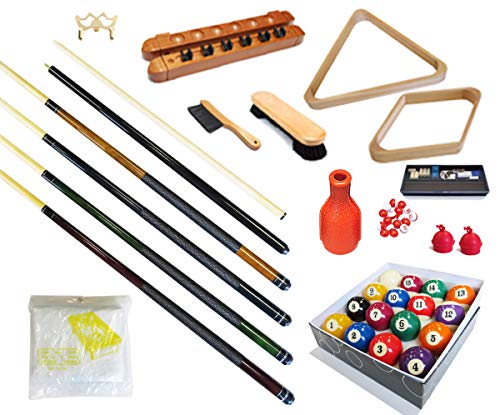
If you have a pool table then you need to get this accessory kit. It includes pool cues, extra pool balls, and all the gear you need to keep your pool table in tip-top shape.
If you are tired of your kids (or friends) ruining your good pool cue when they play then having these extra ones will keep that from happening (just be sure to hide your good one!).
How strong is pool table slate?
If pool table slate is very fragile, then you may be wondering how it is strong. If you are using this, you have probably seen professional players take their final thought through shoot and when they make it with such precision and win; they jump on the pool table to celebrate and entertain the crowd. The question is, how come they can jump on the pool table if there are possibilities to damage the underlying slate? Well, they can do that because the type of slate making when it comes to professional-grade pool tables is very strength-oriented. This goes as far as the organizing committees, requesting extra support on the pool slate from the manufacturers or suppliers of these professional tournament pool tables. So yes, the pool table slate is very fragile. If you, like most consumers, likely bought a pool table just for the leisure of playing with your friends and family, then this subjects you to know how to take care of your Pool to not damage the pool slate,and other parts that make up your table. If you spent the money on a professional grade pool table though, then your table will have thicker slate and be able to hold your weight.
Is pool slate designed to sustain a person’s weight?
Slate is a metamorphic rock that is mined from the ground and the milled to be used by various industries, including the pool sports industry while making pool tables. Slate can break smoothly and evenly along its cleavage, as it is made up of parallel foliated plates. To illustrate this fact with numbers, the hardness of any rock is measured by the Mohs scale and slate ranks at 5.5 out of ten, one being the softest and ten being the hardest. So it’s pretty obvious that stepping on a flat slate that makes up the most percentage of the pool table playfield will result in its cracking or the possibility of it splitting completely.
A slate for a pool table is designed only 19mm thick on average, and for older pool tables the extra support given to the slate is relatively low. Thus, the pool slate could easily collapse if enough weight would be placed on it.
Is it okay to sit on a pool table?
In general, the answer should be no. It makes sense that when you see professional pool players on TV sit or lay on the pool table for professional skilled shots that you want to do the same. You get the feeling that you can do the same with your home pool table, and the problem is, that you will more than likely break your pool table. When it comes to professional pool tournaments, the pool tables used have a slightly different design than recreational pool tables. These completion grade tables are designed to support their slate beds a lot more uniformly and in more places on the slate, this is for playability reasons. As a surplus, these tables generally use thicker slates, making the whole design much more solid. Note that, this is not for the table to be stood upon. Standing or sitting on the pool table alone spoils the cloth, and does no good on the slate.
Move your pool table with care for the slate and other parts
When it comes to moving household items that are heavy and delicate, it is always advised to hire professional movers for the job, as they have expertise in taking them apart and assembling them. This will limit your risks to pay extra amounts while repairing or replacing the damages that can be a consequence of inexperience. For some reason though, if you choose to do it on your own with five or four strong friends, then you are in for a challenge. Please note that, to do this you at least need some special equipment and carpentry skills. Among these tools, you will need a power drill, staple puller, socket wrench, knives, and very strong guys.
In principle, you should take special attention to two parts of the pool table as they are crucial to gameplay. These are the felt and the slate. The felt covers the slate so you need to carefully remove it without damaging it. It is tricky, and requires patience and time to carefully remove the staples from the felt, and make sure you don’t damage it. The slate, on the other hand, is easy to take apart by removing the screws with a power drill. The challenge comes with its weight, as a one-piece slate can weigh more than 360 kg. Any chip or crack on the slate will result in enormous effects on the pool table when you assemble it back. If the slate is in multiple pieces, damaging one is as devastating as damaging all of them.
Conclusion
When it comes to the pool table at your home or if you are a club owner, the odds are that your pool table can’t support two people standing on it without strain or potential of cracking. Yet, we have seen YouTube videos of as many as 6 players jumping up and down on the Pool playfield. Do not be fooled by this and just learn how to take care of your Pool tables. With the above information, it is clear that Pool slate is a delicate material and should not be tampered with by applying extra weight on it and while moving your table. If you are needing to move your pool table, it is always recommended to hire a professional to ensure that it makes it there in one piece.