
*This post may contain affiliate links. As an Amazon Associate we earn from qualifying purchases.
Are you curious to know if Sega was made by PlayStation? Well you have come to the right place. If you keep reading we will go into specifics about Sega and if they were made by Playstation. Although a lot of you think you know the answer, the answer may come as a shock to others.
So is Sega made by PlayStation?
Although some people may think that Sega was made by PlayStation, they might be a little disappointed to read this article. Unfortunately PlayStation did not make Sega. They were in fact enemies in the gaming community.
At the end of the 1980s, one of the most recognized game brands was Sega. In the arcades, the company focused on releasing games to appeal to many different people, including racing games and side-scrollers. Later PlayStation would actually take many of the gamers away from Sega due to the PlayStation’s better graphics and games.
Are you a huge Sega fan? Then you have to check out the amazing Sonic and Sega gear that you can get. Whether you want a Sonic wallet, a Sega sweatshirt, or a classic hat there are plenty of choices to choose from. You can find them all by clicking here.
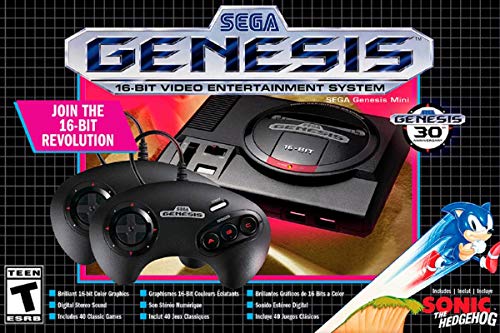
If you love Sega then you will want to check out this Sega Genesis Mini console. It comes with two controllers and even comes preloaded with 42 Games!
Enjoy these classic Sega Genesis games without having to purchase a single game cartridge!
History of Sega and PlayStation
Sega was known as Sega enterprise in the 1960s, and was founded by Martin Bromley and Richard Stewart as Nihon Goraku Bussan. “Periscope” was the first coin-operated game developed by Sega in the late 1960s. In 1969 Sega was sold to Gulf and Western Industries on purpose to become a publicly-traded company. In the early 1980s, Sega began to develop a video console game and they started with the “SG-1000” and “Master System”. Sadly they struggled against competitors such as the Nintendo Entertainment System.
In 1988 Sega released its next Game console the “Sega Genesis” also known as “Mega Drive.” The Genesis found major success after the release of Sonic the Hedgehog in 1991. After that Sega suffered from commercial failures such as the 32X, Sega Saturn and Dreamcast consoles. In the early part of 2004 Sega was acquired by Sammy Corporation. When he took over, he took Sega’s focus off of manufacturing gaming consoles, and onto becoming a third-party developer and publisher.
The PlayStation is developed and marketed by Sony Computer Entertainment as a home video game console. It was first released on December 3, 1994 in Japan. It was then released on September 9, 1995 in North America, in Europe, September 29, 1995, and in Australia, on November 15, 1995.
This was the first of the PlayStation lineup of video game consoles to be released.. PlayStation sold over 100 million consoles, and it was the first computer entertainment platform that sold anywhere near this many.
PlayStation started with a joint venture between Nintendo and Sony. Nintendo already had the floppy disk technology, but Nintendo approached Sony to develop the CD-ROM technology. After developing the CD-ROM technology by Sony they decided to call it the PlayStation.
Why did Sega stop making game hardware?
Although people don’t think of Sega as being around today, they still do produce gaming hardware, and even some systems. Sega officially never stopped making game hardware. Because Sega focused on a home console and only one of their five home consoles achieved success the makers of Pachinko machines bought them out.
Sega was king of the arcade market at one time, and decided to diversify into the home console market. They started with the launching of the SG-1000. It was a matter of very unlucky timing that made the SG-1000 barely sell 200,000 consoles.
Sega’s second attempt was a lot better than the first. They launched the Master System and ended up selling over 13 million consoles. Sadly just when they thought they had everything under control, Nintendo released a gaming system, and they sold over 69 million consoles.
The third attempt of Sega was quite a success with the Mega Drive/Genesis and this game library was so strong.
Then came Sega’s utter disaster console; the Dreamcast. The Dreamcast got many pre-orders and attracted significant interest. Sega announced that Sonic Adventure, the next game starring company mascot Sonic the Hedgehog, would be a Dreamcast launch game.
The company promoted the game on a large scale but Sega could not ship enough consoles for the Dreamcast’s Japanese launch due to a shortage of Power chips caused by a high failure rate in the manufacturing process.
Even with all of the problems, the Dreamcast first launched in Japan in 1998 and by the end of the day the entire stock of 150,000 consoles were gone!The Dreamcast even set a record in North America by selling more than 225,132 Dreamcast systems in under 24 hours.
Why did Sega fail?
Even after that great success, the Sega only had 30% of the market in their pocket. With the release of the PlayStation, Sony had over 60 percent of the U.S. video game market by revenue at the end of 1999. After the release of the Dreamcast, Sony revealed the next generation Playstation and Nintendo announced their next-generation Game console. On the other hand, Xbox began to be developed by Microsoft, all while Sega was left with nothing.
In March 2001, Sega posted a consolidated net loss of $462 million. While the PlayStation 2’s U.S. launch was marred by shortages, this did not benefit the Dreamcast as much as they had hoped. Customers still decided to wait for a PS2 instead of a Dreamcast.Some gamers even decided to purchase a PlayStation 1 instead of buying a Sega. Eventually, Sony and Nintendo held 50 and 35 percent of the U.S. video game market respectively, while Sega held only 15 percent.
If you really want to go into depth about why Sega was once a giant empire, and today is barely even around, you will want to check out this video. This video will help you understand how a company that shook the gaming community, is now a tiny piece of history.
Could Sega make a comeback?
Even though Sega is loved by many people and they have some awesome games that people absolutely love, it just wasn’t possible for Sega to make a comeback. If Sega wants to come back then they will have to do some major investing and restructuring of its business practices, and networks, to take on Nintendo, Sony, and Microsoft.
It certainly isn’t an impossibility that Sega could make a comeback, as there are some rumors that they are making steps to try and get back into the console market, but it is certainly unlikely.
Other questions
What is the most recent Sega console? At the Sega festival of 2019, Sega announced that they will release a retro version of its Sega Genesis console. The Sega Genesis Mini in the US and Mega drive Mini in Japan. That device has 81 built-in games and is a great way to enjoy the games of the past.
You can check out that gaming system here.
What was Sega’s first game? In 1973 Sega released Pong-Tron, it was the first video-based game. Despite late competition from Taito’s hit arcade game Space Invaders in 1978, Sega prospered from the arcade game boom of the late 1970s, with revenues climbing to over $100 million by 1979.
Conclusion
Sega was not made by PlayStation and they were even enemies when they were in the market together. Even though they were enemies, quite a few gamers actually love both game systems. Some gamers even prefer the Sega games and systems over the newer PlayStation games and systems. No matter what you are a fan of, there is no denying the impact both of these creators had on the gaming community.