
*This post may contain affiliate links. As an Amazon Associate we earn from qualifying purchases.
If you are looking at buying a retro Sega console and not sure what one to purchase, you are in the right place. Have you considered buying the Sega Saturn but scared to bite the bullet and purchase it? Well, you are not alone, and we are here to help.
So, should I buy a Sega Saturn?
If you like playing Segas rich variety of games, and you are looking for a 32 bit console, the Saturn will definitely blow your mind! Based upon reviews and the games available for the Saturn, Yes you should buy a Sega Saturn.
If you want to know all you can about the Sega Saturn before you purchase it, then you will want to keep reading. If you are like me and you don’t like reading though, you can watch this video to learn all the information about the Sega Saturn you will need before buying one.
Are you a huge Sega fan? Then you have to check out the amazing Sonic and Sega gear that you can get. Whether you want a Sonic wallet, a Sega sweatshirt, or a classic hat there are plenty of choices to choose from. You can find them all by clicking here.
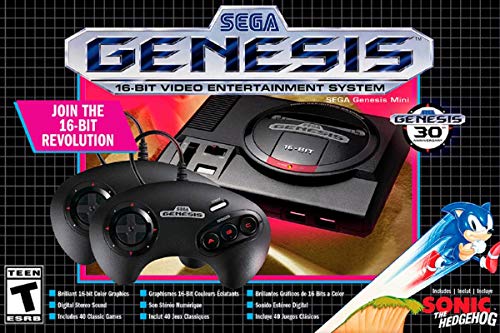
If you love Sega then you will want to check out this Sega Genesis Mini console. It comes with two controllers and even comes preloaded with 42 Games!
Enjoy these classic Sega Genesis games without having to purchase a single game cartridge!
Sega Saturn
The Sega Saturn is a 32 bit home video game console. The Sega Saturn is the fifth generation of consoles produced by Sega. The Saturn was first released on November 22, 1994, in Japan. Later, in May 1995 it was released in North America, in July 1995 the Saturn was released in Europe.
After the big success of the Sega Genesis console, Sega really decided to go all out with the Saturn. Their main features were dual CPU architecture, and eight processors. The Saturn not only had internal RAM for storage, but also a cartridge slot that could be used for additional storage and processing power.
The best cartridge for this is called the Action Replay and can be found here! The Action Replay cartridge also allows you to play games that were only released in Japan on the console as well. This opens up many more games for use that previously would not work on the Sega Saturn.
Manufacturing of the Saturn
Sega produced the Sega Saturn based on advanced technology, so their features are quite different from other gaming consoles. The main reason this is so important is because the console has the capability to handle higher RAM games than any other console on the market at that time!
There are many other reasons why someone would want to purchase a Sega Saturn as well. Some of these reasons are:
- Hardware
- Software
- accessories of Sega Saturn
Below we will go over all of these individually and go more into depth about why they are important,
1. HARDWARE
The CPU of the Sega Saturn is 32 bit which is approximately 28.6MHZ RISC processors. The overall net RAM of the Sega Saturn hardware is 2MB while the video RAM is 1.5MB. For the visuals, transparency and lighting effects the VDP1, and VDP2 graphical systems were designed.
VDP1 is used for focusing on the objects while the VPD2 is used for clarifying the image in the background area. Both of these graphical systems are extremely important, as they are what allso you to see a 3D background if you have a Sega Saturn.
Although Sega thought they would have the gaming console that year all to themselves, Sony released their PlayStation that same year. The PlayStation had great 3D graphics, and was a good gaming console. Because of this, Sega added additional power to the Sega Saturns before they were released in North America.
The cutting edge of the software of the Sega Saturn was a big challenge for the other companies as their consoles did not have that good of software yet.
PRIME TEXTURE CAPABILITIES
The texture was what brought the games to life along with the higher end graphics. Although the PlayStation conquered the Saturn with texture, the Saturn still won overall because of the better display and faster CPU.
The Saturn manufacturer designated 512KB for texting and displaying the graphics, and the same amount of kilobytes for framebuffer and 2d background CPU.
EASY AND ENHANCED EMULATIONS
Although many people emulated the consoles to get better games, this all ended with the production of the PlayStation as it was difficult to do and not really worth it. The emulation of the Sega Saturn on the other hand was easier, and was definitely worth doing as the console has a very high CPU
ESSENTIAL SEGA SATURN HARDWARE
The Sega Saturn itself performed a great number of functions itself. These functions include Scart LED, a power lid, and the two pads and controllers that could be connected.
3D CONTROLLERS
These were specifically designed for the Nights games. These games needed a 360 directional controller, and that is exactly what Sega gave them.
CD VIDEO UPGRADING CARD
The CD upgrading card is responsible for making sure the Saturn could play any VCDS.
2. SOFTWARE
For the conversion of images and debugging purpose, a number of tools were designed in production of the Sega Saturn.
BACKGROUND CONVERTER
This is known as a graphical tool. The function is to convert normal images into Sega Saturn format. This is one of the major reasons you should buy the Sega Saturn. They are supporting input formats like interchange file format, picture exchanging and Traga.
HEAT SERIAL INTERFACE TOOLS
This is a source code that allows the Sega Saturn to be hooked up to your tv and work properly.
LIBRARIES
There are two libraries available for the Sega Saturn. One is a low-level Sega basic library and the second is a high-level Sega 3d library for playing games. The biggest facility in Sega Saturn is Segalib. The sources files like C and ASM are placed in segalib. These are very reliable for performing a number of beneficial functions which are not available in other consoles.
MEMORY CARTRIDGE AND STEERING WHEEL
Using this cartridge is the cheapest way to play a huge variety of games for the Saturn. Once this is installed you will be bale to play any saturn game from the United States as well as those that were just released in Japan.
The steering wheel is extremely beneficial for transforming games from just being on the screen to putting you behind the wheel. For the complete Sega experience, the steering wheel is highly recommended. Several games like Daytona USA are far better to play when you have the steering wheel.
The best games for the Sega Saturn
These are the top 5 games for the Sega Saturn that I love to play.
- Virtua Fighter 2
- Nights into Dreams
- Sega Rally championship
- Shining Force III
- Daytona USA
Here is also a video that shows the top 10 games of the Sega Saturn of all time!
Problems with the Sega Saturn
Although there are not very many problems with the Sega Saturn, there was one that caused problems, and that was the effect chips. Even though the combined effects of VPD1 AND VPD2 were amazing for the Saturn, they also created visibly blurry images. Because of this, some people say that the overall performance of the console is reduced, but most people think it is still the best for its time.
CONCLUSION
Now that you know all of the beneficial aspects of the Saturn, you will be able to make a conscious decision about whether you should buy a saturn or not. If you do decide to buy the Saturn, I highly recommend buying it here as this place has the best consoles at the lowest price!