
*This post may contain affiliate links. As an Amazon Associate we earn from qualifying purchases.
Have you ever been playing Rummikub and you were not sure what the tiles were made out of? It is easy to see that they are not made of the same material as dominoes, but yet they are still tiles. Well, in this article we will go over exactly how Rummikub tiles and made and what they are made of.
So what are Rummikub tiles made of?
Although the family keeps it a secret about exactly how the tiles are made, we were able to find out that the tiles are made of high impact polystyrene as well as other ingredients. Once they are created, they are then formed, cooled, and then stamped with the numbers that they represent.
If you want to know more about Rummikub you will want to keep reading. You can also check out this video which will tell you how to play the game with real examples.
If you love board or card games then you have to check out the game called Throw Throw Burrito! It is a fun fast-paced game where you throw squishy burritos at other people you are playing with! You can learn more by clicking here.
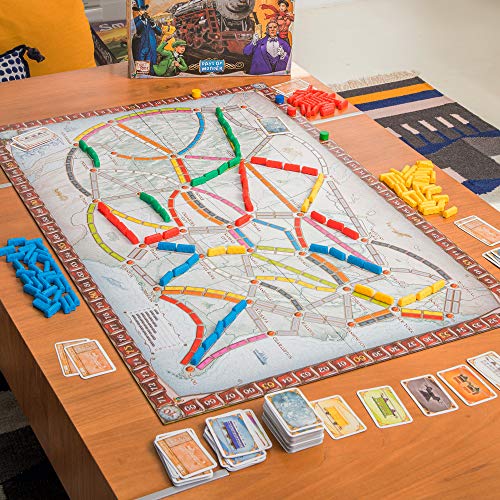
If you love games then you have to check out Ticket To Ride! This fast-paced board game will give you hours of fun with family and friends as you gather train cars and try to take over the board!
Ticket To Ride has many different variations as well so you can play across a variety of different maps.
How to play Rummikub
In the game of Rummikub, once the player has made their initial meld, they can, on each turn, play one or more tiles from their rack. This is made possible by creating or adding to groups and or runs.
The players that cannot or chooses not to play any tile, must pick a tile randomly from the pool and add it to their rack.
By now, you know Rummikub is a very popular game. It is a tile based game that incorporates elements of the card game Rummy and MahJong. The game Rummikub is a multi-award winning modern classic game that is suitable for the whole family.
The game can keep the whole family busy while enjoying something that’s relatively simple to learn and a lot of fun to play. It also comes in both standard and Durex tile sets for a whole family fun time. Players score points by using their tiles in “runs” and “groups”. The first person to lay all their tiles down is crowned the winner. Rummikub is the number one strategic game with excellent replay value with each game being as different as the combinations or moves you choose to play.
How do Rummikub tiles work?
The rules of Rummikub are relatively simple to understand; with the most significant issue being that the game doesn’t come from complicated game play or strategies. All you need is to master what you can and can’t do on your turn, and you are good to enjoy the game.
Much like the card game gin, Rummikub, as well as the solitaire, will cause a loss, because you will find yourself letting in distractions and missing opportunities right in front of you that could allow you to win.
When you come together to play Rummikub, four players are the best. To begin you will need to dump the numbered, multi-colored tiles on the table face-down. As a player, you will draw one tile first. The person with the highest number goes first. From there it will proceed in the clockwise fashion.
Then you will return those tiles randomly to the table with each player will begin drawing 14 tiles from the table, placing them on their rack. Any tile left forms the pool. On the first turn, each player will attempt to make a set of one or more groups or run that adds up to at least 30 points.
Rummikub is played with 106 tiles. Players attempt to lay down sets of tiles in groups. A group is where three or four tiles have the same number but different colors. You can also lay down a run. A run is three or more consecutive numbers of the same color.
Rummikub players can also manipulate the tiles already on the table by rearranging or adding to existing sets to use tiles from their rack. Rummikub is popular, shown by its sales, and also everyone seems to have played that game at some point in their life!
Rummikub is one of the games that never had the cultural moment that says cranium or apple to apples had. The good thing is that it has created a real foothold in a household that desires a game that’s old fashioned. Although most people do not know this, Rummikub was actually a game that was invented to skirt oppressive Communist edicts. For that reason alone, it’s worth a look at your local game store.
Printable Rummikub Tiles
Rummikub tiles are a cross between the card game rummy and the board game Mahjong. It’s great for four players. This creates a collection of tiles to be used to play for the game.
This is one of the games that the whole family enjoys almost every time we play it. One of the reasons most people will enjoy it so much is that you can change the rules each time you play the game.
The game allows rules changes for the tile version of two decks of cards where you can play almost any card game with your tiles. After all, the game, as the name implies, borrows significant forms of the card game Gin.
The tiles are designed to replace plating the cards; thus, whatever card-like game you wind up playing becomes just a little different.
How to change the way you play Rummikub
Do you like to re-invite the game? Here you can add a one or two rules, and as long. As we are re-inventing the game, neither of the players cares about trying to win. Winning is on the table, but no one cares about it.
What the players care about is making new variations of the game that work and having fun together while you play your new game. Much of the fun came, not so much from the new rules, but from the fact that we were the inventors of these new rules. They were the rules, and hence, it was our game. Because it was our game, the fun that we were having together became more important than the rules, and even in the end the game. In the end,it didn’t even matter whether we had all the pieces or not.
The set of tiles
During a player’s turn, sets of tiles that have already been played might be manipulated to allow more tiles to be played. Shifting a run involves players adding the more appropriate tiles to either end of a run or even removing a tile from the other end for use elsewhere. Here if the red 3, 4, and 5 have already been played, then the player might add the red 6 to the end and remove the 3 for use elsewhere.
You will also interact with splitting a run, substituting a group and removing a tile, and even joker substitution. Harvested tiles in the course of a turn mean a tile harvested from; an existing set must be played during your turn. In the end the player who runs out of tiles first is the winner.
Conclusion
Now that you know the history of the game, and what the Rummikub tiles are made of, you can play the game knowing that it is fun and as long as you are having fun with the game, sometimes the rules done even matter.