
*This post may contain affiliate links. As an Amazon Associate we earn from qualifying purchases.
A jukebox is a partially automated music-playing device, usually a coin-operated machine, that will play a patron’s selection from self-contained media. The classic jukebox has buttons, with letters and numbers on them, which, when one of each group is entered after each other, are used to select a specific record. Some may use Compact Discs instead. Disc changers are similar devices that are intended for home use, are small enough to fit in a shelf, may hold up to 400 discs, and allow discs to be easily removed, replaced, and inserted by the user.
So what are the best Jukeboxes for a bar?
Although there are many different types of Jukeboxes that you can purchase for your bars, most bars today will choose either a streaming jukebox, or a modern jukebox. Either of these jukeboxes are the best jukeboxes for a bar.
If you would like to know more about the different types of Jukeboxes, and what the pros and cons of each one are, you will want to keep reading this article. You can also check out this video to watch a full buyers guide to buying a jukebox.
Do you have a game room in your house and you wish that you had a full-sized jukebox to put into it? Well, you are in luck as you can find a variety of them to choose from by clicking here.
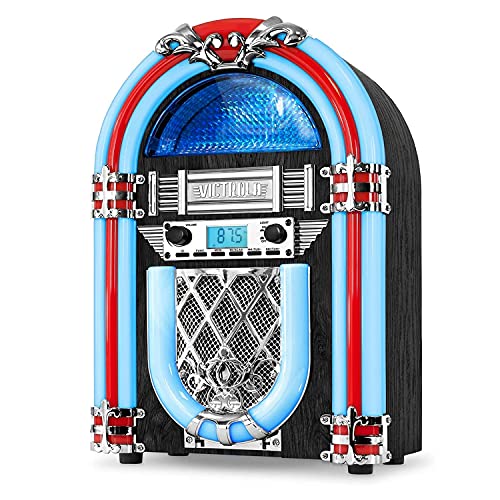
Do you love the thought of a nostalgic jukebox but can’t afford to spend thousands on it?
Then this tabletop jukebox is for you.
Looking and feeling like an old time jukebox but sitting on your counter or table you really can’t go wrong with this one.
Why A Jukebox
Buying the right jukebox can be quite challenging. Many questions can run through your mind, such as what type of music it will play, the cost, how much control you will have, etc.
Did you know the jukebox you choose says a lot about your business and your brand name? This is one of the reasons that you will want to consider it carefully.
Most will say to buy the quality jukebox and, of course, the latest in the market. Nothing contributes to a bar’s ambiance more than music. Without music, the beer will not taste as good as it will with music.
Types Of Jukeboxes
- Vintage jukeboxes
This is a jukebox that plays records.
Pros:
- It is a cold machine and watching the records play is fun
- Vintage is a perfect match for the retro-themed bar
- As the owner, you control the music selection available
Cons:
- Low audio quality
- Getting a replacement part is not easy
- It requires services and maintenance after a certain period of time
- Expensive to buy outright
- Music variety is limited
- Modern jukeboxes
The older but current jukebox that uses CD’s
Pros:
- More selection of music but management has to control it
- Cheaper than the older jukeboxes
- The profit is yours if you own the jukebox outright
Cons:
- Outdated and limited music selection
- It requires services and maintenance after a certain period of time
- You can’t prevent a guest from replaying the same song
- Streaming jukeboxes
They are the new systems using a SaaS model
Pros:
- Songs and style are not limited in number.
- The controller can skip the songs because of irritation
- Flashy and modern- cool with touchscreen phone app control
- Maintenance is not required
Cons:
- The music jumps from one genre to another without a theme
- If it is owned by the service provider and you must abide by their rules
- It can’t work without the internet
- If no one is putting money in it, there is no music playing.
- No jukebox
Pros:
- It is free
- Music selection is controlled
Cons:
- Guests do not participate
- No money generation
- Someone has to DJ music while working
- Staff may play inappropriate music
The Benefit Of A Digital Jukebox
Whatever the business you have, you may need a digital jukebox to boost your profits without any cost to you. Once you install a jukebox in your bar, you can begin to generate extra income. Customers are always tempted to spend more whenever they are happy.
A digital Jukebox has a user-friendly design. Technology has made a significant change in the digital era. Your bar must have the latest and greatest jukebox. All you need to do is utilize an app that corresponds with your jukebox. Once you use your debit card to pay, pick any song in the app. The signal will be sent to your digital jukebox to begin playing the song you selected.
There are frequent updates. Unlike coin-operated machine digital jukebox updates, there is a playlists feature every month. You will be able to access the modern hits of various genres. You will stay updated, and these updates are easy to apply.
There is practical support. In the early days when the jukebox broke, the technician had to come and inspect the unit physically, which is a pure waste of time. With a digital jukebox, you don’t have to worry, for there are virtual support agents 24 hours. They just troubleshoot the software issues offsite. They can fix your unit as quickly as possible.
Challenges of a digital jukebox
- It is not easy to craft a playlist- a soundbar does not take this job lightly
- Digital jukeboxes are a bit expensive considering the cost of internet connection and other hidden costs like services and maintenance
- Everyone will hear the song chosen, whether they like it or not
Reasons You Might Need A Jukebox
It is always good to identify your goal before you choose a jukebox. What kind of jukebox do you need for your bar? Once you find what motivates you, you are in a better position to find a solution. Here are the reasons you might need a jukebox.
- Guests
Of course, your guests expect a jukebox in your bar. The type of guest influences the kind of jukebox you should have. A bar without a jukebox seems incomplete.
- Substitute
This is the primary reason why the jukebox was invented. You can have a live DJ or a house band on some nights, but when the flow is low, a jukebox can be a substitute for live music.
- Increase customer engagement
Pick a jukebox that has a variety of music options, that way the customers can get excited about playing their favorite music.
- To make money
Your jukebox could be another stream of income. For this reason, consider a high-quality jukebox.
Updated Jukeboxes
If you are the person who likes to go bar hopping, you are familiar with the touch tune. The primary goal is to bring jukeboxes into the digital age, and let the customers pick their preferred music. The touch tune is in preparation for the launch of its updated app, which has a variety of features. The new mobile technology is connected to Spotify. Once you log in, all the favorite songs will appear, that way it is easy for you to decide which song you want to play.
If you are not enjoying what you hear in a particular location, touch tune can help you find other bars near you that have a jukebox and what is playing at that moment.
The app is so exciting. If you can’t queue, you can add extra credit and bump the line. The touch tune can also be used as a marketing tool. Through the app, people can know when there are drink specials or upcoming events.
Conclusion
The type of jukebox you buy for your bar depends on your reasons for getting one. In addition to that, consider how much you want to spend upfront and the costs to incur forward. Your jukebox is for your customer’s entertainment. A good jukebox is the one that your guests will get satisfaction from. This is why you will always want to choose a jukebox that interests your customers.