
*This post may contain affiliate links. As an Amazon Associate we earn from qualifying purchases.
Have you ever been playing pool, and someone hit a pool ball off of the table? Maybe someone was trying to do a special jump shot with their new pool cue and hit the cue ball off the table.
Well, if this has ever happened to you, then you probably know there are a lot of different rules about what to do. So in this article, I will go over everything you need to know in case this happens in your next pool game.
So what happens if a pool ball leaves the table?
- In a regular game of pool, if the cue ball leaves the table it is a foul and it becomes the opposing player’s turn. They get the cue ball in hand and can place the cue ball anywhere on the table and shoot at any ball on the table that they like.
- If an object ball (solid or stripes colored balls) is jumped off the table on anything other than the break it is considered a foul and the opponent will get the cue ball in hand.
- If an object ball is jumped off the table on the break it is still a foul but the opponent can either accept the table in the current position or take the cue ball in hand behind the head string.
- If the 8 ball is jumped off the table it means you lose the game.
If an object ball is jumped off the table it is placed back on the table in the foot spot. If the foot spot already has a ball on it then it is placed directly behind the foot spot.
If you want to know more about what to do if the pool ball leaves the table, you will want to keep reading so you know the rules the next time you play. If you only play 8-ball, you can also watch this video to learn all the official rules of 8-ball.
If you are looking to get better at playing pool one of the best ways to do that is by upgrading your pool cue. One of my favorite cues is the Viking Valhalla. It is available in a variety of colors and won’t break the bank. You can find it by clicking here.
If The Cue Ball Leaves The Table Is It A Scratch?
If you have been playing pool for a little while you have likely either hit the cue ball off the table or had it happen to your opponent while you are playing. So if a shooter knocks the cue ball off the table is it a scratch?
If a player knocks the cue ball off the table it counts as a scratch and the incoming player gets the ball in hand. The only exception to this is if the cue ball is knocked off the table on the break shot.
If the cue ball goes off the table on the break shot the opposing player has the cue ball in hand but the cue ball must be placed behind the head string. The requirement to put the cue ball behind the head string when it is jumped off the table is only on the opening break shot.
So if your opponent is shooting at a numbered ball (solid ball or stripe ball) and hits the cue ball off the table you have the cue ball in hand.
When you have the cue ball in hand that means you can place the cue ball anywhere on the table that you like and you can shoot at any ball on that table that you like as well (as long as it is a legal shot). Of course, you can’t shoot at the 8 ball (unless you have already pocketed all of your stripes or solids) and you cannot shoot at your opponent’s balls first (as those wouldn’t be legal shots).
Beyond that, you can put the cue ball anywhere and shoot at any of your balls that you wish. If you would like to learn more about scratching in pool be sure and check out my complete article on pool scratch rules by clicking here.
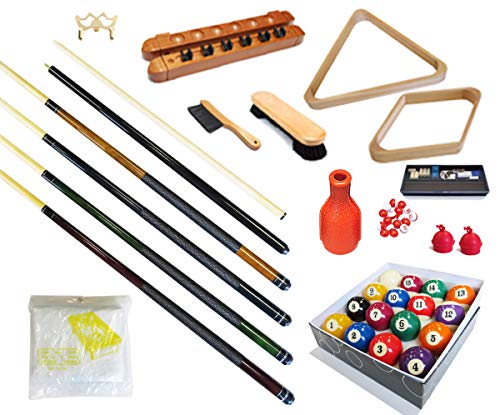
If you have a pool table then you need to get this accessory kit. It includes pool cues, extra pool balls, and all the gear you need to keep your pool table in tip-top shape.
If you are tired of your kids (or friends) ruining your good pool cue when they play then having these extra ones will keep that from happening (just be sure to hide your good one!).
Do You Lose If The Cue Ball Goes Off The Table On The Break?
If you are playing pool and on the break, the breaker knocks the cue ball off the table you might have heard someone say that it means a loss of game. But is that really how it works?
If you hit the cue ball off the table on the break it means a loss of turn but it does not mean that you lose the game. If you knock the cue ball off the table on the break your opponent can place the ball anywhere behind the head string and shoot at any of the shooter’s object balls that are beyond the head string but you don’t lose.
Obviously knocking the cue ball off the table on the break leaves you at a disadvantage so you certainly don’t want to knock the cue ball off the table if at all possible. However, no matter which sets of rules for pool you look at, none of them say that you will automatically lose the game if you knock the cue ball off the table on the break.
If you didn’t knock any of the balls into a pocket on the break when you jumped the cue ball off the table your opponent will have their choice of stripes or solids to shoot at but they must place the cue ball behind the head string. If the cue ball goes off the table at any other time besides on a legal break shot then the opponent will get the ball in hand rather than behind the head string.
What Happens If A Color Ball Comes Off The Table In Pool?
In pool, the goal is to get at least one of your balls into a pocket on each turn. Ideally, you will want to leave the cue ball in a position that allows you to make multiple combination shots and sink as many balls as possible into their designated pocket.
But what happens if when you are shooting pool one of the colored balls (solids or stripes) is accidentally knocked off the table?
If you jump an object ball (solid or stripes) off the table on your turn it is considered a foul penalty. This means your turn is over and your opponent gets the cue ball in hand.
Any colored balls (solid or stripes) that are jumped off the table are placed back on the foot of the table at the foot spot (normally a paper dot). If the foot spot already has a ball on it then the jumped object balls are placed below the ball that is on the foot spot.
No matter if you jumped a colored ball off the table for tactical reasons or it was an accident the rules are still the same. Intentional fouls or unintentional ones are treated the same so your opponent gets the cue ball in hand either way.
What Happens If The 8 Ball Falls Off The Table?
You now know what happens when you are playing pool and a cue ball or object ball goes off the table. But what about if the black 8 ball gets knocked off the pool table? What happens then?
If you knock the 8 ball off the table at any point while you are playing pool you automatically lose the game.
It doesn’t matter if you knocked the 8 ball off on a bank shot, off the head rail or side rails, or exactly how it happened. If you hit the 8 ball hard enough that you knock it off the table then you lose the game.
No excuses get you out of this (no the pool table being too close to the wall isn’t a valid excuse).
Most of the time you will barely touch the 8 ball throughout the game as you try and knock in your solid or striped balls. This is especially true if you are playing a call shot game since you will typically be good enough to only shoot at and knock in a called ball.
However, mistakes do happen.
No matter which variations of the game of pool you are playing, if you knock the 8 ball off the table it will mean that you automatically lose. The same is true for scratching and knocking in the 8 ball on the same turn.
If you do that you will lose also.
Now you might think that knocking the 8 ball off the table would be likely to happen on the break since that is when you will hit the balls the hardest. And that might be the case were it not for the fact that the 8 ball is always in the center of the triangle when you rack them up.
On the break, the first ball of the rack takes the brunt of the force and so the 8 ball that is in the middle will rarely go flying off the table (I personally have never seen the 8 ball leave the table on the break). I have seen the balls on the corner of the rack go flying off if the break was incredibly powerful but the 8 ball in the middle won’t ever go flying off no matter how hard you hit the front ball.
Conclusion
I hope that this article has been helpful in answering your questions about the specific rules and what happens when any of the pool balls are knocked off the table.
There are many different rules when it comes to playing pool including calling shots, illegally pocketed balls, not calling an obvious ball (you are not required to call on an obvious object ball), etc. but I will save those rules for another day.