
*This post may contain affiliate links. As an Amazon Associate we earn from qualifying purchases.
Have you ever been playing a game of pool, and you scratched? Maybe your opponent said that they got to do whatever they want with the cue ball, and that does not sound right. Well, in this article I will go over the rules about scratching in 8-ball and what the official rules say.
Later in this article, I will cover some other pool variations and their specific rules since they will vary from the normal 8-ball rules.
So what happens if you scratch in pool (when playing regular pool)?
If you are playing pool and someone scratches, the opponent is then able to put the ball anywhere on the table that they choose. These are the official rules for pool however, there are some other variations of this rule that are used in other versions of the game.
If you do not want to go by the official rules then that is something that both players should agree to before beginning the game. There are many different “house rules” with pool as with many different games.
So if you are not going to follow the official rules just make sure that you are both fine with those rules before you start playing.
In the next few sections, I will answer some other common questions about what happens when you scratch when playing normal pool (8-ball). All of these will be based on playing 8-ball pool so if you are playing a different variation of pool then the rules might be different.
If you want to know more about the different rules for scratching, you will want to keep reading. You can also watch the video below to learn all about the official rules of 8-ball.
If you are looking to get better at playing pool one of the best ways to do that is by upgrading your pool cue. One of my favorite cues is the Viking Valhalla. It is available in a variety of colors and won’t break the bank. You can find it by clicking here.
What Happens If You Scratch And Make A Ball On The Same Turn In Pool?
Another common thing that happens when you scratch is that you also pocketed a ball at the same time. Some people play that this means you should remove that ball as well as the cue ball. But are those the official rules for 8 ball pool?
If you scratch and make a ball on the same turn do you remove a ball?
If you pocket the cue ball (scratch) and get another ball in at the same time you DO NOT remove that other ball from the pocket. However, you also don’t get another turn and your opponent gets the cue ball in hand since you scratched.
So even if you scratch when you make a ball it still counts. That pocketed ball stays in the pocket but your turn is over.
There is nothing in any of the official rules about removing a pocketed ball when you scratch with the cue ball. Instead, it simply ends your turn and gives your opponent the chance to set the cue ball wherever they want for the most advantageous shot.
There are other variations of pool that have you remove a ball if you scratch at the same time however, with 8 ball pool the made ball is not removed even if you scratch.
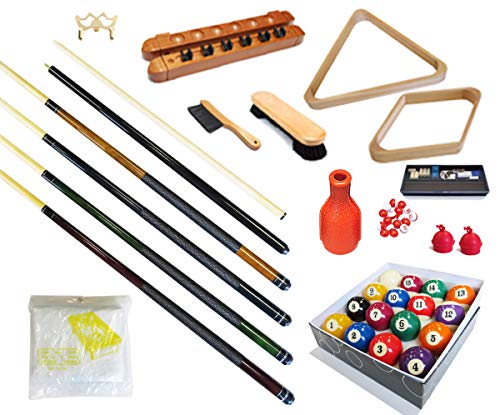
If you have a pool table then you need to get this accessory kit. It includes pool cues, extra pool balls, and all the gear you need to keep your pool table in tip-top shape.
If you are tired of your kids (or friends) ruining your good pool cue when they play then having these extra ones will keep that from happening (just be sure to hide your good one!).
When You Scratch In Pool Where Do You Put The Ball?
Another common misconception when playing 8-ball pool is that when someone scratches their opponent must place the ball behind a certain spot. Some people think that they have to put the ball behind a certain line or even on the center dot.
But is that true?
In 8 ball pool, when a person scratches their opponent has the ball in hand which means they can put the ball anywhere on the table that they like. There are no rules about where someone can and cannot place the ball when their opponent scratches.
You can put the cue ball anywhere after a scratch according to the official pool rules.
So if your opponent scratches when you are playing 8-ball you are free to put the ball anywhere on the table and shoot at any of your balls whether they are forward or backward.
The confusion on this rule likely originates from some of the other pool variations that require the ball to be placed at a certain spot or behind a certain line but this is not a rule in 8 ball pool.
If you scratch when playing 8-ball your opponent can put the ball wherever they like no matter which part of the table you are on or you scratched on. That is why scratching is something that you want to avoid as a savvy opponent can take that ball in hand from when you scratched and turn it into multiple pocketed balls on their turn.

What Happens When You Scratch On The Break In 8-ball Pool?
When you “break” when playing 8-ball pool the cue ball can go into the pocket quite easily simply because of the angle of the balls. When this happens what should you do?
Do you have to rerack and break again? Do any balls that went into the pocket come out? What happens with a break scratch?
When you scratch on the break when playing 8-ball pool your opponent gets the ball in hand but none of the pocketed balls are removed. If you made one ball (either solid or stripes) then that is “your balls” and your opponent will need to shoot for the other balls.
As with the other rules on scratching mentioned above, there are no requirements of where the cue ball must be placed or which balls a person can or cannot shoot at. They have the ball in hand because of the scratch so they can place the ball and shoot at any of the balls that they wish.
If you failed to pocket a ball before scratching then your opponent has the ball in hand and can shoot at any of the balls on the table (besides the 8 ball). In this scenario, they would likely want to place the cue ball in the best position to pocket multiple balls at once leaving you at a serious disadvantage.

When You Scratch In Pool Where Do You Shoot From?
There are a lot of different intricacies when you scratch in pool and it seems like everyone grew up playing with slightly different rules. But what are the official rules for 8-ball when you scratch about shooting?
Where are you supposed to shoot from?
When you scratch in 8-ball pool your opponent has the ball in hand and can shoot from and to anywhere on the table that they like. There are no official restrictions on which balls they can and cannot shoot at or where they have to shoot from.
This is true whether you have a table scratch, gameplay scratch, or what kind of scratch you have.
Some of the pool variations that I will go into below do have different rules that require you to shoot from certain places after a scratch. However, that is not the case when you are playing 8-ball.
After a scratch when playing 8-ball the cue ball is in hand and can be placed anywhere and you can shoot from and to anywhere on the table as well. There are no restrictions on where you can and cannot shoot the cue ball after a scratch.
What Is A Scratch In Pool?
If you are new to the game of pool you might be wondering what all of the different types of scratches are and what actually counts as a scratch. You might know that you want to avoid scratching but not know exactly what it is.
According to the BCA (Billiard Congress Of America), the scratch fouls are:
- When you jump a ball off the table
- When you hit your opponent’s balls before your own
- When you don’t make legal contact with your ball (hitting the cushions doesn’t make it legal)
- When the cue ball goes into any pocket
To not count as a scratch the cue ball must hit a legal object ball. That means if you are solids and you hit a striped ball first that it counts as a scratch in pool. If you are stripes and you hit solid balls first it is also a scratch.
Even if there is a group of balls altogether you are still required to hit your own ball type first. If you hit your opponent’s balls first for any reason then it is a scratch.
Of course, most people know that hitting the cue ball into a pocket counts as a scratch but did you know that hitting a bumper actually is not a legal hit (even if you hit multiple bumpers)?
Many people think that as long as you hit two or three cushions with the cue ball on your turn then it is a legal hit but that is actually untrue. Unless you hit your ball then it is a foul and counts as a scratch.
When you scratch your opponent has an open table and can place the cue ball anywhere that they like and shoot at any ball that they like (assuming it is their ball of course). There are no rules about the cue ball having to be placed behind the head string except in the case of a player scratching on a break.
If there is a scratch on the break then the opposing player has the cue ball in hand. However, it must be placed behind the head string and the player cannot shoot at any balls behind the head string. This is the only exception to the ball-in-hand rule when it comes to scratching in pool.
If you want to learn the specific rules about scratching when shooting for the 8 ball in pool you should check out another article that I wrote. That article about scratching on the 8 ball can be found here.
Do You Have To Move The Cue Ball On A Scratch?
What if your opponent scratches in pool by committing a foul of hitting your ball first (or not hitting their balls at all)? are you required to move the cue ball or can you leave it in the same spot?
When your opponent scratches in pool you have the “ball in hand” which means you can place it anywhere on the table that you like. If you like where the cue ball is currently sitting after a scratch has taken place you can certainly leave it in that position if you choose.
Most of the time when your opponent scratches you will want to move the cue ball as you can set yourself up to make multiple balls in a row. However, if the place where the cue ball is located is where you would like it to be then you can leave it there as well.
Since you have “ball in hand” after a scratch you can leave it, move it to an entirely different location, or even adjust it slightly in the position that it is currently at if you wish.
How Many Scratches Are Allowed In Pool?
If you are playing pool and you and your opponent aren’t very good at the game you might find that you are scratching a lot. Is there a limit to the number of times that you can scratch before you lose a game of pool? Are there specific rules that come into play after you scratch a certain number of times?
There is no limit to the number of times that you can scratch in pool. Every time that you scratch your opponent gets the ball in hand (meaning they can put the ball anywhere that they wish) but there is no limit to the number of times that a player can scratch.
Every time that you scratch in pool you are giving your opponent the advantage (since they get the ball in hand) however if you scratch one time, ten times, or one hundred times over the course of a game it doesn’t change what happens when you scratch.
What Counts As A Scratch In Pool?
If you are new to the game of pool you might be wondering what exactly counts as a scratch.
A scratch or foul in pool is when a player does any of the following:
- Knocks the cue ball into a pocket
- Jumps the cue ball off the table
- Does not touch one of their balls on a turn (doesn’t matter how many bumpers you hit)
- Touches an opponent’s ball with the cue ball before their own
All of these would be considered a foul and therefore a scratch meaning the opponent will get the cue ball in hand. So if you do any of these four things your opponent will be able to place the cue ball anywhere on the table that they like and can shoot at any of their balls on the table that they like as well.
When a player scratches or commits a foul it creates an advantage for their opponent so if at all possible you will want to avoid doing any of the above things when you are playing pool.
Can You Intentionally Scratch In Pool?
If you don’t have a shot when playing pool some people will intentionally scratch. Is that allowed or is it against the rules?
Although it is not against the rules to intentionally scratch when playing pool it is not a good idea. When you scratch your opponent has the ball in hand (they can place the cue ball anywhere) so you give them an advantage when you scratch.
Scratching intentionally is not against the rules but it certainly isn’t something that you would want to do on purpose. It would be much better to barely tap your ball and leave the cue ball tucked behind it than it would be to intentionally scratch.
However, if for whatever reason you determine that it is best for you to intentionally scratch it is not against the rules to do so.

Conclusion
Regardless of the scratch, either intentional or accidental, it will always give the offender a disadvantage of either losing a turn or having a point deduction from his overall score (depending on which pool variation you are playing).
Rules on scratching are different for different types of pool games. No matter what pool game you are playing, you will never want to scratch when it is your turn as it might just cost you the game.