
*This post may contain affiliate links. As an Amazon Associate we earn from qualifying purchases.
Rummikub is a tile-based game that is very similar to the card game Rummy in many aspects. The game requires the players to create sequences and manipulate the existing sequences by adding more connecting tiles.
The goal is to put all your tiles out on the table in sets, either your own sets or by building upon another person’s sets.
So what happens if you can’t go or play?
If a player can’t enter the Rummikub round, or purposely chooses not to, the player must take a tile from their pouch, and the turn ends.
After the other players have made their first plays, they can also build on different sets on the table with tiles from their racks. The game continues until one player empties his rack and calls Rummikub.
If you would like to know more about how to play Rummikub, just keep reading or watch this video!
If you love board or card games then you have to check out the game called Throw Throw Burrito! It is a fun fast-paced game where you throw squishy burritos at other people you are playing with! You can learn more by clicking here.
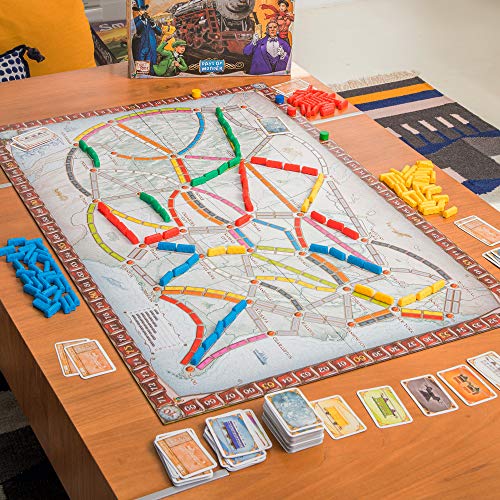
If you love games then you have to check out Ticket To Ride! This fast-paced board game will give you hours of fun with family and friends as you gather train cars and try to take over the board!
Ticket To Ride has many different variations as well so you can play across a variety of different maps.
Beginning The Game
Only the first meld or the ‘initial meld,’ as it is called, is determined beforehand, wherein a player is required to form a sequence summing up to a minimum of 30 points.
The point value of each tile is equal to its face value; if jokers are used, their value is similar to the tile they substitute. The initial meld is necessarily supposed to be a new sequence; a player cannot lay off tiles to an existing sequence on his/her first turn.
Rummikub Stalemate
Try to look for even the slightest manipulations possible; they are sure to help you get further in the game. Also, try to pick as few tiles as possible from the pool. Using the right strategy is undoubtedly going to help you win the game.
You can also visit the Rummikub game website and play the online version for free.
Are you too conservative with the rearrangement rules? Once you’ve done your initial meld, you can rearrange any tiles played in absolutely any fashion as long as you end up with all valid sets and runs, and no leftover tiles.
A Rummikub stalemate happens when everyone has gone and no one can do anything else with any of their tiles. The game is set up where this most likely will not happen, But it is a possibility as with any game.
Rummikub House Rules
Each player (or team) draws one tile from the pile. (Pile tiles should be well mixed and face down.) On the count of three, the players reveal their tiles to everyone. The player holding the tile with the highest number goes first and play proceeds to the left (clockwise).
Each player draws an additional 13 tiles from the pile, setting all 14 tiles in his/her tray.
If the player who drew the highest number can play tiles from his/her tray, she/he does so. To play tiles, they must be either:
- A run, which is three or more sequentially numbered tiles (1-2-3) all the same color.
- A set of three or four tiles of the same number (10-10-10) of all different colors.
If you cannot play on your turn, draw a tile from the pile. Play continues to the left.
Another way to play tiles, once you have laid down at least one set or run from your tray, is to play tiles against runs and sets on the board. For example, if there is a red 5-6-7 on the board and you have a red 8 (and have already played a run or set of tiles from your tray), you can add your red 8 to the red 5-6-7.
You can move tiles on the board around into different groupings, provided you play at least one tile from your tray, and all tiles end up in proper clusters of three or more.
This can be highly complex, such as rearranging five groupings and adding two of your tiles to create six new groupings, or it can be simple, such as breaking up a run of 7-8-9-10-11 to make a run of 7-8-9 and the second run of 9-10-11. (This is the best part of the game!) If you can’t successfully wrangle the tiles into groupings of at least three tiles, you must return all tiles to their previous positions including any tiles from your tray!
Using The Jokers
There are two jokers in Rummikub. They are wild and can represent any tile and can be used to create runs or sets. If you can free the joker from a grouping on the table, it is once again considered wild and can be used as any tile on that turn only.
You cannot free a joker from a grouping on the table and hold on to it for future use.
Just as in card rummy, the ace is low. You can use the ace in a run of 1,2,3 but cannot use it as 12,13,1.
If at any time you cannot play any tiles from your tray, you must draw from the pile. If you run out of tiles, play continues until you are all stuck. The game is set up where that should not happen, but it could be a possibility in a random fluke of play.
You win the game by playing all of your tiles from your tray. Dancing and gloating are optional.
Develop A Hybrid
You can also develop a hybrid game that allows your family to play without fighting. This follows the family’s rules on the first play (30 points, no jokers), and follows the family’s rules on the joker (if you can “free” it, you can use it however you want).
This is also known as a compromise.
The plan would be to teach the kids never to play by the real rules although you probably will want to show them both sets of grandparents’ rules, so that they’ll know how to play when they visit.
Where can I buy Rummikub?
There are many places that you can go to purchase the Rummikub game. Depending upon if you want new or used and how much you can spend will depend upon where you go. If you are looking for a used Rummikub game, the best place to look will be at Goodwill or other second hand stores like that.
You can also look on Facebook Marketplace as sometimes people will have games for sale on there for a good price.
If you are wanting to purchase a new Rummikub game, this is going to be the best place to get one.
They are decently priced and come with everything you need to start playing the game immediately.
Conclusion
We have learned that if a player can’t enter the Rummikub round, or purposely chooses not to, the player must take a tile from their pouch, and the turn ends. After the other players have made their first plays, they can also build on different sets on the table with tiles from their racks.
The game continues until one player empties his rack and calls Rummikub. Remember to have fun while playing!