
*This post may contain affiliate links. As an Amazon Associate we earn from qualifying purchases.
Have you ever been playing Rummikub and you drew a blank tile? Maybe you have just opened your brand new box and you found a blank tile that you didn’t know what to do with. Well, in this article we will go over everything you need to know about Rummikub and just exactly what that blank tile is.
So what is the blank tile in Rummikub?
The blank tile in Rummikub is actually a replacement tile in case you lose one of your original 106 tiles. The blank tile can replace any number or joker that is missing from the game. The blank tile should not be used in the game unless you are missing one of the original 106 tiles.
If you want to know more about Rummikub and how to play, you will want to keep reading. You can also check out this short video that will show you exactly how to play Rummikub the proper way.
If you love board or card games then you have to check out the game called Throw Throw Burrito! It is a fun fast-paced game where you throw squishy burritos at other people you are playing with! You can learn more by clicking here.
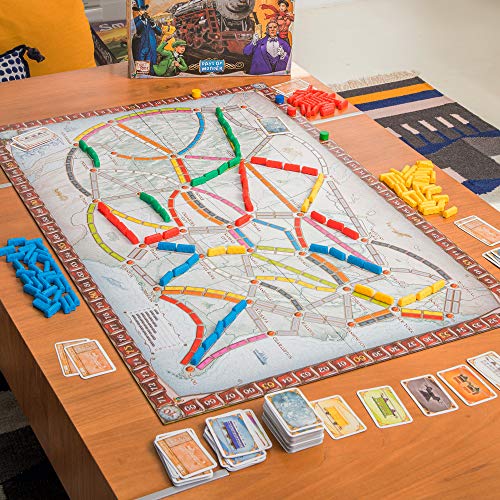
If you love games then you have to check out Ticket To Ride! This fast-paced board game will give you hours of fun with family and friends as you gather train cars and try to take over the board!
Ticket To Ride has many different variations as well so you can play across a variety of different maps.
Rules and regulations of Rummikub
Rummikub is one of our personal favorite games. This is because whenever our family sits together to play a game, Rummikub is the game that is almost always picked. Because we play it often, our family always enjoys sitting and playing a few rounds with each other to have some fun.
When it comes to playing the game, there are several rules and regulations that you need to follow. You can read the instructions from the book inside the game, or you can keep reading in this article to learn all of the rules.
There are 104 numbered tiles in the Rummikub game and two separate jokers as well. This makes the Rummikub game have a total of 106 tiles. All the tiles have different numbers ranging from 1-13 with four different colors. Before you start the game, it is mandatory to shuffle the tiles before you pass them out. If you have a blank tile in your set, you can set it aside for later.
The tiles are distributed among all the players, and each player gets 14 tiles to start. One thing you will need to remember is that you cannot play with more than four players. If you want to play with more than 4 players, you will need another Rummikub set so you can add in more tiles or a whole second game.
Many people do this, and if you want to know more about adding a second game to yours, you will want to check out this article!
When we play Rummikub it always seems like someone forgets the rules or what something was worth in the end. Maybe they were trying to cheat to beat all of us as sometimes there is a lot of competitiveness when playing with family! No matter what the reason, you should always read the rules before you begin to play the game. This makes sure everyone is on the same page and eliminates any confusion.
Rules and Regulations of Rummikub
There are several rules that you need to follow, and we are listing them all down below. Before you start the game, it’s better to understand the concept of “sets” and “sequences.” A player can place the tiles in the form of sets or runs on the table when they play.
- A group, or set includes at least three tiles containing the same number with different colors
- A run is made up of at least 3 tiles containing sequence numbers with the same color. Some variations of the game allow you to play where the runs are able to be of different colors. That is something that you will need to discuss with the other players before you begin the game.
Beginning Play
- As discussed above, Rummikub requires between two and four players to play the game. The objective of the game is to arrange the numbers in an appropriate sequence from the tiles on your rack, and the one who does this first and uses all of the tiles on their rack, will win the round. The winner of the game is the person who reaches a predetermined score first (normally 200-300)
- To begin the game, you have to shuffle all the tiles without showing the numbers to anyone. Each one of the players will get 14 tiles. This will need to be done so no one can see the face of the tiles when they are being chosen. Another thing that needs to be determined before you begin the game is if you will have one person deal your tiles, or if they will all be on the table and every person will pick their own tiles. Most people prefer to pick their own tiles as some people claim to be extremely lucky and that is how they win the game.
- Once you’re done with the distribution of the tiles, you will be asked to draw one additional tile. You will show this tile to everyone and the person who draws the highest tile will then start the game.
- To begin the game, you will have to start the first meld in the form of a set or a run. The points value of your initial meld or melds must be at least 30 points. If you do not have the 30 points, you will need to draw for this turn and hope you get something that can make it that high for your next turn.
Types of Manipulation
When the situation of manipulation comes up, you can make the following changes.
- You can build on an existing set by adding tiles to it
- You can take the fourth tile out of the set and then create a new set
- You can also split one or two sets into multiple sets
- Basically as long as you leave all of the tiles on the table in new sets or runs you can manipulate the tiles however you like within your two minute time frame.
Frequently Asked Questions
- What is a meld in Rummikub?
The Rummikub game is all about “Sets and Runs,” and there’s another popular term that is known as meld. When a player makes sets or runs and puts them on the table, it is known as a meld.
- Do you draw a tile every turn in Rummikub?
If you are playing the game and you cannot play on your turn, or you do not have enough points in your initial meld to lay down, you will need to draw a tile. You will not draw a tile on your turn unless you cannot play on the table at all.
- Is Rummikub the same as Rummy?
Although they are not the same, they both are similar in many ways. Below are the ways that Rummikub and Rummy are similar.
- You can play the game with between two players and four players. No more players are allowed to play the game.
- You have to shuffle each of the tiles before you distribute them and you have to shuffle the cards before you proceed.
- The player with the highest points will win the game in both the games.
- There are three famous versions of Rummikub and three versions of Rummy as well that are famous worldwide
Conclusion
Now that you know about Rummikub and how to play, you can easily begin to practice and then beat all of your friends and family. You also should now know what the blank tile is for and how to use it if you need it. Most of the time you will never use this tile, but it may come in handy later down the road.
If you need to buy another set of Rummikub, this is the best place to do it. So, what are you waiting for? Go ahead and challenge that family member to a game of Rummikub and show them how much you know!