
*This post may contain affiliate links. As an Amazon Associate we earn from qualifying purchases.
Have you ever been playing Rummikub and someone said that you keep score? Maybe you are keeping score but you can never remember what the wild is worth when you are adding up points. Well, in this article we will go over everything you need to know about Rummikub and the value of the tiles at the end of the game.
So what is the wild worth in Rummikub?
The wild or joker in Rummikub is worth 30 points. If you have it on your rack at the end of the game, you will have to count the tile as negative 30 points for yourself and a positive 30 points for the winner. As you can see you certainly don’t want to get caught with the wild on your rack!
If you want to know more about Rummikub and what tiles are worth the most points, you will want to keep reading. You can also watch this short video to learn how to play Rummikub if you do not know all of the rules.
If you love board or card games then you have to check out the game called Throw Throw Burrito! It is a fun fast-paced game where you throw squishy burritos at other people you are playing with! You can learn more by clicking here.
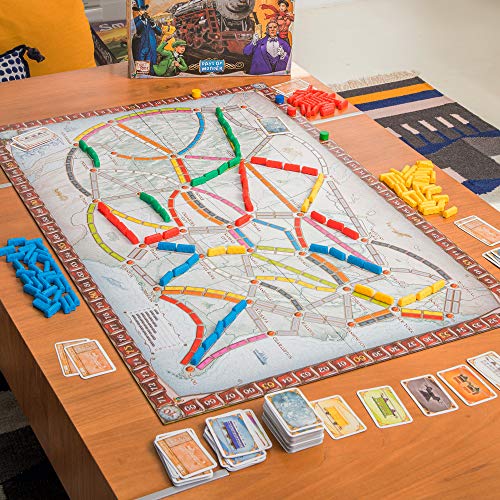
If you love games then you have to check out Ticket To Ride! This fast-paced board game will give you hours of fun with family and friends as you gather train cars and try to take over the board!
Ticket To Ride has many different variations as well so you can play across a variety of different maps.
What is Rummikub?
Rummikub is the most entertaining and fun game that holds a special place in many people’s hearts! People have been playing this game all over the world for many years! Whether you have the online game or you just bought it here, you will enjoy playing this game. The game is most famous in Israel and America because the founder of the game was actually from Israel.
The manufacturer of the game has included a book with the name of the game and it talks about the instructions, rules and regulations in it. Surprisingly, there are still a lot of people who are still confused about many things.
If you have jokers on your rack, you can win the game by using your skills and a variety of tactics. You will want to make sure that you never take the game for granted because other players can be immensely skillful as well and even if you have a joker or wild, you can still lose the game.
If you get caught with the joker in your rack you could not only lose the round but the entire game with the 60 point swing it brings you (30 negative points for you and 30 positive points for the winner).
How to play Rummikub
There are 2 jokers in every game. Other tiles in the game contain numbers from 1-13 with four different colors (Red, Black, Blue, and Orange). All the tiles are first placed in the pouch for the shuffling purpose, then the tiles are placed on the table and players reshuffle them again without exposing the numbers written on them or they are drawn directly from the pouch.
After the shuffling is done, one of the players will be asked to distribute 14 tiles to each of the players sitting around the table or the players will draw their own tiles from the pouch/table. The game will then proceed in the clockwise direction.
The first player to manipulate all of the tiles on the table and use all of the tiles in their rack is the winner of the round. Just because you win one round though, does not mean that you win the entire game. In order to win the entire game, you will need to have the highest score after a certain number or rounds or will need to reach a specific score first (depending on how everyone agrees at the beginning of the game).
This can be hard to do as every round you do not win you will receive negative points based on what tiles you have left on your rack.
If you have 70 points in the round you win, but in the second round you lose with a joker and a 13 in your hand, you will lose 43 of your 70 points. This is how even though you think you may win just because you won one round, it is not a given. Many people have come back to win even though it looked like they were not anywhere close to winning at the beginning.
This is part of what makes the game so exciting. Even though the games may move a little slower than some people like, it definitely has a surprise factor at the end to see how many points you will have.
The Jokers or wilds are worth 30 points, and the other tiles are worth the value on the tiles. So if you lose a round and you have a blue 10, a blue 11, and an orange 3, you will have negative 24 points. If you would have had a wild or joker with those tiles though, you would have ended with negative 54 points.
The winner of the round gets everyone’s combined points for the round, but positive in number. So if players 2,3, and 4 each have 25 negative points then the round winner will get 75 positive points for winning the round.
Yes, you can move a joker in Rummikub, but you can’t take the joker off the table once it has been played just like other tiles on the table.
You can use the joker without any problem in the middle of the game. But, keep one thing in your mind, if you get two jokers in one game, you can’t use two jokers in one meld. They must be used separately.
Below we will go over some questions that many people have asked us that we think you should know as well.
How many tiles do you need for Rummikub?
There are 14 tiles that you get when you begin playing, and a total of 106 tiles that the game is required to have in order to play. There is a limit of only a maximum of four players that can play at one time.
If you have more than four players, you can always add 53 more tiles for every two players. You can also add an entire second game if you are playing with 8 players.
Does Walmart sell Rummikub?
Yes, they do sell the Rummikub, and they have all the versions of Rummikub available. You can also check for Rummikub online here as it is normally cheaper.
What is Rummikub?
Rummikub is a famous game, which is a tile-based game for 2-4 players. You can compete with 1 friend and 3 friends at one time or team up as well. All the players have 14 tiles initially, and the one who is able to lay down all of their tiles first is the winner of the round.
You can draw only one tile at a time. The game is free to download and play as well through the different app stores. Many people prefer to play at the table with the actual game though.
Is Rummikub hard to play?
No, Rummikub isn’t hard to play. All you have to do is to understand the concept of the game and practice a lot before you challenge anyone. This is our go-to game for vacations and parties and we just love it.
Can you play on other people’s tiles in Rummikub?
A player cannot use other people’s tiles in Rummikub to make their initial meld. If you are somehow unable to make the initial meld and get “out”, you’ll have to take one tile from the pool and then repeat the same process until you can get out.
After the initial meld or melds are placed, you can then use other people’s tiles in Rummikub to play on or manipulate as you see fit. Tiles that are on the table are for anyone to play on when it is their turn.
Can you move a joker in Rummikub?
Yes, you can move a joker in Rummikub, but you can’t take the joker off the table once it has been played just like other tiles on the table.
You can use the joker without any problem in the middle of the game. But, keep one thing in your mind, if you get two jokers in one game, you can’t use two jokers in one meld. They must be used separately.
How many points do you need to start Rummikub?
You need to lay out 30 points on the table to get started and be considered “out”. You have to score 30 points in your first meld or melds if you want to start the game; otherwise, you will have to draw and hope what you draw allows you to get “out” on your next turn.
Conclusion
Now that you know what Rummikub is, and what the joker or wild of the game is worth, you can easily play the game to win! With a little bit of luck and a little bit of skill, you can become very good at the game and beat all of your friends whenever you play.
This game is fun for everyone and everyone who has ever played it, is likely to love this game!