
*This post may contain affiliate links. As an Amazon Associate we earn from qualifying purchases.
Have you ever wondered about refelting a pool table? Maybe you are looking at getting a pool table, but you are not sure if the felt should be replaced first or if it is fine. Well, in this article we will go over everything you need to know about refelting a pool table.
So when should you refelt a pool table?
If you own a pool table, you will want to replace the pool table felt if there are any holes, tears, or bumps in the felt, as well as if the felt has become loose over time and is no longer taunt to the sides of the table.
If you want to know more about pool table felt and when and how to replace it, you will want to keep reading. You can also watch this short video to learn how to replace your own pool table felt.
If you are looking to get better at playing pool one of the best ways to do that is by upgrading your pool cue. One of my favorite cues is the Viking Valhalla. It is available in a variety of colors and won’t break the bank. You can find it by clicking here.
Do public pool tables ever get new felt?
Pool tables located at bars and public places are frequently in use; hence the felt material covering the table tends to wear out pretty quickly. Consequently, there arises a need to refelt the tables from time to time. Tables intended for domestic use see less action and sometimes last up to four years before there is a need to change the felt.
There are a few things that can be done to make a pool table last long. Some of these include brushing and vacuum-cleaning the table. Dust particles should also be kept away from the cover.
Although felt in good condition doesn’t need to be changed, people still change it for a new color. This is because it is more affordable to change the color than to purchase a new pool table.
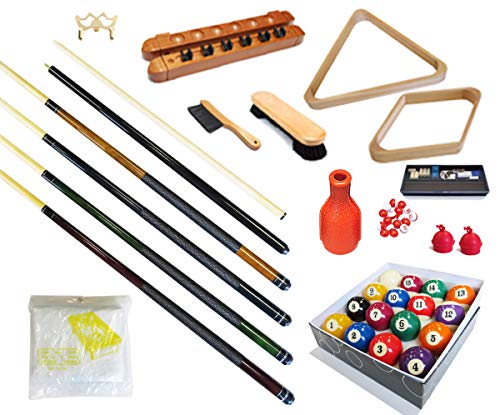
If you have a pool table then you need to get this accessory kit. It includes pool cues, extra pool balls, and all the gear you need to keep your pool table in tip-top shape.
If you are tired of your kids (or friends) ruining your good pool cue when they play then having these extra ones will keep that from happening (just be sure to hide your good one!).
Should the felt be replaced if you move?
There’s a general misconception that there’s a need to refelt in a new location. Felt can always be reused if dismantled carefully. In cases where tables are moved in succession, there’s a need for a new cloth after a few moves. The increasing rate of imperfections necessitates this change as felts get stretched. The fabric also weakens, thereby making a change even more important.
Felt also need to be changed when colors don’t match. The cost of replacement increases as the table needs to be reassembled from scratch.
How to refelt a pool table
Refelting a pool table is an easy task that can be completed in a short amount of time if correctly done, and with the right set of tools. Follow the steps listed below to change the cover of your pool table:
- Disassemble the table
The first thing to do before refelting a pool table is to disassemble the table. To take apart a pool table, all you need do is remove the pocket liners that are positioned under the pool table. After that, you will need to remove the rails as well. The rails vary according to different pool tables, with some having just a single rail, while others have up to four.
- Remove the old felt
After disassembling the table, the next thing to do is take off the old felt. Although pool tables are designed to last for a very long time, felts wear off with time, and they need to be changed frequently. A lot of things cause the wearing off of felts, including friction, the frequent ball bouncing, and a lot of other things.
To determine if felts are worn, you check if it is dusty. This test is carried out by running your finger over the felt material. If this material feels briskly, it is due for a change. Replacement of felts is done in two major ways.
The first method involves the use of glue. In cases where the felt is joined to the table with glue, you only have to remove felt by scraping off the glue. This process should be done with caution so as to ensure the table is not damaged during the process.
Alternatively, felts can be removed by taking out staples. This method is easier than the first because it involves the use of a specialized staple remover for taking out the pins faster.
- Clean the slate
Once the old felt is removed, the next thing to do is clean the slate. Slate is quite durable and doesn’t break easily; hence why pool tables tend to last for long periods with only a few of its materials requiring periodic maintenance.
It is also crucial to clean the slate immediately after the felt is removed. This should be done with the use of a dry cloth. This is done to ensure the slates remain dust-free. The use of wet clothes is not advised in cleaning slates because it can result in the board becoming damp and soft.
Old residues should also be removed by scraping off with dry cloths.
- Determine the size of the pool table
After cleaning the slate, you need to find out the dimensions of the pool table. This can be carried out with the aid of a measuring tape. Be sure to write down the dimensions to make it easier when you go to buy your piece of felt. Felts come in different colors, and they can be purchased at various sport, and fabric stores.
Felts are cut and stapled together at the point of purchase to give the exact size required.
- Reassembling the table
The newly purchased felt is fixed directly on the table, either with the use of glue or by stapling it in place. After that, you will replace the rails.
Lastly, the pocket liners are inserted, and the pool table is, once again, ready to host exciting matches.
How will I know the exact time to refelt a pool table?
Although felt doesn’t last as long as the pool table, it is not advisable to change it frequently. You know the time is right to replace the felt cover when it tears or loosens easily. In cases where pool tables are used in bars, it needs constant changes as it has effects in their games. The lifespan of felt can be extended if the pool table is covered when not in use.
Another thing to take note of is the fact that people get sick of the same color. Unlike several years ago, when green was the only choice, there’re lots of felt colors available now. Colors such as black and tan are trendy nowadays.
Felts are also made to last for a certain period, and once the time elapses, they need to be changed, even without showing signs of distress. Generally, felts are made to last around 5 to 15 years.
Conclusion
Now that you know when and how to change the pool table felt, you can see when it needs to be changed and you can save some money and do it yourself. Although it may seem like a daunting task, if you follow the steps one by one, it is fairly easy to do. No matter if you are changing the table felt because it is damaged or worn, or just because you do not like the color anymore, you will use the exact same process every single time that you change the felt.