
*This post may contain affiliate links. As an Amazon Associate we earn from qualifying purchases.
If you think of a brand that will make people smile, Atari Flashback will surely come to mind. Everything home video games is this brands’ specialty. Atari Flashback brand is a series of several home video game consoles that are manufactured, published and sold by the Atari Company.
The first series was released in 2004 and was upgraded until 2019 with different versions.
So which is the best Atari Flashback?
There are many different opinions about which Atari Flashback is the best. Depending on your point of view and what you prefer in a gaming system will depend on which Atari Flashback you like. The general consensus seems to be that the Atari Flashback X is the best one currently released.
If you would like to know more about the Atari Flashback please keep reading or watch the video below!
If you are an old-school Atari lover then you have to get a classic Atari T-Shirt to show it! To see the most popular Atari T-Shirt retro designs that will stay classics for years just click here.
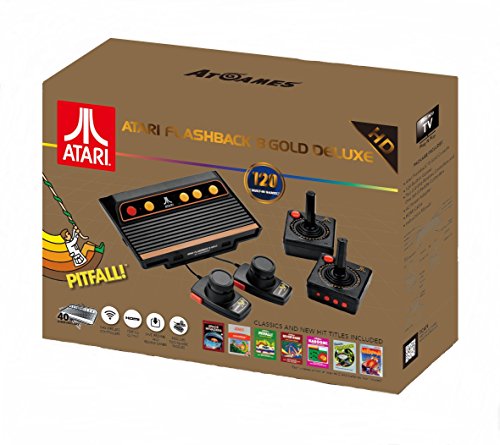
If you love all things Atari then you have to check out this awesome Atari Flashback console.
The Atari Flashback 8 comes with two wireless controllers (YES, WIRELESS!) two paddle controllers, and 120 authentic Atari games.
Original Atari Flashback
This was the first Atari game console which was released in 2004, it was designed by Atari veteran Curt Vendel, in a company named Syzygy Co. that designed other home video games.
This Atari flashback looked like an Atari 7800, and even came with a pair of controllers similar to it, but the former was slightly smaller. The system had twenty built-in games.
A setback about this flashback is that it was based on ‘’NES-on-a-chip’’ hardware which did not resemble either of the Atari systems’(Atari 7800 and Atari 2600) it was meant to represent.
As a result, the Atari Flashback had to be upgraded with another version because the games it contained were ports and were different in degrees from the main games.
This Flashback was not very popular with some purists however.
The games on Atari Flashback include:
- Adventure
- Air-Sea Battle
- Battlezone
- Breakout
- Canyon Bomber
- Crystal Castles
- Gravitar
- Haunted House
- Millipede
- Saboteur
- Sky Diver
- Solaris
- Sprint Master
- Warlords
- Yars’ Revenge
- Asteroids
- Centipede
- Desert Falcon
- Charley Chuck’s Food Fight
- Planet Smashers.
Learn more about the original Flashback by clicking here.
Atari Flashback 2
The discrepancies in Atari Flashback made the company decide to update to a newer version. This version was released in 2005 and has 40 Atari built-in games which is many more than the original Atari Flashback.
The Atari Flashback 2 was developed by Curt Vendel and Legacy Engineering, but unlike the original flashback console, the Atari Flashback 2 contains a single-chip version of circuity which was designed by Vendel and the project was code named after Vendal’s wife Michele.
However, because of changes in the game content during development and some issues which affected the graphic design company, the Flashback 2 manual had several errors including typos. For instance, the manual made gamers believe that there is a two-player mode in centipede but there was not.
All of the games on the Atari Flashback 2 are:
- 3D Tic-Tac-Toe
- Adventure
- Adventure II
- Aquaventure (unreleased prototype)
- Arcade Asteroids
- Arcade Pong
- Asteroids Deluxe
- Atari Climber (homebrew), released in 2004 as Climber 5
- Battle Zones
- Caverns of Mars (exclusive)
- Centipede
- Combat
- Combat 2 (unreleased prototype)
- Dodge ‘Em
- Fatal Run (only released in Europe)
- Frog Pond (unreleased prototype)
- Hangman
- Haunted House
- Human Cannonball
- Lunar Lander
- Maze Craze
- Millipede
- Missile Command
- Off the Wall
- Outlaw
- Pitfall! (originally released by Activision)
- Quadrun (originally sold only by mail order through the Atari fan club)
- Radar Lock
- Return to Haunted House
- River Raid (originally released by Activision)
- Saboteur (unreleased prototype)
- Save Mary (unreleased prototype)
- Secret Quest
- Space Duel
- Space War
- Super Breakout
- Video Checkers
- Video Chess
- Warlords
- Wizard
- Yars’ Return (exclusive sequel to Yars’ Revenge built on its original assembly-based game code)
- Yars’ Revenge
Learn more about the Flashback 2 by clicking here.
Atari Flashback 2+
This was released in January 2010. This console is the same as Atari Flashback 2, but some included games like Pitfall, Wizard, Caverns of Mars and Atari Climbers were removed. This led to a replacement with a sports station that included games like boxing, soccer, and baseball.
You can find this model by clicking here.
Atari Flashback 3
This was developed in 2011. This console had 60 games built in, Atari 2600, 2 joysticks and a case design that actually looks like FB 2/2+ except that it has a front port for the joystick no B/W switch and it is curved differently . The flashback 3 enables the functioning of the original 2600 and paddles, you can also set the video to a much lower pitch/volume.
All of the built in games on the Flashback 3 are:
- 3D Tic-Tac-Toe
- Adventure
- Adventure II
- Air-Sea Battle
- Aquaventure
- Asteroids
- Backgammon
- Basketball
- Battlezone
- Bowling
- Canyon Bomber
- Centipede
- Championship Soccer
- Circus Atari
- Combat
- Combat 2
- Demons to Diamonds
- Desert Falcon
- Dodge ‘Em
- Double Dunk
- Fatal Run
- Flag Capture
- Frog Pond
- Fun with Numbers
- Golf
- Gravitar
- Hangman
- Haunted House
- Home Run
- Human Cannonball
- Maze Craze
- Miniature Golf
- Missile Command
- Night Driver
- Off the Wall
- Outlaw
- Realsports Baseball
- Realsports Basketball
- Realsports Soccer
- Realsports Volleyball
- Saboteur
- Save Mary
- Secret Quest
- Sky Diver
- Space War
- Sprintmaster
- Star Ship
- Steeplechase
- Submarine Commander
- Super Baseball
- Super Breakout
- Super Football
- Surround
- Swordquest: Earthworld
- Swordquest: Fireworld
- Video Checkers
- Video Chess
- Video Pinball
- Wizard
- Yars’ Revenge
If the Flashback 3 is the console you want then you can find it here.
Atari Flashback 4
This Atari Flashback was released by AtGames on November 13, 2012. The console was very similar to the Flashback 3, but the former had a wireless joystick and the number of built in games was increased by 15 more games bringing the total up to 75.
This provided more playable games for the buyers.
The games that are included with the Flashback 4 are:
- 3D Tic-Tac-Toe
- Adventure
- Adventure II
- Air-Sea Battle
- Aquaventure
- Asteroids
- Backgammon
- Basketball
- Battlezone
- Black Jack
- Bowling
- Breakout
- Canyon Bomber
- Centipede
- Championship Soccer
- Circus Atari
- Combat
- Combat 2
- Crystal Castles
- Demons to Diamonds
- Desert Falcon
- Dodge ‘Em
- Double Dunk
- Fatal Run
- Flag Capture
- Football
- Frog Pond
- Front Line (not the original 2600 version)
- Fun with Numbers
- Golf
- Gravitar
- Hangman
- Haunted House
- Home Run
- Human Cannonball
- Jungle Hunt (not the original 2600 version)
- Maze Craze
- Miniature Golf
- Missile Command
- Night Driver
- Off the Wall
- Outlaw
- Polaris (not the original 2600 version)
- Pong
- Realsports Baseball
- Realsports Basketball
- Realsports Soccer
- Realsports Volleyball
- Return to Haunted House
- Saboteur
- Save Mary
- Sky Diver
- Slot Machine
- Slot Racers
- Space Invaders (not the original 2600 version)
- Space War
- Sprintmaster
- Star Ship
- Steeplechase
- Stellar Track
- Street Racer
- Submarine Commander
- Super Baseball
- Super Breakout
- Super Football
- Surround
- Swordquest: Earthworld
- Swordquest: Fireworld
- Tempest
- Video Checkers
- Video Chess
- Video Pinball
- Warlords
- Wizard
- Yars’ Revenge
Other versions of the FB 4 were also designed. Some versions of this console include a 76th “bonus” game, Millipede.
Check out some additional reviews of the Flashback 4 by clicking here.
Atari Flashback 5
The Atari Flashback 5 release date was October 1, 2014. It was also built by AtGames just like FB 3 and 4. This console is similar to the Flashback 4 in a lot of ways including the wireless infrared joysticks that came with it.
The Atari Flashback 5, just like the other updated versions, also came with some additional built in games, which was basically what gave it an additional advantage over the Flashback 4 and the preceding Ataris.
It added 17 more games to the 75 that the Flashback 4 had, for a total of 92 games. The additional Flashback 5 games are:
- Air Raiders
- Armor Ambush
- Astroblast
- Dark Cavern
- Frogs and Flies
- International Soccer
- Super Challenge Baseball
- Super Challenge Football
- Space Attack
- Star Strike
- Sea Battle
- Sword Fight
- Chase It
- Escape It
- Miss It
- Shield Shifter
- Strip Off
Although finding new versions of the Flashback 5 is difficult you can pick up some used versions of the consoles here.
Atari Flashback 6
The Atari Flashback 6 was released on September 15, 2015. This Atari Flashback was designed and built by AtGames just like the three preceding consoles.
It came with the same infrared wireless joystick like Flashback 5 and Flashback 4.
The only difference here is the additional 8 games which made the Atari Flashback 6 a console with 100 built in games. The new games are:
- Atari Climber
- Indy 500
- MotoRodeo
- Radar Lock
- Secret Quest
- Solaris
- Swordquest
- Waterworld
- Yars’ Return
To see some of the reviews for this model you can click here.
Atari Flashback 7
This console was released on October 1, 2016. This Atari Flashback console came with similar features like the previous Flashbacks, a wireless joystick and was built by AtGames too. It however made an upgrade of an additional built in game called Frogger!
The Flashback 7 however had a deluxe version which came with two wired paddle controllers in addition to the wireless joysticks.
Check out the Flashback 7 on Amazon by clicking here.
Atari Flashback 8
This Atari Flashback was released in September of 2017 and was also built by AtGames. These versions are not very different after all because this console, just like the previous ones, had a wireless joystick that came with it.
It also had the same built in games that were included on the Flashback 7, just with these additional games added/removed:
Added
- H.E.R.O.
- Kaboom!
- Pitfall!
- Pressure Cooker
- River Raid
Removed games:
- Strip Off
The Flashback 8 versions also included Atari Flashback 8 Deluxe, Atari Flashback 8 Gold, Atari Flashback 8 Gold Deluxe, Atari Flashback 8 Gold Activision Edition.
To get some additional info about the Flashback 8 you can check it out on Amazon here.
Atari Flashback 9
The Atari Flashback 9 was released on October 24, 2018. Like the previous six released versions of Atari Flashbacks, it was built by AtGames.This flashback however came with double wired controllers and yes, 110 games!
It came with so many renewed features that showed how much effort was put into updating the versions, it included an SD slot for firmware updates, and games that are downloaded. You can also save and resume to your playing position if the console is turned off.
Another change is the replacement of the AC power adapter with a 5V/1A MicroUSB power adapter and cable.
A version of Flashback 9 was Atari Flashback 9 Gold which came with 120 in built games but had a wireless joystick just like the FB 8.
To read some additional reviews about the Atari Flashback 9 you can click here.
Atari Flashback X
This was released 2019, it includes two wired controllers, 110 games, and was built by AtGames just like the previous Flashbacks.
You can learn more about the Atari Flashback X on Amazon by clicking here.
Conclusion
From this article, it will be observed that most of the Atari Flashbacks have similar features and structures, were designed almost as similar to one another but with additional game differences.
Although Flashback 9 has more edges over most of the Flashbacks with so many included important features, which makes it easier for users to operate and have a fulfilling game time.
It also includes lots of built in games providing more than enough options for the user. The Flashback 9 has good game selections, scanline filter, saves previous game positions, wireless control devices with an SD card port addition.
The Atari Flashback 9 is quite a good definition of the Flashbacks stepping up their game.