
*This post may contain affiliate links. As an Amazon Associate we earn from qualifying purchases.
Have you ever gone to buy some Nintendo 64 games and realized that they are still super expensive even now? Maybe you always thought they would come down in price, but some games have actually only gone up? Well, in this article we will go over everything you need to know about Nintendo 64 games.
So why are Nintendo 64 games so expensive?
Nintendo 64 games are expensive for many reasons. Those reasons range from the fact that they were not the discs that were commonly used at the time, to Nintendo simply wanted to charge a lot of money so they could market their games as high end.
Another more likely reason that they have stayed so expensive over the years is because of nostalgia. People who grew up playing the N64 want to play it again so the increase in demand and the fact that no more games or N64 consoles are being produced can only drive the prices up.
If you want to know more about why Nintendo 64 games are so expensive, you will want to keep reading. You can also check out this video to see the most expensive Nintendo 64 games ever!
Are you a huge Nintendo fan? Then you have to check out the Mario and Nintendo gear that you can get. Whether you want a Mario wallet, a Nintendo sweatshirt, or a classic NES hat there are plenty of choices to choose from. You can find them all by clicking here.
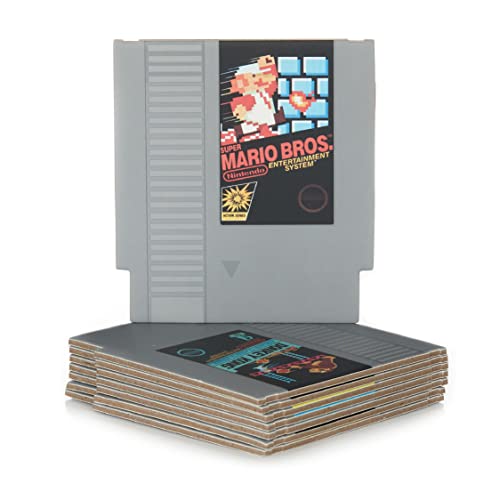
Do you love Nintendo? Then you have to check out this amazon NES cartridge drink coaster set!
This set includes 8 double sides drink coasters that look just like the classic NES cartridges.
This set is a perfect gift for the gamer in your life!
Was the Nintendo 64 special?
The Nintendo 64 or N64, was released in 1996. It was able to compete quite well with both the Sony PlayStation and the Sega Saturn. By the time the 2000s rolled around, hundreds of games had been made for the Nintendo 64. For some reason though, the games made for the Nintendo 64 were far more expensive than for any other console.
These prices weren’t something that was left back in the previous century though, it has continued even till today. The prices for not only the Nintendo 64 but for many other Nintendo systems are still far higher than most other older gaming systems. This brings many people to wonder why not only Nintendo 64 games are so expensive, but all Nintendo games are so expensive.
Reasons why Nintendo 64 games are so expensive.
- Making games was very expensive for the Nintendo 64 compared to the PlayStation. This is why many video game companies didn’t make games for the Nintendo 64. Because people refused to make games for the Nintendo 64 the limited number of games being produced drove up demand. This made prices higher as the games had more demand than supply.
- Nintendo as a company also didn’t like their games to have violence or blood in them.This is why companies that didn’t produce games with violence made games for the Nintendo 64. This made the number of games produced for the Nintendo 64 even fewer which also drove up demand. By doing this, Nintendo created a luxury item which they charged a premium for.
- Another reason was that Nintendo wanted to price its games high. Although this sounds crazy, such a move would have allowed them to market their games as high end items that could only be purchased by a certain class of people. Because people want what they cannot have, This drove up demand even further, and allowed Nintendo to sit back and make a killing on their games.
- The Nintendo 64 differed from other consoles of that day. The biggest difference was that it didn’t use CDs or discs to play the games on. Even though all the other gaming systems went to discs, Nintendo refused. Instead, they continued to use cartridges. This also made sure that making games for them was more expensive. As a result, prices had to be increased when selling the games to cover the cost.
- Because games for the Nintendo 64 were so expensive to produce, some developers published their titles in small quantities. This increased the demand for those titles and again, drove up the prices.
- Another reason was the simple fact that everyone wanted to get their hands on the Nintendo 64! Because the demand was high and everyone wanted one, the prices for not only the consoles, but also the games there were extremely high.
Most expensive Nintendo 64 games
Nintendo 64 is famous for having some of the highest price games in the market. Below are some of the most expensive Nintendo 64 games you can buy today!
- Turok Rage Wars Gray Version
Priced at a good $150, this Turok version will be a heavy blow to your pocket. But there’s an interesting story behind this price. When Turok Rage Wars was first released, it had a bug which broke the game. This defect wasn’t detected before a large number of units had already been shipped out. The developer’s apologized and said that they would fix the issue for free if the users were willing to send it back to them.
Today we know that the bugged ones that have been fixed are different from the new batch. The ones that had been fixed came with a gray casing whereas the bugged version had a black casing. The copies of the game that are in the gray casing are worth $150 or more. This is because no one knows how many copies of gray cartridges are around.
- Clay Fighter Sculptor’s Cut
At a whopping $550, the Clay Fighter Sculptor’s Cut will certainly be able to empty your pockets. This game was produced by Interplay. They are the same company which produced famous franchises like Fallout, Baldur’s Gate and Earthworm and many others. One of its franchises was Clay Fighter. This game was a parody of Street Fighter but in Clay-animation style. The whole game had a very circus-style humour but the audience didn’t laugh at all. Even with all of the mocking, Blockbuster still made a rental exclusive called Clay Fighter Sculptor’s Cut. This cut has four more characters and quite a lot of new content. This version has sold for over $550 and even has even has even been listed on ebay for $29,999.99
- Wide-Boy 64
If you want to buy this then get ready to shell out $2000 for it. This is because Wide-Boy 64 was not ever intended for consumer purchase. It was just supposed to allow people to play the Game Boy Advance and Gameboy Color game on a much bigger screen. The big screen helped in relieving eye strains for those testers or people whose job were to play these games for hours on end.
The juicy rumour is that Nintendo sold the Wide Boy 64 to people who were interested in it for a price of $1,400. This is truly an astonishing price! The machinery which even made it possible to run this thing had to be crammed into an oversized cartridge. If you go to buy one today, you can expect to spend over $2000 for it.
- The Legend of Zelda: Majora’s Mask Adventure Set
If you want this and you want a brand new one, get ready to shell out almost $20,000 for it! Yes you read that right! A brand new sealed game sold for almost $20,000. Everyone who has played Zelda knows that these games get special editions pretty often. But some of the special editions are more special than others. One of the reasons for its skyrocketing price is the simple fact that only a thousand sets were made of it before it was released in just Europe.
The reason for its high price can also be attributed to the fact that the game set comes with some extra goodies like a watch. Since you will be paying such a high price for it, you will also get a certificate of authenticity with it.
Conclusion
Now that you can see why Nintendo 64 games are so expensive, you can start saving up your money to buy one of these iconic games or the console. Even if you just want some regular games, you are not going to be able to pick them up for $1 like other console games. You can expect to pay $20-40 for any Nintendo 64 games that you want to own.
If you are looking for a classic game, for your Nintendo 64 but want a new game, you will want to get your games from here.