
*This post may contain affiliate links. As an Amazon Associate we earn from qualifying purchases.
Have you ever wondered why Nintendo games seem to be hard to find compared to other games? Some people say that Nintendo makes their games exclusive to keep the prices high. Well, in this article we will go over everything you need to know about Nintendo games.
So why are Nintendo games exclusive?
Nintendo games are exclusive because by doing so Nintendo keeps people buying their consoles to get their games. Without that people would buy Nintendo’s games and play them on XBox or Playstation. If they allowed all of their games to work on every system, then the value of the games would not be as much and far less people would buy the Nintendo consoles as well.
Nintendo wanted to give the best user experience, and in order to do this the games needed to only work with Nintendo’s consoles. The exclusivity factor is what sets Nintendo apart and is why this game company is still making games and consoles after 4 decades instead of drastically changing like Sega, Atari, etc.
If you want to know more about Nintendo games being exclusive, you will want to keep reading this article. You can also watch this video to see the top 10 Nintendo games that are exclusive to them.
Are you a huge Nintendo fan? Then you have to check out the Mario and Nintendo gear that you can get. Whether you want a Mario wallet, a Nintendo sweatshirt, or a classic NES hat there are plenty of choices to choose from. You can find them all by clicking here.
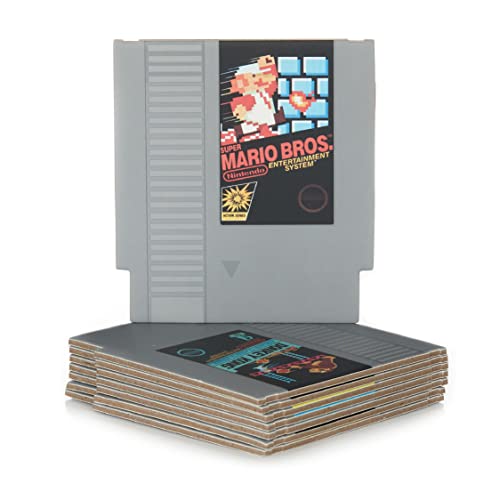
Do you love Nintendo? Then you have to check out this amazon NES cartridge drink coaster set!
This set includes 8 double sides drink coasters that look just like the classic NES cartridges.
This set is a perfect gift for the gamer in your life!
What does exclusive mean?
An exclusive game is a game released exclusively on one console. It’s never released for any other console besides the one it was initially released for. Generation exclusive means a game that is exclusive to one console from a single generation of consoles but also released on previous generation consoles.
Nintendo games are exclusive because their games can’t be played on any other third-party platforms. If they released their games on all systems, it would diminish the value of the systems they try to sell because video game consoles are fundamentally about the games you can play on them.
Third-party consoles are not very good and they can’t provide the same quality as the original console. That’s why Nintendo never sold their game to third party consoles. According to the law of exclusive games, we can say that this is the reason Nintendo games are exclusive.
What makes Nintendo a unique video game company?
Nintendo is a Japanese multinational video game company. It is one of the largest video game companies in the world and it produces many unique and exclusive games such as Mario, The Legend of Zelda, Animal Crossing, and Pokémon.
Nintendo is a unique gaming company because Nintendo doesn’t see itself as a video game company. They see themselves as a toy company which helps them to understand their customers. The other game companies see themselves as video game companies, but Nintendo approaches its hardware from the perspective of a toy manufacturer.
That is the reason why you get items like the Nintendo Labo, Nintendo Wii, and the Nintendo DS, and others. Because many of Nintendo’s games are actually made by someone without skill in mind, Nintendo didn’t jump into the VR market but wasted no time creating Amiibo. Also, instead of the next super powerful Nintendo console, you get a portable/console hybrid we know as the Switch.
Why won’t Nintendo bring their high-quality exclusive games to other platforms?
Nintendo won’t bring their games to other platforms because these exclusive games are one of the main reasons why people buy Nintendo consoles. If you think about people playing Mario, Zelda, or Pokémon on another game console like Xbox or Playstation, it just doesn’t seem right! The Nintendo Switch can’t play any other console games, just like the PS4 or Xbox.
Nintendo games can never be played on any other consoles. This makes it exclusive and it’s the main reason people buy their games and their consoles. People want the Nintendo experience which is why they buy Nintendo products. This is the same reason people buy Apple products. They want the specific platform and system that they offer.
Is Nintendo the best video game company?
The best video game company by this title actually varies and moves from time to time. At one time, people loved the Sega console far better than any other console. Nintendo then took a place on the video game market back in 1999. That same year, the Sega Dreamcast took 31 percent of the game market in the U.S.A and the Sony PlayStation had 60 percent of the game market. Even though Nintendo was not the best video game company at that time, they were able to compete with their competitors very well.
After a couple of years, Nintendo had given us so many exclusive games and video game consoles. This is why many gamers from all over the world consider Nintendo to be the best video game company ever! They have so many great games, and they even created one of the original best gaming systems ever! Nintendo basically paved the way for all of the other game systems that are popular today with their original NES!
Will Super Mario games always be exclusive to Nintendo?
Although there are many people that think that Nintendo games should be shared or made playable on every console, Super Mario will always be owned by Nintendo. Super Mario is one of the top selling games of Nintendo and the Mario series is what most people think about when they think about Nintendo.
Almost every year Nintendo releases a video game console. The business model with consoles is that they are initially sold at a loss or bare profit, and most of the profits are made by the licensing of games to third party developers or by selling their own games for it.
The Xbox and Playstation companies design their games for third party developers because most of their income is from third party licenses. Third party developers have demands for the graphical power that they will need and this is taken into account when designing the console. If the consoles cannot support the latest graphics, then the latest games that can be played on the consoles will not be able to be better than the previous years games.
What is Nintendo’s primary source of income?
In Nintendo’s case, their primary income source is their own games. Nintendo normally does not develop their games for third party developers. The biggest system sellers for Nintendo are all from the Mario franchise. There are many great games in this series from Super Mario Brothers to Mario Kart and everything in between. There is also Super Smash Brothers which is also a big seller for Nintendo. For all of their handheld devices, Nintendo’s biggest seller is actually all of the Pokémon games.
It is games like this that make people want to buy a Nintendo console, and that is why Nintendo will always be exclusive.
Nintendo Game consoles
Nintendo is one of the world’s biggest game developer companies. They release a lot of home video game consoles and handheld consoles. They started with
- The Nintendo Entertainment System:
This is the first 8-bit home video game console released by Nintendo in North America, South America, Europe, Asia, and Africa. This was released in 1983. It is also known as the “Family Computer” in Japan. This is the first game console that is openly manufactured by third-party developers. It sold over 61 million units all over the world. The NES helped revitalize the video game industry following the video game crash of 1983. It actually set the standard for many other consoles in everything from game design to business practices in the following years.
- The Super Nintendo Entertainment System
The Super Nintendo Entertainment System is officially known as the Super NES or SNES and colloquially shortened to Super Nintendo. This is a 16-bit video game console that was released by Nintendo in 1990. It was officially released in North America, South America, Europe, Asia, and Africa. When it was released the SNES quickly became the best-selling console of the 16-bit era. It sold over 49 million systems worldwide.
- The Nintendo Switch
The Nintendo Switch is one of the latest video game consoles released in 2017 by Nintendo. This is an eighth-generation video game console. The system was codenamed “Nintendo NX” prior to its official announcement. It is a hybrid gaming console because it can be used as a home console by being inserted into the Nintendo Switch Dock, and attached to a television, as well as a mobile device that can be stood up on a table with the kickstand, or used as a tablet while you are on the go. It features two detachable wireless controllers called Joy-Cons. They can be used individually or attached to a grip to provide a more traditional gamepad form.
Nintendo Handheld Consoles
The Nintendo 3DS is Nintendo’s most popular handheld video game console. There are many handheld gaming consoles that have been released by Nintendo. They are the Gameboy, Virtual Boy, Gameboy Color, Gameboy Advance, Nintendo DS and the Nintendo Switch. Nintendo first released the Gameboy that featured interchangeable cartridges for each game in 1989. It was first released in Japan, and it was one of the world’s best-selling gaming console lines, with over 100 million units sold worldwide.
After the Gameboy, Nintendo released its first portable game console capable of displaying true 3D graphics. Nintendo released its most advanced system, an affordable Handheld game console named the Nintendo Switch Lite. This console is similar to a regular Nintendo Switch and can play almost all the same games, but is only the portable version and it is also slightly smaller than the regular Nintendo Switch.
Conclusion
Now that you know that Nintendo’s games are exclusive, you can clearly see they are not the only one. Every company has its own business strategy. Just like Sony and Microsoft produce their games for third party consoles, to make a profit, Nintendo keeps their games exclusive to make a profit.