
*This post may contain affiliate links. As an Amazon Associate we earn from qualifying purchases.
When Playstation and Xbox release a game, they cost around the same price as a Nintendo game, but after a few months, Xbox and Playstation decrease the game price. An example of this would be, The Nier Automata released in March 2017 and a few days after Zelda-Breath of the Wild was released for PlayStation 4 for $59.99.
The game was well-received by critics and one and a half million units were sold during its first two months in the market. After that huge success, today, we can get a new copy of this game for $19.99. Can you imagine? Just one-third of the launch price.
So Why Are Nintendo Games So Expensive?
Nintendo games are expensive if you compare them with Xbox and PlayStation. The main reason is the people who buy a Nintendo game console have the intention of playing Nintendo exclusive games. This is the main reason Nintendo game prices are so high.
If you would like to know more about why Nintendo games are so expensive, please keep reading or check out this video!
Are you a huge Nintendo fan? Then you have to check out the Mario and Nintendo gear that you can get. Whether you want a Mario wallet, a Nintendo sweatshirt, or a classic NES hat there are plenty of choices to choose from. You can find them all by clicking here.
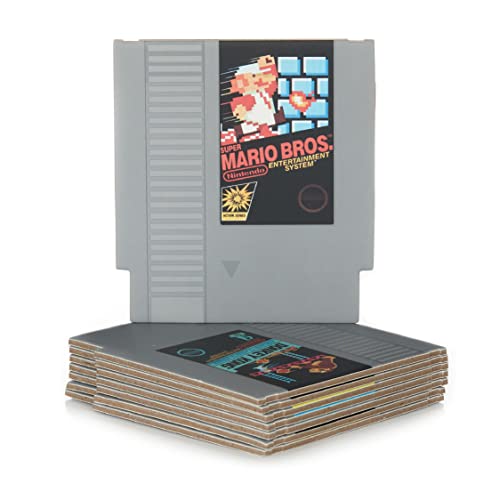
Do you love Nintendo? Then you have to check out this amazon NES cartridge drink coaster set!
This set includes 8 double sides drink coasters that look just like the classic NES cartridges.
This set is a perfect gift for the gamer in your life!
Third Party Game Sales
This price slash happens because Sony, PlayStation, and Xbox develop their games for third party companies and most of the earnings come from third party companies. That’s why they can decrease the game price.
According to an investigation of the Polygon video game media, up to 55% of the owners of the Nintendo Switch console also have Zelda-Breath of the Wild. This under any parameter is an impressive figure.
People buy Nintendo games because they are exclusive. Nintendo never develops theirs for third-party companies so that is the reason Nintendo never decreases their games price. Not even on Black Friday.
It also doesn’t matter for Nintendo if they drop the prices because they know the people who buy the Nintendo consoles have the intention of playing exclusive Nintendo games.
Higher Production Costs
High production cost is also one of the main reasons for the more expensive game price. The Playstation 4 or Xbox One sell their games on Blu-ray discs. The capacity of this disc is 25 or 50 gigabytes. But Nintendo only sells their games on cards or cartridges. Capacity is anywhere from 1 to 32 gigabytes. According to Polygon, it is a well known fact that Nintendo cartridges are up to 60% more expensive than the PlayStation and Xbox Blu-ray discs.
The price of cartridges increases according to its capacity. This means that particularly heavy games will find higher production costs and, therefore, lower profit margins. Not reducing the price is a strategy to mitigate the higher production costs.
The other thing is Nintendo has been in the gaming industry for more than 30 years and they have so many unique games and characters. People love to play Nintendo games. Therefore, their games already have a seal of quality, which many of their historical fans value a lot because they grew up playing the Nintendobrand of games. So the main point is Nintendo has its exclusive games collection, Nintendo production cost is so high and they have their brand value because they have fulfilled customers’ demands for 30 years. This is another reason Nintendo games are expensive.
Older Games
Old Nintendo games are exclusive because of the limited quantity of these games. Thus the games are in higher demand. Nowadays, many people under the sun want to play old games or they want to make their collection. On the one hand game developers are busy with new and upcoming games, they don’t want to take the time to upgrade or develop old games. On the other hand, Nintendo has made their games classic and timeless from the beginning, so they don’t have to worry about upgrading their games.
More recently, you can play some of those older games online even if they are rarely in retail stores or on websites. A lot of people desire older Nintendo games as well so the demand is higher and to make a huge profit the shop owners take the chance on buying the games in the first place. They increase the game price and potentially never worry about money. They simply just buy the game.
Newer Games
Nintendo Switch is the most recent game console released by Nintendo in 2017. This is a hybrid game console that can be used as a home console and portable device. Its wireless Joy-Con controllers, with standard buttons and directional analog sticks for user input. Motion sensing, and tactile feedback, can attach to both sides of the console to support handheld-style play.
They can also connect to a Grip accessory to provide a traditional home console gamepad form or be used individually in the hand like the Wii Remote and Nunchuk, supporting local multiplayer modes. The Nintendo Switch’s software supports online gaming through Internet connectivity, as well as local wireless ad hoc connectivity with other consoles. Nintendo Switch games and software are available on both physical flash-based ROM cartridges and digital distribution via Nintendo eShop. The system has no region lock and you can even buy this game using Nintendo gift cards.
This is not the first time Nintendo games are so expensive. Every Nintendo game console games are expensive because their games are exclusive, their production cost is so high, and after all, they have their brand value.
Nintendo meanwhile focuses more than any other company on the physical act of gameplay and interaction between the player, the controller, and the game. Nintendo thinks that their games don’t mysteriously become worthless six months after they come out. Instead, they keep the games at full price with infrequent sales, relying on selling at a higher price rather than selling at a higher volume and also convincing people who want their games to not wait for a price drop.
It definitely has seemed to work for them.
Worth The Cost
It is true Nintendo games are more expensive than other console games. So, in that case, are Nintendo games worth the cost? Actually, the answer depends on your choice. As an example, there are a lot of smartphone companies available like Sony, Nokia, Huawei and also iPhone. The iPhone price is higher than all of these companies’ phones with the same features. Then why do people buy iPhones?
Because the iPhone has its own brand value and people trust Apple. They were in the phone market before those other companies and their service is exclusive. The iPhone provides better service and quality among these companies.
Nintendo’s case is also similar. Nintendo has been in the gaming industry for more than 30 years and they have so many unique games and characters. They provide so many unique games and all of them are exclusive. Their production cost is high so their product quality is also better than the others. Nintendo has its own potential customers who love to play Nintendo games.
So if you are prepared to play only Nintendo games and love to play Pokémon or Super Mario Bros., yes, Nintendo is worth it for you. Otherwise, Nintendo may not be for you.
Related Questions
- What is the most expensive Nintendo game?
All of the Nintendo games are expensive but according to customer’s demands and quality, some games are more expensive than regular games. Nintendo’s “Super Mario Bros.” is one of the most iconic video game franchises in the world, and well-maintained copies of the original game are now coveted by collectors. This is one of the most expensive Nintendo games. A mint condition original copy of Super Mario Bros. for the NES has sold for a whopping $100,150 at an auction, making it one of the most expensive games ever sold.
- What is Nintendo’s rarest game?
The Amazing Tater is one of the rarest games. This game was released in 1991 for the Game Boy console. Amazing Tater is a puzzle adventure game for the original Game Boy. Unfortunately for developer Atlus, audience reception was poor and sales were far lower than its predecessor. This was likely due to a mix of poor marketing and a general distaste for the vegetable-based character design. People did not buy the game so they did not make as many copies which means that to find one now is rare.
Conclusion
Nintendo games are expensive if you compare them with Xbox and PlayStation. The main reason is the people who buy a Nintendo game console have the intention of playing Nintendo exclusive games. This is the main reason Nintendo game prices are so high.