
*This post may contain affiliate links. As an Amazon Associate we earn from qualifying purchases.
A PlayStation is a gaming console developed by Sony. It is a device used for playing video games but can also be used for streaming services or to play DVDs and Blu-Rays. The controller is an important part of the Playstation system as it is what you will use to control the system as well as play the game on it.
Since the controllers are an integral part of the system you would expect them to be readily available and at a good price but while the first one is true they are certainly not cheap to buy.
So, why are Playstation controllers so expensive?
Playstation controllers are expensive because of all the technology that goes into making them work properly and to help them continue to work for years to come. There is a lot of technology packed into each controller and to be able to handle all of the buttons being pressed at lightning speed so as not to lag this technology has to be top notch. The better the technology the more expensive that the controller will have to be.
I have had the same wireless Playstation controller for over a decade now and it still works just fine. Since controllers are often only purchased once and then used for years the price of those controllers also has to have the margin built in to cover the cost of building them as it is unlikely that you will replace your controllers very often.
A PlayStation system is an expensive piece of hardware. The controller is an important accessory of a PlayStation and since it is impossible to use your Playstation without it you don’t have much of a choice on whether you buy a Playstation controller or not.
Since most people want to play the system with friends you will often have to buy multiple additional controllers when you purchase the new system and Playstation takes advantage of this by charging you a steep price for the extra controllers.
When it comes to Playstation controllers the price is quite high. There are a few different reasons that this is true and we will dive into each of those reasons in the rest of this article.
If you love PlayStation you need to check out this amazing game room light decor. It looks just like the buttons on the PlayStation controller and the light reacts to the music that you are playing as well! You can check it out by clicking here.
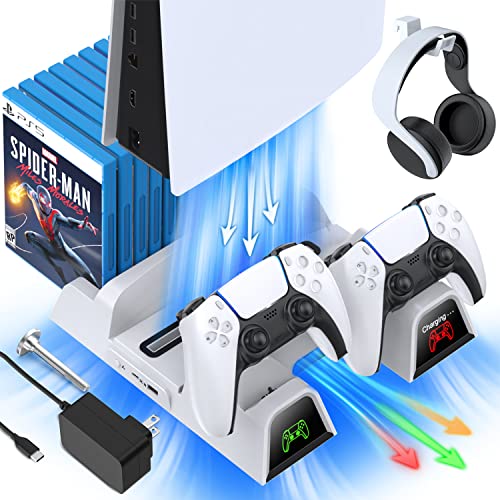
If you have a PlayStation console you should also have one of these stands. It makes it incredibly easy to organize your console and games as well as charge your controllers at the same time.
Plus it has a cooling fan to make sure your console doesn’t overheat when you have your weekend gaming marathons!
The PlayStation Controller Hardware
A controller can be either wired or wireless. It is easy to understand the cost of these devices if we delve deeper into what goes into making the hardware.
A 2013 study revealed that it costs about $381 to build a single PS4. The report also stated that Sony made just $18 on each PS4. The gigantic memory chips that go into making the PS4 take up a large part of the cost.
Since the system itself is not a large profit center then the only way that Sony makes money is through the sale of accessories and games. Since the controllers are needed and Sony knows that people will have to buy them then they can make a profit on those by keeping the costs higher.
The DualShock controller – Some features that lead to high costs
The controller’s features are tweaked with the release of each new version. The controllers are expensive mainly because of their features. Dual Shock is a series of controllers built for the PlayStation. Its latest device, the DualShock 4 has a clickable touchpad. It is fitted with a gyroscope and an accelerometer that provides motion detection.
The rubber on the thumbsticks in the older controllers used to fall off with prolonged usage. With DualShock 4, the thumbsticks have better durability and they have a smoother feel. In the older version, the touchpad used to be inaccurate sometimes. This has been corrected as well.
A striking feature of the PS controller is the light bar. The light bar consists of 3 LEDs, each of 3 different colors. The players can use these colors to match the colors of the characters that they are controlling in the game they are playing. The chosen color lights up the light bar in the controller when the player starts playing the game.
Another reason for the high prices of the controllers could simply be its non-diminishing popularity. Companies reduce the price of their devices only when the demand drops or if they are planning to release a new model with enhanced features. However, this is not the case with the PS4 controller. The sales were pretty much good, and Sony did not have any plans for phasing out the model. If gamers are still interested in a particular version of the product, those prices are here to stay.
Apart from these features, the controller also has several connectors for input and output – a jack for stereo headset, micro-USB and extension ports.
The DualShock 4 is available in a range of pretty colors – Jet Black, Glacier White, Gold, Silver, Sunset Orange, Wave Blue, Magma Red to name a few.
To learn more about how the Playstation controller has changed over the years you can watch the video below.
PlayStation Move
The PS Move is one of the controllers built by Sony. Although it was initially meant for use with PS3, it was later made compatible with PS4 as well. The technology that is incorporated to offer the fascinating features that these controllers have, require a lot of research and development. These controllers are usually on par with trending technology, which is why they cost a lot.
The primary feature of PS Move is the motion controller. The controller resembles a wand with an orb at its head. The wand can be used to interact with the console. The wand has several internal motion sensors that do the job. Also, the orb can light up in a variety of colors. The orb is also capable of producing simulating aesthetic effects and giving visual feedback. The controller is built in such a way that it recognizes the color of the environment and it automatically lights up the orb in a different color.
This controller also makes use of Haptic technology, which allows the creation and control of virtual objects and the user gets to experience a sense of touch.
Use in therapy
The design of the PS move is so good that it has been used in recreational therapy for children with obesity disorders. The children will engage in exercise, but they will also be able to enjoy the duration of the game so that it doesn’t really feel like a workout. In some cases, this recreational therapy program has proved to be beneficial.
Thus, when a device built for recreational purposes can be utilized in other fields as well, its price is undoubtedly going to be high.
Are controllers worth the price?
A common question that every consumer has, is whether the product they are investing in is worth the price. Regarding controllers, if you look at the technology that is used to design the various aspects of a controller, it is easy to understand why they cost so much. Also, if you have a spare controller, you can always challenge a friend and have a good time playing games simultaneously. Thus, it is good to invest in a controller, if you are interested in playing on a Playstation system.
No matter which game system you choose the cost of the controllers is going to be high so if you want to play video games with friends on your system then you will need to buy these expensive controllers.
Conclusion
As is evident from the discussion above, controllers make use of cutting-edge technology. A ton of research goes into the making of a Playstation controller. Also, every new version promises something better and fancier than the older ones.
Keeping up the promises and maintaining established standards costs a lot of money and Sony has to make a profit at some point so the cost of this technology is passed on to the person who buys the controller.
A controller needs to look good on the outside as well. Thus, a lot of thought goes into the placement of the buttons, the touchpad and other things. Also, they need to be built to give a smooth experience but at the same time should be durable enough so that there is no wear and tear with short-term use. Controllers are available in a wide array of colors as well so that can also raise the manufacturing cost of the controllers.
Also, more than the consoles themselves, the controllers and the game software are the way that Sony is able to turn a profit. Hence, the games and accessories of gaming consoles always have a high cost.